NIIF Unveils $600 mn India-Japan Fund
Relevance: GS2 - Bilateral, Regional and Global Groupings and agreements involving India; GS3 - Indian Economy and issues relating to planning, mobilization of resources, growth, development and employment; Prelims
(Source: The Hindu, 10/07/2023)
Click here for Daily Current Affairs
Why in the news?
Recently, the National Investment and Infrastructure Fund (NIIF) has entered into a collaboration with Japan Bank for International Cooperation (JBIC) to unveil a $600 million India-Japan Fund.
Table of Contents
What is India-Japan Fund (IJF)?
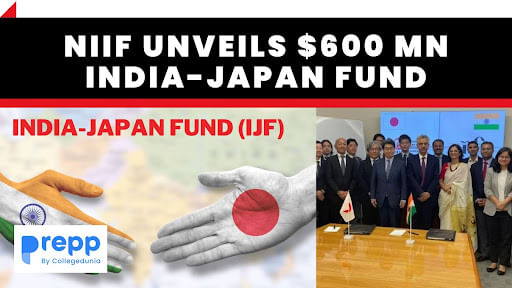
- The Indian government will contribute 49% to the target corpus for the India-Japan fund, which is also NIIF’s first bilateral fund, while the remaining 51% will be contributed by JBIC.
- The primary focus of the India-Japan Fund will be on investments in environmental sustainability and strategies to reduce carbon emissions.
- It aims to channel investments into India's environmental conservation sectors, encompassing renewable energy, e-mobility, and circular economy areas like waste management and water management.
- Its objective is to serve as a preferred partner to promote increased Japanese investments in India.
- The setting up of the India-Japan Fund represents a key milestone in the strategic and economic partnership between the Japanese Government and Indian Government.
About National Investment and Infrastructure Fund (NIIF)
- NIIF is a collaborative investment platform for international and Indian investors who are looking for investment opportunities in infrastructure and other high-growth sectors of the country.
- It is India’s first infrastructure specific investment fund and was set up by the Government of India in February 2015.
- It was set up as Category II Alternative Investment Fund (AIF) under the Securities and Exchange Board of India (SEBI) Regulations.
- The total corpus of the fund is Rs.40,000 crore.
- The Indian government has a 49 % stake in NIIF with the rest held by marquee foreign and domestic investors.
- It is headquartered in Mumbai.
- Governance:
- NIIF has a Governing Council, which is chaired by the Hon’ble Finance Minister of India.
- It comprises eminent members from corporates, investments, and policy sectors.
- The Governing Council meets annually and provides guidance on the overall strategy of NIIF.
Functions of NIIF
- Raising funds through various instruments such as offshore credit-enhanced bonds and attracting anchor investors to join as partners in NIIF.
- Managing the servicing and support for the investors involved with NIIF.
- Evaluating and approving potential companies, institutions, and projects, including those owned by state entities, for investments, and conducting regular monitoring of these investments.
- Investing in funds created by Asset Management Companies (AMCs) dedicated to private equity investments.
- Developing a portfolio of infrastructure projects and offering advisory services related to infrastructure development.
Funds managed by NIIF
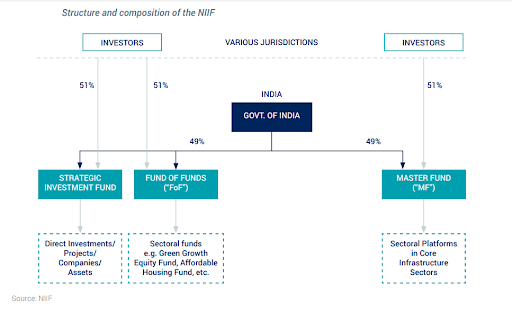
- Master Fund: It is an infrastructure fund with the objective of primarily investing in operating assets in the core infrastructure sectors such as roads, ports, airports, power etc.
- Fund of Funds: It is managed by fund managers who have good track records in infrastructure and associated sectors in India. Some of the sectors of focus include Green Infrastructure, Mid-Income & Affordable Housing, Infrastructure services and allied sectors.
- Strategic Investment Fund: It is registered as an Alternative Investment Fund II under SEBI in India. The objective is to invest largely in equity and equity-linked instruments. It will focus on greenfield and brown field investments in the core infrastructure sectors.
Investors of NIIF
- NIIF's Inaugural Investment Deal: In October 2017, the National Investment and Infrastructure Fund (NIIF) initiated its journey by securing a landmark $1 billion investment from the Abu Dhabi Investment Authority (ADIA). This move established ADIA as the first international investor in the master fund.
- Domestic Investors: NIIF's investors include prominent Indian financial institutions like HDFC Bank, Axis Bank, ICICI Bank, and Kotak Mahindra Life.
- Asian Infrastructure Investment Bank (AIIB): In June 2018, AIIB committed to investing $200 million in NIIF.
- First Fund-of-Funds and Investment Sources: The first fund-of-funds received commitments totaling $600 million, backed by support from the Indian government and various multilateral institutions such as AIIB, ADB, and NDB.
Portfolio Management and Funds of NIIF
- Equity Capital Commitments: NIIF effectively manages over $4.3 billion in equity capital commitments, distributed across three funds: Master Fund, Fund-of-Funds, and Strategic Opportunities Fund.
- Strategic Opportunities Fund: The Strategic Opportunities Fund directly invests in companies like FirstCry and Ather Energy, focusing on strategic investments.
- Master Fund: The Master Fund primarily focuses on core infrastructure sectors and stands as one of India's largest infrastructure funds. NIIF has plans to launch its first Infrastructure Investment Trust (InvIT) for its road assets, with an estimated portfolio value of approximately $2 billion.
Role of NIIF in Economy Building
- Catalyzing Multi-modal Connectivity: NIIF acts as a catalyst in realizing the vision of Gati Shakti, the National Master Plan for Multi-modal Connectivity, thereby promoting seamless transportation and logistics networks.
- Providing Capital for Infrastructure: NIIF addresses the funding gap in the capital-constrained infrastructure sector by channeling much-needed investment into critical projects.
- Enhancing Infrastructure Liquidation: The infrastructure sector requires significant long-term funding, including old and new projects in areas like roads, railways, ports, airports, and energy. The National Investment and Infrastructure Fund (NIIF) can play a crucial role by providing patient capital for these projects with extended gestation periods.
- Mitigating Banking Sector Challenges: NIIF helps relieve banks from the burden of providing long-term funds to infrastructure projects, reducing asset-liability mismatches in the banking sector, and promoting overall financial stability.
Challenges faced by NIIF
- Funding and Capital Raising: One of the primary challenges is raising sufficient capital to finance large-scale infrastructure projects. This requires attracting investments from various sources, such as government contributions, domestic and foreign investors, and multilateral institutions.
- Attracting International Investors: While NIIF seeks to attract international investors, it may face challenges related to regulatory compliance, geopolitical factors, and market conditions that affect foreign investment in India.
- Project Identification and Development: Identifying viable infrastructure projects and preparing them for investment can be a lengthy and complex process. It involves conducting feasibility studies, securing necessary permits, and addressing regulatory hurdles.
- Policy and Regulatory Uncertainty: Changes in government policies, regulations, and taxation can impact the attractiveness of infrastructure investments. Such uncertainty can deter potential investors.
- Coordinating with Stakeholders: Collaborating with various government agencies, private investors, and other stakeholders to ensure successful infrastructure development can be challenging due to differing interests and priorities.
- Market and Economic Volatility: Economic fluctuations and market volatility can affect the performance of infrastructure investments, making it challenging to achieve stable and predictable returns.
Conclusion
The NIIF-JBIC collaboration for the India-Japan Fund strengthens economic ties and promotes sustainable infrastructure. While NIIF is India's pioneer infrastructure investment fund, challenges in raising capital, attracting global investors, project development, and regulatory uncertainties need to be addressed for it to effectively drive infrastructure growth and economic stability.
(*Click this link to read prelims specific weekly current affairs articles)
FAQs
Question: What is NIIF?
Answer:
NIIF is a collaborative investment platform for international and Indian investors who are looking for investment opportunities in infrastructure and other high-growth sectors of the country. It was founded in February 2015 and its headquarters are in Mumbai, India.
Question: What are the different types of NIIF funds?
Answer:
There are three different types of NIIF funds:
- Master Funds
- Fund of Funds
- Strategic Funds
Question: What is India-Japan Fund?
Answer:
The Indian government will contribute 49% to the target corpus for the India-Japan fund, which is also NIIF’s first bilateral fund, while the remaining 51% will be contributed by JBIC. The primary focus will be on investments in environmental sustainability and strategies to reduce carbon emissions.
MCQs
Question: With reference to 'National Investment and Infrastructure Fund', which of the following statements is/are correct? (UPSC 2017)
- It is an organ of NITI Aayog.
- It has a corpus of Rs 4,00,000 crore at present.
Select the correct answer using the code given below:
(a) 1 only
(b) 2 only
(c) Both 1 and 2
(d) Neither 1 nor 2
Answer: (d) See the Explanation
The National Investment and Infrastructure Fund (NIIF) is a fund established by the Government of India to boost infrastructure financing. It was announced in the 2015-16 Union Budget. The governing council of NIIF is not part of NITI Aayog; it operates independently and is chaired by the Finance Minister.
The proposed corpus of NIIF is Rs. 40,000 Crores.
Therefore, option (d) is the correct answer.
Download the PREPP App and attempt FREE IAS Exam Mock Tests and get complete study material!

Full Test - 04: UPSC CSE Prelims CSAT (Paper-II)
Full Test - 03: UPSC CSE Prelims CSAT (Paper-II)
UPSC CSE Prelims 2026 GS Paper 1 Question Paper (24-May-2026)
UPSC CSE Prelims 2026 CSAT Paper 2 Question Paper (24-May-2026)

17 February 2025 | The Hindu Must Read Articles | Current Affairs

16 February 2026 | The Hindu Must Read Articles | Current Affairs

13 February 2026 | The Hindu Must Read Articles | Current Affairs









Comments