Iranian Narges Mohammadi Gets Nobel Peace Prize 2023
Relevance: Prelims- Current events of international importance
(Source: The Hindu, 10/07/2023)
Click here for Daily Current Affairs
Why in the news?
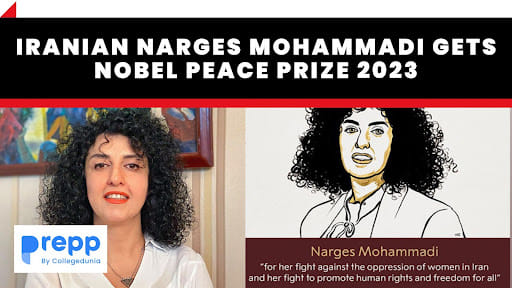
- Recently, the Nobel Peace Prize 2023 was awarded to Iranian activist Narges Mohammadi for her work against the oppression of women and for the promotion of freedom and human rights.
- According to the Royal Swedish Academy, the award also recognizes the hundreds of thousands of people who have demonstrated against discrimination and oppression targeting women by Iranian authorities.
- The Academy also claimed that the motto of the Iranian protests - “Zan – Zendegi – Azadi or Woman – Life – Freedom” - perfectly represented the work done by Narges Mohammadi.
Table of Contents
Who is Narges Mohammadi?
- Narges Mohammadi is an Iranian human rights advocate and freedom fighter.
- She is an engineer and physicist.
- She is presently imprisoned in Iran under charges of “spreading anti-state propaganda” and defamation according to the theocratic regime in Iran.
- According to reports, she has been arrested 13 times, convicted five times, and sentenced to a total of 31 years in prison and 154 lashes.
- She joined the Center for Human Rights Defenders in Iran, founded by Iranian lawyer and 2003 Nobel laureate Shirin Ebadi, to campaign for the abolition of the death penalty.
- Book: “b which details the experiences faced by her and other women inmates in Iranian prisons
Why was she awarded the Nobel Peace Prize in 2023
- She has been protesting against the systematic use of torture and sexualized violence against political prisoners, particularly women, by authorities in Iranian prisons.
- She expressed support for demonstrators participating in the widespread protests against the murder of Mahsa Jina Amini by Iranian morality police for not covering her head, and organized solidarity actions among the inmates of Evin prison, Tehran, where she was imprisoned.
- Despite being subjected to oppressive conditions such as a prohibition on calls and visitors, she managed to publish an article highlighting the torture, abuse, and solitary confinement faced by women in Iranian prisons.
Other recognition
- Andrei Sakharov Prize in 2018, which recognizes outstanding leadership or achievements of scientists in upholding human rights.
- 2023 PEN/Barbey Freedom to Write Award
- 2023 UNESCO/Guillermo Cano World Press Freedom Prize
What are the protests in Iran?
- The demonstrations began in Iran in September 2023 after the arrest by Iran’s morality police and later custodial death of a Kurdish woman Mahsa Jina Amini.
- Although Iranian authorities claimed that the death was due to pre-existing medical conditions, a UN human rights expert said the death was a result of beatings by the morality police.
- The protests have since grown into anti-government protests involving all the 31 provinces of Iran.
- It was much larger in scale than previous protests against the policies of the theocratic regime, with women cutting their hair and setting their hijabs on fire.
- Iran’s response:
- The authorities have described the demonstrations as riots and anti-state activities.
- It has accused the U.S.A. and Israel of orchestrating the riots and fabricating evidence against Iran.
- Surveillance cameras have been installed to identify women who do not wear the hijab.
- The Iranian Parliament passed a new “hijab and chastity” bill that imposes severe punishments on those violating the strict dress code including financial penalties, prison terms, etc.
- Casualties:
- According to the Iran Human Rights Activists’ News Agency, more than 530 protestors have been killed by security forces while more than 20,000 protestors have been detained.
- Seven protesters have been executed with dozens of others charged or sentenced to capital punishment.
Morality Police
- The Gasht-e Ershad or "Guidance Patrol”, was established under hardline President Mahmoud Ahmadinejad to enforce the hijab mandate, and began patrolling in 2006.
To know more click the link.
Nobel Prize
|
(*Click this link to read prelims specific weekly current affairs articles)
FAQs
Question: What is a theocratic state?
Answer:
A theocratic state is a state in which God is recognized as the true ruler, who rules by giving divine guidance through His chosen leader. Governance is usually done on the basis of religious texts or doctrines. Theocratic states include Iran and the Vatican.
Question: Who are the Kurdish people?
Answer:
The Kurdish people, also known as Kurds, are an Iranian ethnic group native to the mountainous region of Kurdistan in Western Asia which spreads across southeastern Turkey, northwestern Iran, northern Iraq, and northern Syria. They are the fourth-largest ethnic group in the Middle East after Arabs, Persians, and Turks and are considered to be the world’s largest stateless ethnic group.
UPSC Mains Practice Question:
|
MCQs
Question: Shirin Ebadi, who won the Nobel Peace Prize in 2003, is from: (UPSC CSE 2004)
(a) Iraq
(b) Nigeria
(c) Iran
(d) Libya
Answer: (c) See the Explanation
- Shirin Ebadi is a lawyer and the first woman judge from Iran.
- She has worked significantly for the democratization of Iran and the rights of women and founded the Center for Human Rights Defenders in Iran.
- She was awarded the Nobel Peace Prize in 2003 for her work in Iran.
Therefore, option (c) is the correct answer.
Question: Consider the following names: [2002]
- Archbishop Desmond Tutu
- Lech Walesa
- Shimon Peres
- Yasser Arafat
Who among these won the Nobel Peace Prize?
(a) 1 and 2
(b) 1, 3 and 4
(c) 2, 3 and 4
(d) 1, 2, 3 and 4
Answer: (d) See the Explanation
- Archbishop Desmond Tutu is a veteran of South Africa’s struggle against white minority rule. He suggested the idea of “Rainbow Nation” and was awarded the Nobel Peace Prize in 1984. Hence statement 1 is correct.
- Lech Walesa, is a former President of Poland who co-founded and headed Solidarity, the Soviet bloc's first independent trade union. He won the Nobel Peace Prize in 1983. Hence statement 2 is correct.
- Shimon Peres, the former Prime Minister of Israel, was awarded the Nobel Peace Prize in 1994 along with Palestinian leader Yasser Arafat for the 1993 peace deal between the two countries. Hence statements 3 and 4 are correct.
Therefore, option (d) is the correct answer.
Download the PREPP App and attempt FREE IAS Exam Mock Tests and get complete study material!

Full Test - 04: UPSC CSE Prelims CSAT (Paper-II)
Full Test - 03: UPSC CSE Prelims CSAT (Paper-II)
UPSC CSE Prelims 2026 GS Paper 1 Question Paper (24-May-2026)
UPSC CSE Prelims 2026 CSAT Paper 2 Question Paper (24-May-2026)

17 February 2025 | The Hindu Must Read Articles | Current Affairs

16 February 2026 | The Hindu Must Read Articles | Current Affairs

13 February 2026 | The Hindu Must Read Articles | Current Affairs









Comments