MGNREGS Runs Out Of Funds; Rural Ministry Seeks More Budget
Relevance: GS2 - Government policies and interventions for development in various sectors and issues arising out of their design and implementation; Issues Relating to Development; GS3 - Government Budgeting; Growth & Development
(Source: The Hindu, 10/07/2023)
Click here for Daily Current Affairs
Why in the news?
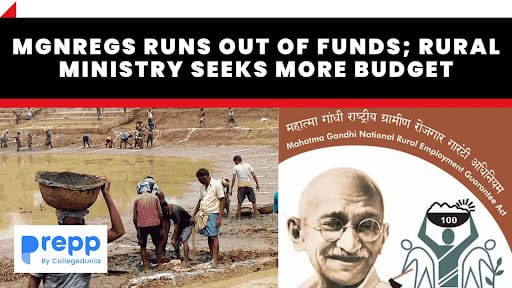
- Recently, the Mahatma Gandhi National Rural Employment Guarantee Scheme (MGNREGS), a crucial rural employment program in India, has run out of funds, at the midpoint of the fiscal year.
- Official statistics released by the Ministry of Rural Development indicate a deficit of ₹6,146.93 crore in the program's finances.
- The Ministry of Rural Development (MoRD) had approached the Finance Ministry asking for a supplementary budget of ₹23,000 crore.
Table of Contents
How has MGNREGA evolved over time?
- There has been a steady decline in the budget allocation for the scheme. The government cut the spending to ₹60,000 crore for 2023-24 from ₹89,400 crore in 2022-23.
- The budget for the scheme is the lowest in the past two years, which was ₹98,468 crore and ₹89,400 crore for the year 2021-22 and 2022-23, respectively.
- According to Census 2011, since 2006, over 30 million water conservation related assets have been created in the country’s rural areas. This comes to at least 50 water-related structures per village, with the total number of villages in India being 0.6 million.
- The scheme has introduced several technological tools, such as online registration, electronic fund transfer, and geotagging through mobile apps to make the implementation more transparent and efficient.
- The National Mobile Monitoring Software (NMMS) App was made mandatory in January 2023. It demands online attendance from employees twice a day
- The scheme has been integrated with other programs such as the National Rural Livelihood Mission (NRLM), the Pradhan Mantri Awas Yojana (PMAY), and the Swachh Bharat Abhiyan to achieve better convergence of resources and efforts.
What is MGNREGA?
- MGNREGA is one of the largest work guarantee programmes in the world launched in 2005 to augment employment generation and social security in India.
- The scheme is a demand-driven wage employment scheme, which functions under the Ministry of Rural Development.
- The primary objective of the scheme is to guarantee 100 days of employment in every financial year to adult members of any rural household willing to do public work-related unskilled manual work.
- As of February, 2023, there are 15.51 crore active workers under the MGNREGA.
- Unlike earlier employment guarantee schemes, the act aims at addressing the causes of chronic poverty through a rights-based framework. At least one-third of beneficiaries have to be women.
- Wages must be paid according to the statutory minimum wages specified for agricultural labourers in the state under the Minimum Wages Act, 1948.
- As per Section 3(4) of the MGNREGA, the States may make provisions for providing additional days beyond the period guaranteed under the Act from their own funds.
Challenges faced by MGNREGS regarding Budget Constraints
- Budget Cuts: In the financial year 2023-24, the allocated budget was significantly lower (33%) than both the budget estimates and revised estimates of the previous year. This puts a strain on the program's ability to meet the demand for rural employment effectively.
- Delay in Supplementary Budget: Despite the Ministry of Rural Development (MoRD) requesting a supplementary budget of ₹23,000 crore to cover the deficit, there has been no response from the Finance Ministry. Delay in approving supplementary budgets can lead to a shortage of funds, affecting the program's implementation on the ground.
- For example, Between 2021-22 and 2022-23 too, the MGNREGS budget was cut by 25%, forcing the Ministry to ask for an additional ₹25,000 crore to meet the shortfall, but it only got ₹16,000 crore.
- Wage Dues and Work Allocation: It can result in wage dues piling up. When funds are insufficient, work allocation to beneficiaries may decrease, ultimately impacting the program's effectiveness and the livelihoods of rural workers.
- Impact on Program Implementation: The shortage of fund can disrupt the smooth functioning of MGNREGS. As funds become scarcer, the program may come to a near halt, causing adverse effects on the livelihoods of those dependent on it.
- Uncertainty for Beneficiaries: The uncertainty regarding the availability of funds and delays in budget approvals can create uncertainty and insecurity among the rural workforce who depend on MGNREGS for employment opportunities.
- Shortfall in Meeting Demand: MGNREGS is designed to be a demand-driven scheme, and its success depends on the ability to provide employment opportunities based on the demand for work in rural areas. Budget constraints can lead to the program falling short in meeting the actual demand for employment.
- Impact on Poverty Alleviation: MGNREGS plays a crucial role in poverty alleviation and rural development. Budget shortage and delays can hinder its ability to effectively contribute to poverty reduction and rural economic development.
Way Ahead
- To overcome these challenges, there is a need for consistent and adequate funding for MGNREGS to ensure that it can fulfill its objectives of providing employment, reducing poverty, and supporting rural development.
- Implement a performance-based funding mechanism that rewards states and union territories for efficient and effective implementation of the program. This can encourage better utilization of funds and improved outcomes.
- There should be transparency in fund allocation and utilization, by publishing regular reports on the program's performance, including financial data and job creation metrics.
(*Click this link to read prelims specific weekly current affairs articles)
FAQs
Question: What is MGNREGA?
Answer:
The Mahatma Gandhi National Rural Employment Guarantee Act, 2005 aims at enhancing the livelihood security of people in rural areas by guaranteeing 100 days of wage employment in a financial year to a rural household whose adult members volunteer to do unskilled manual work.
Question: What is Social security?
Answer:
Social security is the protection that a society provides to individuals and households to ensure access to health care and to guarantee income security, particularly in cases of old age, unemployment, sickness, invalidity, work injury, maternity or loss of a breadwinner.
Question: What is National Mobile Monitoring Software (NMMS)?
Answer:
The Ministry of Rural Development had launched the National Mobile Monitoring System (Software) (NMMS) app for capturing the attendance of workers under Mahatma Gandhi National Rural Employment Guarantee Scheme (MGNREGS)
MCQ
Question: Among the following who are eligible to benefit from the “Mahatma Gandhi National Rural Employment Guarantee Act”? (UPSC 2011)
(a) Adult members of only the scheduled caste and scheduled tribe households
(b) Adult members of below poverty line (BPL) households
(c) Adult members of households of all backward communities
(d) Adult members of any household
Answer: (d) See the Explanation
MGNREGS is a demand-driven wage employment scheme, which functions under the Ministry of Rural Development. The primary objective of the scheme is to guarantee 100 days of employment in every financial year to adult members of any rural household willing to do public work-related unskilled manual work.
Therefore, option (d) is the correct answer.
Download the PREPP App and attempt FREE IAS Exam Mock Tests and get complete study material!

Full Test - 04: UPSC CSE Prelims CSAT (Paper-II)
Full Test - 03: UPSC CSE Prelims CSAT (Paper-II)
UPSC CSE Prelims 2026 GS Paper 1 Question Paper (24-May-2026)
UPSC CSE Prelims 2026 CSAT Paper 2 Question Paper (24-May-2026)

17 February 2025 | The Hindu Must Read Articles | Current Affairs

16 February 2026 | The Hindu Must Read Articles | Current Affairs

13 February 2026 | The Hindu Must Read Articles | Current Affairs









Comments