To Remove Gender Stereotypes From The Law, A New SC Handbook
Relevance: GS 2 - Structure, organization, and functioning of the Judiciary; Indian Society
(Source: The Hindu, 08/17/23)
Click here for Daily Current Affairs
Why in the news?
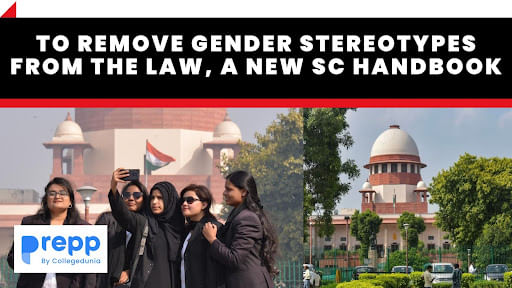
- Recently, the Supreme Court released a 30-page Handbook on Combating Gender Stereotypes.
- It aims to free the judiciary and the legal community from the mechanical application of gender-stereotypical language in judgments, orders, and court pleadings.
Table of Contents
What is the significance?
- Combats Gender Stereotypes: It aims to combat gender stereotypes in language used within the judiciary and legal community.
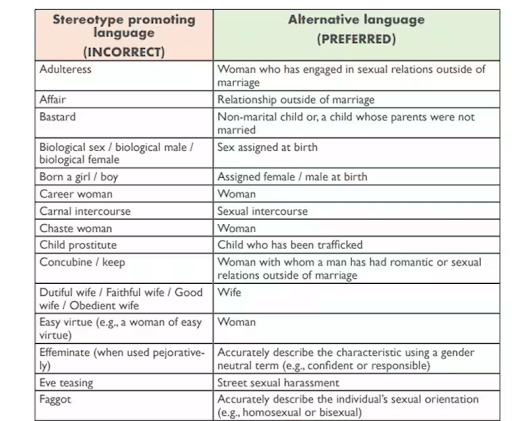
- For instance, terms like "career woman," "fallen woman," "faithful or obedient wife," "eve-teasing," and "hermaphrodite" have been identified as gender-unjust terms.
- The Supreme Court suggests using more neutral and respectful terms like "woman," "wife," "street sexual harassment," and "intersex" instead.
- Promoting Equity and Justice: Promoting a more just and equitable society. He mentioned that relying on predetermined stereotypes in judicial decision-making goes against the duty of judges to decide cases impartially, based on their merits.
- Addresses false assumptions: The handbook addresses false assumptions about women's characteristics, such as the stereotype that women are overly emotional, illogical, and unable to make rational decisions.
- It emphasizes that a person's gender should not determine their capacity for rational thought.
- Addresses Prejudices: The handbook discusses assumptions made about a woman's character based on her clothing choices and sexual history.
- These assumptions can influence how the court assesses her actions, particularly in cases involving sexual violence, and may undermine the importance of consent in such cases.
- Significance of language: The Chief Justice pointed out that language used by judges reflects not only their interpretation of the law but also their perception of society.
- The example of changing the term "pauper" to "indigent" in the Code of Civil Procedure, 1908 was cited to demonstrate how language can impact the dignity and humanity attributed to individuals.
- The handbook aims to raise awareness about the role of language in perpetuating gender stereotypes within the legal system and provides guidance on using more respectful and neutral terms to promote fairness and equality.
(*Click this link to read prelims specific weekly current affairs articles)
FAQs
Question: What is Stereotypical language?
Answer:
Stereotypical language refers to language that is used to make preconceived judgements or assumptions about a person or group of people
Question: What is the Code of Civil Procedure (CPC) of 1908?
Answer:
The Code of Civil Procedure (CPC) of 1908 is a type of procedural or adjective legislation. This legislation governs the administration of civil processes in the nation. It is concerned with the enforcement of duties and rights specified by substantive law rules.
Question: What is Code of Criminal Procedure (CrPC)?
Answer:
The Code of Criminal Procedure (CrPC) is the principal body of legislation that govern the administration of substantive criminal law. Our legal system's criminal law is principally included in the Code of Criminal Procedure, 1973, which entered into effect on April 1, 1974. The Criminal Procedure Code of 1973 is divided into 37 Chapters, 484 Sections, and two Schedules. The basic purpose of criminal law is to safeguard society against criminals and lawbreakers.
UPSC Mains Practice Question:
|
MCQ
Question: Which of the following is/are the indicator/indicators used by UNDP (United nation development program) to compute the Gender Inequality Index (GII)?
- Reproductive health
- Economic status
- Empowerment
Select the correct answer using the code given below.
(a) 1 only
(b) 2 and 3 only
(c) 1 , 2 and 3
(d) 1 and 3 only
Answer: (c) See the Explanation
- Gender Inequality Index (GII) measures gender inequalities in three important aspects of human development:
- reproductive health, measured by maternal mortality ratio and adolescent birth rates;
- empowerment, measured by the proportion of parliamentary seats occupied by females and proportion of adult females and males aged 25 years and older with at least some secondary education; and
- economic status expressed as labour market participation and measured by labour force participation rate of female and male populations aged 15 years and older.
- It exposes the differences in the distribution of achievements between women and men.
- It measures the human development costs of gender inequality.
- Thus the higher the GII value the more disparities between females and males and the more loss to human development.
- It yields insights into gender gaps in major areas of human development.
- The component indicators highlight areas in need of critical policy intervention and it stimulates proactive thinking and public policy to overcome systematic disadvantages of women.
- Therefore, option(c) is the correct answer.
Download the PREPP App and attempt FREE IAS Exam Mock Tests and get complete study material!

Full Test - 04: UPSC CSE Prelims CSAT (Paper-II)
Full Test - 03: UPSC CSE Prelims CSAT (Paper-II)
UPSC CSE Prelims 2026 GS Paper 1 Question Paper (24-May-2026)
UPSC CSE Prelims 2026 CSAT Paper 2 Question Paper (24-May-2026)

17 February 2025 | The Hindu Must Read Articles | Current Affairs

16 February 2026 | The Hindu Must Read Articles | Current Affairs

13 February 2026 | The Hindu Must Read Articles | Current Affairs









Comments