A Necessary Brake: On Altered Weather Patterns And Infrastructure Development
Relevance: GS3 - Disaster and disaster management GS1 - Important Geophysical phenomena
(Source: The Hindu, Deccan Herald, 08/17/2023)
Click here for Daily Current Affairs
Why in the news?
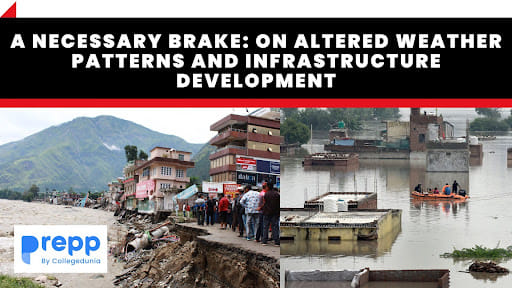
- Recently, multiple floods occurred in Uttarakhand and Himachal Pradesh claiming at least sixty lives.
- The excess rain from the Western Disturbances was the main factor behind the flooding despite predictions that North India would experience drought due to the El Nino season.
- A series of landslides was also experienced in the region which has led to the destruction of infrastructure and the blocking of highways.
Table of Contents
What is the major reason for the floods and landslides in North India?
- The major reason for the floods and landslides in North India recently is the unexpected but abundant rainfall that the region has received.
- The surplus rainfall was mainly due to the excess in the Western Disturbances, which normally bring rainfall to the region during the winter.
- However, the Western Disturbances (WD) have been erratic throughout 2023.
- The erratic nature of the WD is partly due to the warming of the Arctic.
- This has caused a deviation from the regular path of the moisture-carrying polar jet stream.
- As a result, the disturbances occurred in north India during the monsoon.
- The frequency of Western disturbances has increased, but the precipitation associated with them has not been due to global warming.
- Global warming has caused the western disturbances to become lighter and higher, thereby reducing moisture content.
- Although climate scientists have said that the combination of WD and monsoon can be dismissed as ‘freak’ weather, they have warned of the increasing probability of such high-risk events.
Impacts of the erratic WDs
- They were absent or limited in the period between December and February which resulted in the hottest February in India in the last century
- However, they have been in abundance in June and July, which is not normal.
- Earlier, record rainfall in parts of Himachal Pradesh, Punjab, and Uttarakhand had led to flooding and around 150 deaths and ₹10,000 crores worth of losses in Himachal Pradesh alone.
Western Disturbances
- The Western disturbances are extra-tropical storms that originate in the Caspian or Mediterranean Sea and bring non-monsoonal rainfall to northwest India.
- A disturbance refers to an area of “disturbed” or reduced air pressure.
- They primarily affect the northern and northwestern regions of the Indian subcontinent by carrying over moisture from the Mediterranean Sea and/or the Atlantic Ocean.
- Origin: A high-pressure forms over areas like Ukraine and its neighborhood which results in the entry of cold air from the polar regions towards an area of relatively warmer air with high moisture content.
- As a result of the change in pressure from cold air to warm air, a favorable set of conditions for cyclogenesis is created in the upper layer of the atmosphere.
- This promotes the formation of an eastward-moving extratropical depression in the sea.
- Once formed, they follow the polar jet stream and travel eastward through Iran, Afghanistan, and Pakistan, and enter India from the northwest.
Impact on Weather
- Rainfall and Snowfall: It brings rain, snow, and fog to different parts of north India and contributes to winter precipitation.
- Atmospheric Instability: It interacts with the prevailing weather systems leading to the formation of clouds, thunderstorms, and occasionally severe weather events.
- These adverse weather events include floods, flash floods, landslides, dust storms, hail storms, and cold waves
- Temperature: It causes temperature fluctuations by introducing cooler conditions on arrival and after passage a subsequent rise in temperatures.
- Monsoon: It can lead to variation in rainfall patterns by interacting with the Indian monsoon.
Significance
- It is important for Indian agriculture, especially rabi crops like wheat.
- It brings moderate to heavy rain in low-lying areas and snow to the mountainous areas of the region.
Crisis in the Himalayas
- Instability: According to geologists, the entire Himalayan region is unstable, tectonically alive, and environmentally fragile even without human interference.
- Human activities like tunneling and blasting to build hydropower projects, road widening, and buildings on slopes have worsened the tectonic instability of the ecosystem.
- Adverse events: Reports by the IPCC and the IMD have highlighted the risk of extreme weather-related adverse events in the region as a result of global warming.
- These include mass movement of land such as creeping, uplift, subsidence, faulting, fracturing, slope failures, and landslides.
- Urbanization: The Himalayan region is one of the most rapidly urbanizing mountain ecosystems in the world.
- The built-up area of the region has increased by 33% of which more than 60% consists of poor-quality construction that is concentrated in environmentally unsafe zones, and landslide and flood-prone areas.
- Tourism: Domestic tourism has resulted in rapid urbanization even in inaccessible areas.
- This has led to the encroachment of forests, disruption of natural drainage, and excavation of hill slopes for infrastructure construction, which have increased the frequency of landslides.
- Unscientific regulations: One of the major problems is the unscientific and politically motivated approval of construction projects which has led to increased geohydrological risks which threaten the lives of the locals.
What must be done?
Amidst Shifting Weather Patterns, Himalayan Construction Raises Alarms
- As weather patterns and climatic conditions are changing significantly, it is necessary to acknowledge the scientific concerns associated with reckless construction activities in the Himalayan region.
- Eg: The ongoing Char Dham road project.
- It has resulted in extensive modification of the mountain landscape as large portions have been carved away to satisfy the logistic requirements of the region.
- This has however raised the susceptibility of the regions to instability and led to disasters such as the land subsidence in Joshimath, and dangers to humans settled in the area.
Urgent Need for Long-term Planning and Sustainable Approaches
- State governments should focus on long-term approaches and preventive action instead of adopting short-term solutions such as compensation from the central authorities for disaster relief.
- It is necessary to reform infrastructure development in such ecologically sensitive areas through the adoption of sustainable practices and the imposition of stringent regulations to curtail illegal and unscientific construction.
- The focus must be shifted from short-term-profits to long-term concerns such as hazard mitigation and ensuring environmental stability.
Balancing Development and Environmental Preservation
- The Himalayas are subject to a conflict between developmental aspirations and the preservation of the ecologically important and fragile ecosystem.
- Therefore the goal of environment preservation must be integrated within infrastructure development to ensure that the region's unique ecological characteristics are protected while also implementing developmental activities.
Sustainable Development
- The rebuilding process must include a detailed and large-scale risk-zone mapping of all towns.
- Local self-governments must make it mandatory for disaster risk reduction and climate change adaptation strategies to be included in all urban development plans.
- A comprehensive action plan for sustainable tourism based on socio-ecological carrying capacity should be developed in hill stations.
- Some activists have suggested the declaration of a moratorium on unscientific activities like dam building, road widening, and forest-cutting in the Himalayas.
(*Click this link to read prelims specific weekly current affairs articles)
FAQs
Question: What is a jet stream?
Answer:
It is a strong narrow current concentrated along a quasi-horizontal axis in the upper troposphere or the stratosphere characterized by strong vertical and lateral wind shear and featuring one or more velocity maxima.
Question: What are landslides?
Answer:
Landslides are natural disasters that involve a sudden movement of rock, boulders, earth, or debris down a slope. It generally occurs in mountainous terrains where there are conducive conditions of soil, rock, geology, and slope.
UPSC Mains Practice Question:
|
MCQs
Question: Consider the following statements:
- The Western Disturbances aid monsoonal rainfall in northwest India.
- They are storms that originate in the Caspian or Mediterranean Sea.
Which of the above statements is/are correct?
(a) Only 1
(b) Only 2
(c) Both 1 and 2
(d) None of the above
Answer: (b) See the Explanation
- The Western Disturbances are associated with non-monsoonal rainfall in northwest India. Hence Statement 1 is incorrect.
- The Western disturbances are storms that originate in the Caspian or Mediterranean Sea and travel in a west-east direction. Hence statement 2 is correct.
Therefore, option (b) is the correct answer.
Question: Consider the following statements:
- The Western Disturbances carry moisture from the Indian Ocean.
- They help in the cultivation of rice in South India.
Which of the above statements is/are correct?
(a) Only 1
(b) Only 2
(c) Both 1 and 2
(d) None of the above
Answer: (d) See the Explanation
- The Western Disturbances originate over the Ukraine region and carry moisture from the Mediterranean or Atlantic Moisture as they travel from west to east. Hence statement 1 is incorrect.
- The Western Disturbances are associated with non-monsoonal rainfall in northwest India, therefore they cannot assist in rice cultivation in South India. Hence Statement 2 is incorrect.
Therefore, option (d) is the correct answer.
Download the PREPP App and attempt FREE IAS Exam Mock Tests and get complete study material!

Full Test - 04: UPSC CSE Prelims CSAT (Paper-II)
Full Test - 03: UPSC CSE Prelims CSAT (Paper-II)
UPSC CSE Prelims 2026 GS Paper 1 Question Paper (24-May-2026)
UPSC CSE Prelims 2026 CSAT Paper 2 Question Paper (24-May-2026)

17 February 2025 | The Hindu Must Read Articles | Current Affairs

16 February 2026 | The Hindu Must Read Articles | Current Affairs

13 February 2026 | The Hindu Must Read Articles | Current Affairs









Comments