Textile Exports Continue To Decline
Relevance: GS3: Indian Economy - Economic Development, International Trade, Industries, Manufacturing Sector
(Source: The Hindu, 08/17/23)
Click here for Daily Current Affairs
Why in the news?
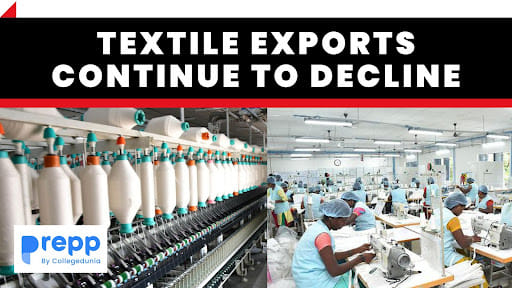
- Recently, exports of textiles and apparel declined 1.9% and 17.4%, respectively, compared with the same period the year earlier.
- Cumulative export of textiles and apparel for the April-July 2023 period declined by 13.7% year on year.
- Experts in the field think that if local cotton prices become competitive, exports may go up in the upcoming season.
Table of Contents
Import and Export issues in Textile industry
- Confederation of Indian Textile Industry (CITI) data revealed that the market for cotton yarn, textiles, and made-ups increased by 6.62% in July 2022 ($946.48 million) to $1,009 million last month.
- However, the shipment of synthetic fibres, textiles, made-ups, jute goods, carpets, and clothing items declined.
- For a year, exports of clothing were at a "sustained low".
- According Economic Survey 2022-23, exports have slowed down compared to FY22, which has been difficult for the textile sector. o The textile industry has not yet experienced FDI inflows comparable to those prior to the epidemic.
- With the slowdown of global output and demand, textiles, clothing, and leather have been growing slowly. This is because there is less of a market for these items abroad.
- Other issues are, the less demand of Indian textiles in major importing countries like US, Germany, UK, due to inflation.
- Also, recently Indian cotton prices are higher than international prices.
- Sector experts blame the trade dispute between the US and China and the free trade deal between China and Pakistan for the decline in demand.
- However, China has resorted to purchasing from Bangladesh and Vietnam during the past ten years, almost cutting off the supply from India and driving the market in this country into disarray.
- Additionally, nations like Peru, Turkey, and Vietnam have improved their production capacity, which makes us even more competitive.
- Due to the import charge that customers must pay if they buy from India, the Indian textile sector no longer receives special treatment or access. Because nations like Bangladesh and Sri Lanka enjoy unrestricted access to the US and UK markets.
- The fall was abrupt when measured in volume. Retailers in the US market were reducing their inventory in anticipation of a rebound in demand.
- Next season, India anticipates a big cotton production. Exports will increase if cotton prices stay competitive.
Challenges facing by the Textile sector in India
- High fragmentation: The unorganised sector and small and medium-sized businesses dominate India's textile industry, which is characterised by high fragmentation.
- Infrastructure issues: Inadequate infrastructure, such as inadequate power supplies and inadequate transportation systems, raises manufacturing costs and lowers the competitiveness of the Indian textile sector.
- Technology Obsolescence: Many textile businesses in India continue to rely on antiquated technology, which reduces their ability to compete with businesses in other nations.
- Impact of the Goods and Services Tax (GST): GST has reduced the competitiveness of India's textile and apparel industry by introducing distortions.
- Man-made fibres (MMF), for instance, are taxed at 18% for fibre, 12% for yarn, and 5% for fabric. MMF fabrics are pricey as a result of this inverted tax system.
- Environment-related problems: The production of textiles, which mainly relies on non-biodegradable chemicals and uses a lot of water, presents serious environmental problems.
Government initiatives to boost Textile industry
- PM Mega Integrated Textile Region and Apparel (PM MITRA) Scheme: Seven mega textile parks are intended to be established as part of the programme, which was originally mentioned in the union budget address of 2021–2022, in order to make the Indian textile industry competitive on a worldwide scale.
- Mega Textile Parks are intended to bring together all aspects of the textile value chain—from spinning and weaving to processing and printing to garment manufacturing—in one place.
- National Handloom Development Programme: it offers fundamental materials, looms and accessories, design and development, infrastructure development, marketing of handwoven goods, etc.
- National Technical Textiles Mission: The program would be established with a total investment of Rs. 1480 crore and an implementation span of four years, from FY 2020–2021 to 2023–2024.
- SAMARTH (Scheme for Capacity Building in Textile Sector): It promotes skill development throughout the whole textile value chain, with the exception of organised sector spinning & weaving.
- Scheme for Incubation in garment Manufacturing (SIAM): It is an initiative to support emerging business owners in the garment industry.
- Scheme for Textile Industry Workers' Accommodation (STIWA): It aims to offer workers in the textile and apparel sectors safe, suitable, and conveniently placed housing close to locations with a large concentration of these businesses.
- Scheme for Remission of Duties and Taxes on Exported Products (RoDTEP): Refunds of GST taxes, import/customs fees, VAT on fuel used for transportation, mandi tax, and duty on electricity used for manufacturing would all fall under its purview.
Prelims points about Textile industry in India
|
(*Click this link to read prelims specific weekly current affairs articles)
FAQs
Question: What is SAMARTH?
Answer:
Samarth (Scheme for Capacity Building in the Textile Sector) is a flagship skill development programme that the Cabinet Committee on Economic Affairs authorised as a continuation of the Integrated Skill Development Programme for the 12th Five Year Plan (FYP). To offer demand-driven, job-focused skill-upgrading programmes to encourage industry efforts to create jobs in organised textile and related sectors, as well as to promote skilling and skill upgradation in the traditional sectors through the relevant sectoral divisions/organisations of the Ministry of Textile.
Question: What is Man-made fibres (MMF)?
Answer:
The term "man-made fibres" (MMF), sometimes known as "synthetic fibres" or "artificial fibres," refers to fibres produced using a variety of chemical processes from raw materials generated from chemicals based on petroleum, naturally occurring polymers, or other substances. The characteristics of natural fibres like cotton, wool, or silk are imitated or replicated in these materials, which also have the added benefits of being durable, economical, and versatile.
Question: What is inflation?
Answer:
The general level of prices for goods and services in an economy that consistently rises over time is referred to as inflation. In other words, it reflects the fact that each unit of currency now only buys somewhat less in terms of goods and services.
Download the PREPP App and attempt FREE IAS Exam Mock Tests and get complete study material!

Full Test - 04: UPSC CSE Prelims CSAT (Paper-II)
Full Test - 03: UPSC CSE Prelims CSAT (Paper-II)
UPSC CSE Prelims 2026 GS Paper 1 Question Paper (24-May-2026)
UPSC CSE Prelims 2026 CSAT Paper 2 Question Paper (24-May-2026)

17 February 2025 | The Hindu Must Read Articles | Current Affairs

16 February 2026 | The Hindu Must Read Articles | Current Affairs

13 February 2026 | The Hindu Must Read Articles | Current Affairs









Comments