Global Headwinds
Relevance: GS3 - Effects of liberalization on the economy
(Source: Indian Express, 08/17/23)
Click here for Daily Current Affairs
Why in the news?
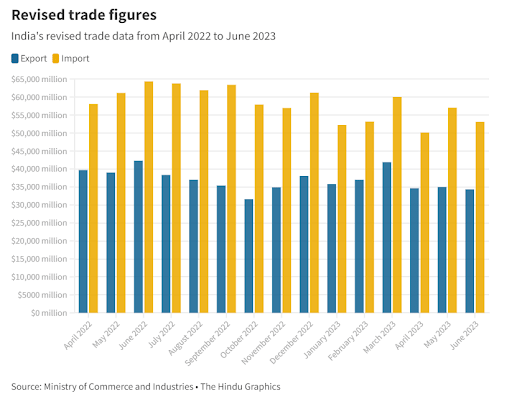
- Recently, trade data released by the Ministry of Commerce and Industry pointed towards a continuing weakness in India’s exports. In July, merchandise exports reached their lowest level in nine months, dropping by nearly 16 percent to $32.25 billion. Similarly, goods imports also decreased by 17 percent to $52.9 billion.
- Over the initial four months of the fiscal year (April-July), both exports and imports have shrunk by approximately 14.5 percent and 13.8 percent, respectively.
Table of Contents
What are the Factors Behind Decline in Exports?
- High inflation in developed regions.
- Slowdown in China: Falling demand in China is one of the leading causes of lower commodity prices.
- Slowdown in the EU and US: The US and European Union (EU) are two of the largest destinations, accounting for 18% and 15.4%, respectively, of India’s merchandise exports in fiscal 2022.
Impact Across Sectors
- Notable declines are observed in petroleum (-43.7%), gems and jewelry (-29.7%), handicrafts (-21.2%), and ready-made textile garments (-17.4%).
- Labor-intensive sectors like gems, jewelry, leather products, and textiles experience a decline.
- Excluding petroleum and gems and jewelry, the decrease in export value for July was comparatively moderate, standing at 5.7%.
- Electronic exports exhibit robust growth, rising by 37.6% this financial year.
Global Economic Context
- In the first two months of the financial year, exports to Asia Pacific declined by 21.8 per cent, followed by the US (12.9 percent), Africa (8.6 per cent) and Europe (6 percent).
- The International Monetary Fund's World Economic Outlook indicates a growth rate of 3% for the global economy this year down from 3.5 per cent the year before.
- World trade volume growth is expected to slow from 5.2% to 2%.
Which export products are at a greater risk?
- The European Union (EU) constitutes a significant share of India's leather and footwear exports, accounting for 46.2% and 42.7% respectively.
- The US plays a crucial role in various categories including 'other made-up textiles, rags', pharmaceutical products, and marine products.
- The heavy dependence on exports to these regions, particularly in discretionary items like textiles and leather products, exposes domestic exporters to the economic slowdown in these areas.
- Labor-intensive sectors like leather articles, footwear, and textiles exhibit high export dependence on these advanced economies, this may impact employment generation.
Why are exports important?
- Exports are a key driver of growth in any economy.
- It has the potential to influence a country's GDP, exchange rate, inflation rate, and interest rates.
- A strong export data set is advantageous because it increases job opportunities, foreign currency reserves, manufacturing, and government revenue collection.
- It is also a good way for a country to get out of a slump.
- Furthermore, it plays an important role in strengthening domestic manufacturing units by increasing their quality, allowing India-made products to compete and stand out against global peers.
Which factors are responsible for decline in Imports?
- The decline in import value of petroleum, vegetable oil, coal, coke & briquette, etc has been largely on account of decline in commodity prices.
- Decline in gold import has been largely on account of import duty.
(*Click this link to read prelims specific weekly current affairs articles)
FAQs
Question: What is Gross Domestic Product (GDP)?
Answer:
Gross Domestic Product (GDP) means the monetary measurement of the total market value of all the finished goods and services that nations manufacture within their borders and sell over a given time period. GDP acts as an indicator of a nation’s economic health.
Question: What is the Trade deficit?
Answer:
A Trade deficit occurs when the cost of a country's imports exceeds the cost of its exports. It's also known as a negative balance of trade, and it's one way of measuring international commerce. A trade deficit is calculated by subtracting the total value of a country's exports from its total value of imports.
Question: What is Balance of Payments?
Answer:
Balance of Payment (BOP) of a country can be defined as a systematic statement of all economic transactions of a country with the rest of the world during a specific period usually one year. The balance of payments includes both the current account and capital account.
MCQ
Question:With reference to the international trade of India at present, which of the following statements is/are correct? (UPSC-2020)
(1) India’s merchandise exports are less than its merchandise imports.
(2) India’s imports of iron and steel, chemicals, fertilisers and machinery have decreased in recent years.
(3) India’s exports of services are more than its imports of services.
(4) India suffers from an overall trade/current account deficit.
Select the correct answer using the code given below:
(a) 1 and 2 only
(b) 2 and 4 only
(c) 3 only
(d) 1, 3 and 4 only
Answer: (d) See the Explanation
- The greatest component of India's current account deficit (CAD) is the merchandise trade imbalance. India's merchandise exports are larger than its imports, according to RBI data. Hence, statement 1 is correct.
- The composition of imports by commodity reveals that imports of iron and steel, organic chemicals, and industrial machinery have experienced positive growth rates as a percentage of total imports. Hence, statement 2 is incorrect.
- India has a net services surplus (service exports minus service imports). Hence, statement 3 is correct.
- The difference between goods exported and products imported is commonly referred to as the trade deficit. The net export of goods, services, and transfer payments is referred to as the current account deficit (CAD). India has a current account deficit as well as a balance of trade deficit. Hence, statement 4 is correct.
- Therefore, option (d) is the correct answer.
Download the PREPP App and attempt FREE IAS Exam Mock Tests and get complete study material!

Full Test - 04: UPSC CSE Prelims CSAT (Paper-II)
Full Test - 03: UPSC CSE Prelims CSAT (Paper-II)
UPSC CSE Prelims 2026 GS Paper 1 Question Paper (24-May-2026)
UPSC CSE Prelims 2026 CSAT Paper 2 Question Paper (24-May-2026)

17 February 2025 | The Hindu Must Read Articles | Current Affairs

16 February 2026 | The Hindu Must Read Articles | Current Affairs

13 February 2026 | The Hindu Must Read Articles | Current Affairs









Comments