The Saudi Arabia-UAE Divide Becomes Public
Relevance: GS2 - Effect of policies and politics of developed and developing countries on India’s interests, Indian diaspora.
(Source: The Hindu, 08/22/23)
Click here for Daily Current Affairs
Why in the news?
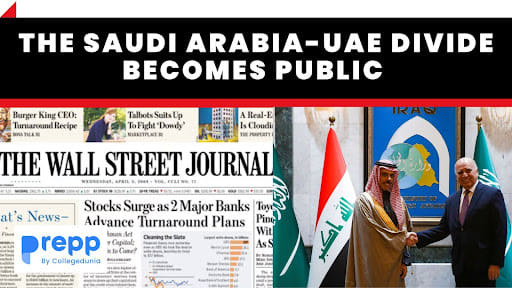
- In mid-July the Wall Street Journal disclosed that Saudi Crown Prince Mohammed bin Salman, commonly known as MbS, expressed strong discontent towards the United Arab Emirates (UAE).
- The reported tensions seemingly stemmed from the UAE ruler, Sheikh Mohammed bin Zayed (MbZ), being conspicuously absent from a pivotal Gulf Cooperation Council (GCC) summit meeting during Chinese President Xi Jinping's visit. This absence has raised questions about the underlying dynamics of the Saudi-UAE relationship.
Table of Contents
Areas of convergence
- The two countries collaborated in the war in Yemen,
- worked together to strengthen al-Sisi’s regime in Egypt,
- viewed Iran as a regional threat,
- disliked the Muslim Brotherhood, and then collaborated closely to implement the blockade of Qatar.
- In 2019, they also subverted the nascent democratic process in Sudan by backing the armed forces against the civilian Prime Minister.
Obvious differences in regional politics
- Oil production: In July 2017, the UAE rejected an "OPEC +" proposal to reduce oil production, citing the need to significantly increase its own base production. This move aligned with Abu Dhabi's efforts to enhance its oil production for maximum monetization.
- Yemen: The UAE withdrew its troops from Yemen in 2019, but continued to pursue a separate agenda of supporting the secessionist movement in the south and mobilising local fighters backing the independence of the south.
- The UAE set up military bases in Eritrea and Somaliland, creating a formidable strategic network connecting the Gulf with the Red Sea and the Horn of Africa. In contrast, Saudi Arabia took on the burden of military engagement in Yemen but achieved limited results over an eight-year period.
- The UAE also expanded its maritime footprint in the region by taking control of Yemeni ports and Socotra Island in the Gulf of Aden, and Perim Island at the mouth of the Bab al-Mandab.
- Saudi Arabia faced challenges in Syria due to Russian intervention in 2015, which prevented the overthrow of the Assad government.
- Iran and Qatar: Saudi Arabia encountered difficulties in dealing with Iran, as the United States did not respond to missile and drone attacks in 2019. These setbacks prompted Saudi Arabia to shift towards de-escalation and regional dialogue.
- This shift began with the removal of the Qatar blockade in January 2021 and the initiation of talks with Iran in Baghdad in April 2021.
- However, the UAE showed reluctance to participate in these efforts, maintaining a reserved stance towards Qatar and pursuing its own approach to engaging with Iran.
- Israel: The UAE's normalization of ties with Israel in August 2020 marked a departure from the Saudi-backed Arab Peace Initiative, which prioritizes Palestinian interests before Arab-Israeli normalization.
- Syria: Saudi Arabia facilitated Syria's re-entry into the Arab League in May, though UAE's leader MbZ did not attend the summit.
- Sudan: In Sudan, the two Gulf nations are supporting different leaders — Saudi Arabia backs Army chief al-Burhan, while the UAE supports militia leader Dagalo, contributing to the ongoing civil conflict. The UAE reportedly feels uneasy about Saudi Arabia's swift normalization of ties with Iran in March of this year.
Competition in the same sectors
- Sectoral supremacy: Both Saudi Arabia and the UAE aspire to establish their dominance in key sectors such as global business, tourism, finance, and technology.
- Saudi Arabia seeks to position itself as the primary hub for regional trade, a move that directly challenges the UAE's current position as the dominant player in this field.
- Development of Ports: Both nations are engaged in ambitious plans to develop ports within the Gulf and the Red Sea, with the aim of asserting their presence in logistical connectivity projects aligned with China's Belt and Road Initiative.
Strengths of UAE and Saudi Arabia
- UAE: Despite its smaller size, the UAE is determined not to be viewed as a junior partner to Saudi Arabia in political, economic, and logistical spheres.
- The UAE capitalizes on the visionary leadership, dynamism, and ambition of its leaders to compensate for its size limitations.
- The UAE's head start in global engagements across trade, connectivity, tourism, finance, and technology strengthens its competitive stance.
- Saudi Arabia: Saudi Arabia's leadership role in the Arab and Islamic world remains prominent
- The kingdom's pivotal role in global energy, business, and finance secures its preeminent position in both regional and global political and economic dynamics.
How Saudi Arabia-UAE divide will have an impact on India?
- Energy Security Concerns: India heavily relies on Gulf countries for energy needs. Any turmoil disrupting energy flow, as witnessed in past conflicts, could impact India's energy security and economic stability.
- Impact on Indian Workers: The potential travel bans, such as those affecting Qatar Airways, could hinder the movement of Indian workers in the region. This might not only affect their livelihoods but also have an impact on remittances.
- Balancing Act in Diplomacy: India's historical ties with Saudi Arabia and UAE makes it challenging to take sides in the growing rivalry. Maintaining balanced relations while safeguarding its interests will require adept diplomatic maneuvering.
- Impact on counter-terrorism: In recent years, India has forged closer counter-terrorism cooperation with West Asian countries, notably Saudi Arabia and the UAE. This collaboration has proved effective in intercepting and repatriating individuals linked to terrorist organizations like the Islamic State.
Conclusion
The relationship between Saudi Arabia and the UAE is more likely to be defined by competition rather than collaboration, as they vie for influence and power.
(*Click this link to read prelims specific weekly current affairs articles)
FAQs
Question: What is GCC?
Answer:
The Gulf Cooperation Council (GCC) was established by an agreement concluded on 25 May 1981 in Riyadh, Saudi Arabia among Bahrain, Kuwait, Oman, Qatar, Saudi Arabia and UAE in view of their special relations, geographic proximity, similar political systems based on Islamic beliefs, joint destiny and common objectives. Presently it encompasses a total area of 2,672,700 sq.km. The official language is Arabic.
Question: What is Arab League?
Answer:
The Arab League is an intergovernmental organization (IGO), a voluntary association of independent African and Middle East countries whose peoples are mainly Arabic speaking. The stated purposes of the Arab League are to strengthen ties among the member states, coordinate their policies, and promote their common interests.
Question: What do you mean by Arab Peace Initiative?
Answer:
The Arab Peace Initiative is a 10 sentence proposal for an end to the Arab–Israeli conflict that was endorsed by the Arab League in 2002 at the Beirut Summit and re-endorsed at the 2007 and at the 2017 Arab League summits.
UPSC Mains Practice Question:
|
MCQ
A similar question can be asked on GCC or countries bordering Saudi Arabia
Question: In which one of the following groups are all the four countries members of G20?
(a) Argentina, Mexico, South Africa and Turkey
(b) Australia, Canada, Malaysia and New Zealand
(c) Brazil, Iran, Saudi Arabia and Vietnam
(d) Indonesia, Japan, Singapore and South Korea
Answer: (a) See the Explanation
- The members of the G20 are: Argentina, Australia, Brazil, Canada, China, France, Germany, India, Indonesia, Italy, Japan, Republic of Korea, Mexico, Russia, Saudi Arabia, South Africa, Türkiye, the United Kingdom, the United States, and the European Union.
- The G20 brings together the world's major and systemically important economies. Its members represent 85% of global GDP, 75% of international trade and two-thirds of the world's population.
- Therefore, option (a) is the correct answer.
Download the PREPP App and attempt FREE IAS Exam Mock Tests and get complete study material!

Full Test - 04: UPSC CSE Prelims CSAT (Paper-II)
Full Test - 03: UPSC CSE Prelims CSAT (Paper-II)
UPSC CSE Prelims 2026 GS Paper 1 Question Paper (24-May-2026)
UPSC CSE Prelims 2026 CSAT Paper 2 Question Paper (24-May-2026)

17 February 2025 | The Hindu Must Read Articles | Current Affairs

16 February 2026 | The Hindu Must Read Articles | Current Affairs

13 February 2026 | The Hindu Must Read Articles | Current Affairs









Comments