On Protecting The Biodiversity Of The Northeast
Relevance: GS 3- Conservation, Environmental Pollution and Degradation, Environmental Impact Assessment GS1 - Distribution of key natural resources across the world (including South Asia and the Indian subcontinent);
(Source: The Hindu, 08/23/2023)
Click here for Daily Current Affairs
Why in the news?
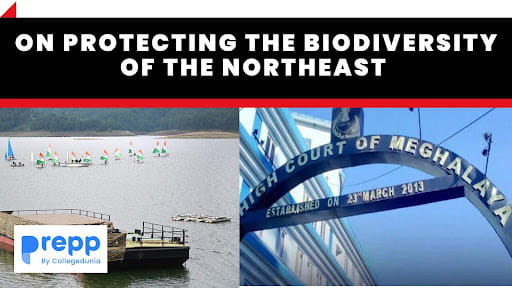
- Recently, a division bench of the High Court of Meghalaya stated in the Re: Cleanliness of Umiam Lake versus State of Meghalaya (2023) case that the natural beauty of the state should not be destroyed to promote tourism and employment.
- The North-East which accounts for about 8% of India’s total geographical area is a biodiversity hotspot.
- In 2022, the India State of Forests Report prepared by the Forest Survey of India (FSI) stated that the forest cover of the North Eastern region has shrunk by 1,020 sq km from the previous assessment.
Table of Contents
The biodiverse Northeast India
- Northeast India which is made up of Assam, Meghalaya, Tripura, Mizoram, Manipur, Arunachal Pradesh, Nagaland, and Sikkim is one of the most culturally rich and biodiverse regions of the country.
- It is home to a variety of physiographic and climatic conditions and a significant portion of India’s endemic flora and fauna.
- It is a green belt region with abundant natural resources such as oil, natural gas, minerals, freshwater, etc.
Challenges faced by the region
- However, the northeast region is industrially backward and prone to natural disasters like floods and deforestation.
- The existing industries in the region have caused serious problems to the environment in the region.
- According to an environmental assessment of the North East Rural Livelihood Project, Northeast India is an ecologically fragile and biologically rich region that is located in transboundary river basins and highly prone to climatic changes.
- The flora and fauna of the areas are threatened by deforestation, mining, quarrying, shifting cultivation, etc.
Environmental laws
- Offenses related to or against the environment dealing with pollution of land, air, and water are considered ‘public nuisance” under Sections 268 to 290 of the Indian Penal Code (IPC), 1860.
- However, District Councils are granted autonomy on matters like the use of land as per the Sixth Schedule of the Constitution.
- This restricts the authority of the State on these matters while district councils do not impose adequate regulations for the protection of environmental resources as in the case of the Umiam Lake.
- The emergence of PILs and judicial activism in the 1970s led to a number of petitions being filed.
- The strict enforcement of guidelines and imposition of penalties by judicial authorities in environmental litigation has helped protect the ecologically sensitive flora and fauna of the region.
- Eg: In 2019, the Meghalaya government was fined ₹100 crores for failing to stop illegal mining in the state, and in 2022 the Manipur government was fined ₹200 crores for improper waste management.
To know more about the environmental laws in India click the link.
Umiam Lake
- Umiam Lake, also known as Bara Pani is one of the largest artificial lakes in Meghalaya.
- The lake stretches over an area of about 220 square kilometers.
- It is situated on the Umiam River, about 15 kilometers north of Shillong.
- River Umiam originates from Shillong Peak, the highest point in Meghalaya, and flows through the state before crossing into Bangladesh.
- It was initially established in 1965 as a dam or reservoir for hydroelectric power generation but currently serves as a popular tourist destination.
- The Government of Assam and Meghalaya have announced plans to jointly develop the lake as a 'world-class' water sports venue.
Opportunity-cost
- The Meghalaya High Court was recently hearing a Public Interest Litigation (PIL) on the cleanliness of the Umiam Lake.
- The court observed that the Meghalaya Waterbodies (Preservation and Conservation) Guidelines, 2023, do not deal with the rapid increase and mushrooming of construction around the lake.
- It stated that activities like tourism, and infrastructure development must not adversely impact the environment in the region.
- Although they provided an opportunity in the present, they could transform into a costly challenge in the long term.
The need to protect and grow
- The Union and state governments have to develop infrastructure and generate revenue and employment to fulfill the aspirations of the people of the region.
- However, this must be done using a strategy of sustainable development with proper regulation of resource use and environmental impact.
Negative List
- The Negative List in the North East Industrial Development Scheme (NEIDS), 2017 is an example of sustainable policy making.
- Entities that do not adhere to the required environmental standards and lack necessary environmental clearances and pollution board consent will be placed on the negative list, making them ineligible for any incentives under the scheme.
- Examples of industries on the negative list include those related to tobacco, pan masala, plastic bags of thickness less than 20 microns, etc.
Act Fast for Northeast
- In 2022, the Prime Minister of India highlighted the need to adopt a policy of “Act Fast for Northeast” and “Act First for Northeast”.
- Power: The Northeast can become a hydropower powerhouse making the region power-surplus.
- This would contribute to industrial expansion and employment generation.
- Tourism: The culture and biodiversity of the Northeast are attracting tourists from across the world which could be aided by the identification, development, and management of tourism circuits.
- However, this leads to concerns about ecological stress, and pollution.
- Connectivity: Connectivity has been improved in the region with an increase in airports and flights to the region, and the expansion of railways, highways, and waterways.
- Infrastructure: Under the PM-DevINE scheme, infrastructure development was progressing rapidly in the region.
- Communication: The optical fiber network was being expanded across the region alongside the development of Aatmanirbhar 5G infrastructure.
- This is expected to contribute to the growth of the startup ecosystem and the services sectors which could make the Northeast a hub of economic and cultural growth.
- Agriculture: Natural farming could be implemented to increase the agricultural productivity of the Northeast.
- The Krishi UDAN scheme enabled farmers to market and sell their products across the country, thus improving their financial status.
Conclusion
It would not be wise to strive for a 10 trillion-dollar economy without ensuring the protection of India’s environment, particularly in hotspots like the Northeast.
(*Click this link to read prelims specific weekly current affairs articles)
FAQs
Question: What is the North East Industrial Development Scheme (NEIDS)?
Answer:
The NEIDS 2017, is a scheme related to the manufacturing and service sectors which is implemented by the Department of Promotion of Industry and Internal Trade (DPIIT). It incentivizes eligible industrial units in the form of GST and income tax reimbursement, investment incentives, etc in order to accelerate economic growth and industrialization in Northeast India.
Question: What is the PM-DevINE scheme?
Answer:
The PM-DevINE scheme was introduced as part of the Union Budget 2022-23. It is a Central Sector scheme, with 100% central funding, that will be implemented by the Ministry of Development of North-East Region. It aims to fund infrastructure development, support social development and empower the youth and women of the region.
UPSC Mains Practice Question:
|
MCQs
Question: Consider the following pairs:
Reservoirs States
- Ghataprabha — Telangana
- Gandhi Sagar — Madhya Pradesh
- Indira Sagar — Andhra Pradesh
- Maithon — Chhattisgarh
How many pairs given above are not correctly matched?
(a) Only one pair
(b) Only two pairs
(c) Only three pairs
(d) All four pairs
Answer: (c) See the Explanation
- The Ghataprabha Reservoir on the Ghataprabha River, a tributary of the Krishna, is located in Karnataka. Hence Pair 1 is incorrect.
- The Gandhi Sagar Dam is built on the Chambal River and is located in Madhya Pradesh. Hence Pair 2 is correct.
- The Indira Sagar Dam on the Narmada River is located in Madhya Pradesh. Hence Pair 3 is incorrect.
- The Maithon dam on the Barakar River is located in Jharkhand. Hence Pair 4 is incorrect.
Therefore, option (c) is the correct answer.
Question: Which of the following National Parks is unique in being a swamp with floating vegetation that supports a rich biodiversity?
(a) Bhitarkanika National Park
(b) Keibul Lamjao National Park
(c) Keoladeo Ghana National Park
(d) Sultanpur National Park
Answer: (b) See the Explanation
- Keibul Lamjao National Park is the world’s only floating wildlife sanctuary and is located on the Loktak Lake in Manipur.
- It is famous for the patches and rings of biomass called phumdis, a carpet of dead and decaying flora, which floats on the surface of the lake.
Therefore, option (b) is the correct answer.
Download the PREPP App and attempt FREE IAS Exam Mock Tests and get complete study material!

Full Test - 04: UPSC CSE Prelims CSAT (Paper-II)
Full Test - 03: UPSC CSE Prelims CSAT (Paper-II)
UPSC CSE Prelims 2026 GS Paper 1 Question Paper (24-May-2026)
UPSC CSE Prelims 2026 CSAT Paper 2 Question Paper (24-May-2026)

17 February 2025 | The Hindu Must Read Articles | Current Affairs

16 February 2026 | The Hindu Must Read Articles | Current Affairs

13 February 2026 | The Hindu Must Read Articles | Current Affairs









Comments