Japan To Release Water From Fukushima Nuclear Plant
Relevance: GS2: International relations, Effect of policies and politics of developed and developing countries GS3 Environmental pollution
(Source: The Hindu, 08/23/23)
Click here for Daily Current Affairs
Why in the news?
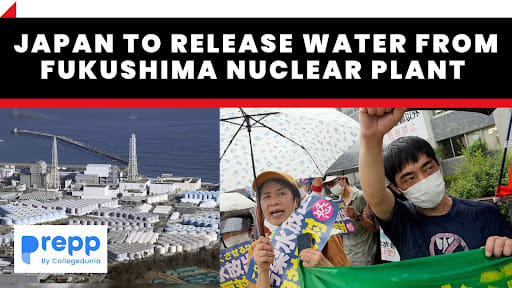
- Recently, Japan is expected to begin releasing massive amounts of treated radioactive water from the tsunami-damaged Fukushima nuclear power plant into the Pacific Ocean, a highly contentious decision that has sparked outrage in neighbouring countries.
- The impending discharge of water comes more than a decade after Japan was devastated by the world's second-worst nuclear disaster.
Table of Contents
Why does Japan plan to release Fukushima water into the ocean?
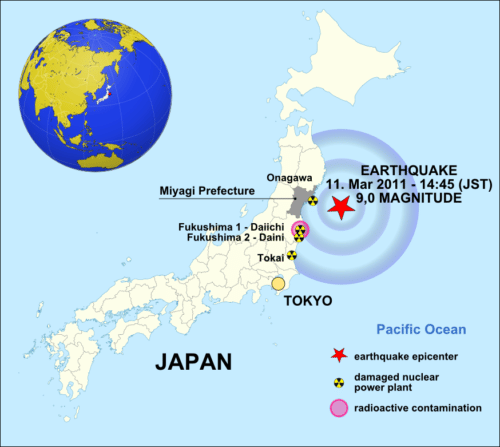
- The release of the water is a critical phase in the plant's decommissioning and the rehabilitation of Fukushima prefecture following the March 11, 2011, earthquake and tsunami tragedy.
- Water disposal will take decades to complete, with a continual filtration and diluting process taking place alongside the plant's planned retirement.
- For the time being, the government has done all possible to safeguard the plan's safety, maintain Japan's fishing industry, and fully explain the scientific foundation for the action.
- The government has promised to continue its efforts until the completion of the release and decommissioning process, which will take decades.
- In a final assessment issued in July, the International Atomic Energy Agency stated that the release, if carried out as planned, will have no effect on the environment or human health.
- Even after accounting for possible bioconcentration of low-dose radionuclides in the water, the environmental and health impact remains insignificant.
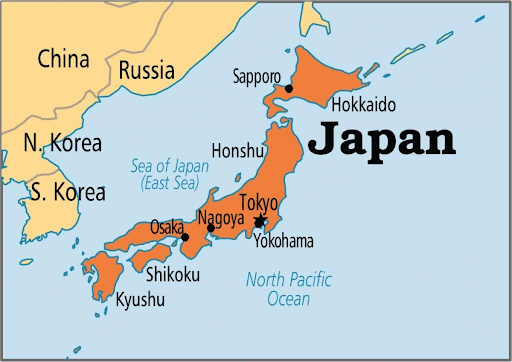
- Officials in South Korea and China are concerned about the impact on their respective islands.
Why release instead of treating the water?
- The Tokyo Electric Power Company (TEPCO), which runs the Fukushima facility, first intended to clean the wastewater, but ultimately chose to release the water since there wasn't enough space for the water-tanks.
- Additionally, due to the short half-life (12–13 years) of tritium, Japan is unable to keep water for longer than necessary.
Concerns of releasing the water into Pacific ocean
- Any release of radioactive materials will raise the risk of cancer and other known adverse health effects for people who are exposed because there is no known radiation safety threshold beyond which exposure may be deemed safe.
- Anyone who lives close to the discharge site may be at danger since the water released may be harmful to fish.
- Due to the difficulty of doing so, Tokyo Electric Power Company (TEPCO) has not eliminated tritium from the water.
- Also the water contains ruthenium and plutonium isotopes, which may last longer in the bodies of marine organisms and on the ocean floor.
- Fukushima's fishing unions have been pleading with the government not to release the water for years, saying that doing so would undermine efforts to repair the harm done to their fisheries' reputations.
Read more about Radioactive waste click here
Uproar in neighbouring countries
- Nuclear power plants all throughout the globe routinely emit waste water with tritium levels higher than the treated water from Fukushima.
- However, the idea has sparked outrage among nearby countries, with China being the most outspoken opponent. Japan was accused of treating the ocean as its "private sewer."
- Hong Kong announced it will "immediately activate" import restrictions on some Japanese foods.
- South Korea and China have already prohibited imports of seafood from the Fukushima area.
Fukushima Nuclear power plant
|
(*Click this link to read prelims specific weekly current affairs articles)
FAQs
Question: What is the Half life period?
Answer:
The "half-life" of a material or quantity is the length of time it takes for half of it to disintegrate, degrade, or convert. It's most typically used in radioactive decay, where it describes the time it takes for half of a radioactive material to decay and turn into another element.
Question: What is Bioconcentration?
Answer:
The process through which a living creature collects a specific component, often a chemical or molecule, at a greater concentration than what is present in its surrounding environment is referred to as bioconcentration. This is something that can happen to aquatic creatures, plants, and animals.
Question: What is the International Atomic Energy Agency?
Answer:
The International Atomic Energy Agency (IAEA) is a United Nations (UN) organisation that works internationally. It was founded in 1957 and is based in Vienna, Austria. The IAEA's principal goal is to promote the peaceful use of nuclear energy while avoiding nuclear weapon proliferation and fostering international collaboration in different nuclear-related disciplines.
UPSC Mains Practice Question:
|
MCQs
Question: The function of heavy water in a nuclear reactor is to (UPSC 2011)
(a) Slow down the speed of neutrons
(b) Increase the speed of neutrons
(c) Cool down the reactor
(d) Stop the nuclear reaction
Answer: (a) See the Explanation
- Heavy Water (D20), also known as deuterium oxide, is composed of two deuterium atoms and one oxygen atom.
- Heavy Water has comparable physical and chemical qualities to regular water but varies in nuclear properties, making it an exceptionally effective material for use as a moderator and coolant in Pressurised Heavy Water Reactors (PHWRs).
- In a nuclear reactor, a moderator is necessary to slow down the neutrons produced during the fission event so that the chain reaction may continue. Because of its high moderating ratio and low neutron absorption cross-section, heavy water is an effective moderator.
- Moderators are employed in nuclear reactors to slow down the energy neutrons produced during the nuclear fission process by fuel components.
- Because of the presence of deuterons, which are capable of reducing neutron speed, ordinary or heavy water is commonly utilised as a moderator in nuclear reactors.
Therefore option (a) is the correct answer.
Download the PREPP App and attempt FREE IAS Exam Mock Tests and get complete study material!

Full Test - 04: UPSC CSE Prelims CSAT (Paper-II)
Full Test - 03: UPSC CSE Prelims CSAT (Paper-II)
UPSC CSE Prelims 2026 GS Paper 1 Question Paper (24-May-2026)
UPSC CSE Prelims 2026 CSAT Paper 2 Question Paper (24-May-2026)

17 February 2025 | The Hindu Must Read Articles | Current Affairs

16 February 2026 | The Hindu Must Read Articles | Current Affairs

13 February 2026 | The Hindu Must Read Articles | Current Affairs









Comments