How India Is Becoming A Young Country But With An Ageing Workforce
Relevance: GS3 - Indian Economy and issues relating to planning, mobilization, of resources, growth, development and employment. Inclusive growth and issues arising from it. GS1 - Population and associated issues, Poverty and developmental issues, Effects of globalization on Indian society. GS2 - Issues relating to development and management of Social Sector/Services relating to Human Resources,
(Source: Indian Express, 08/23/2023)
Click here for Daily Current Affairs
Why in the news?
- Recently, an analysis of India’s workforce using CMIE’s Economic Outlook data revealed that the Indian workforce is rapidly aging despite having the most youthful population.
- Prime Minister Narendra Modi highlighted the significance of India being a youthful nation and highlighted the opportunities available during his Independence Day address.
Table of Contents

What has the CMIE-Outlook data revealed?
Aging Workforce
- According to the survey conducted by the Center for Monitoring Indian Economy (CMIE) and the Outlook, India’s workforce was aging rapidly.
- This meant that the youth were being driven out of the job market.
- The share of those near the age of 60 in the workforce is rising while that of younger people is declining.
- The data defines the youth as those belonging to the age group of 15 to 25 years. It has divided the workforce into three categories:
- Those aged 15 years or more but less than 30 years,
- Those aged 30 years or more but less than 45 years, and
- Those aged 45 years and older.
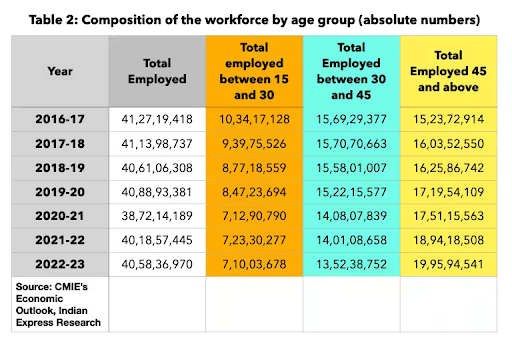
- The share of India’s youth in the workforce has dropped from 25% in 2016-17 to 17% in 2022-23.
- The share of those in the 30-45 age group fell from 38% to 33% in the same period.
- In contrast, the share of people belonging to the oldest age category increased from 37% to 49%.
- Since 2016, the share of people aged 45 years and above has risen from one-third to almost one-half of the workforce.
Decrease in Employment
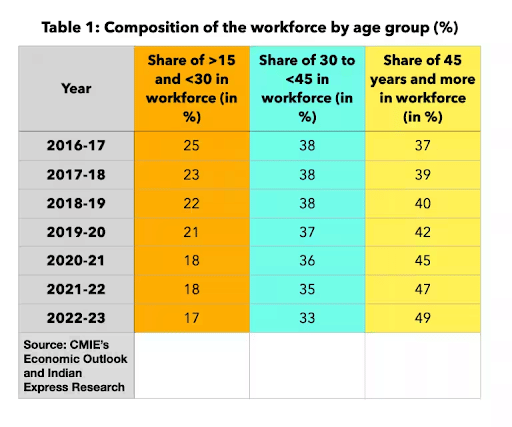
- The overall employment i.e the total number of employed people has fallen from 41.27 crore to 40.58 crore.
- The number of people under the age of 30 in the workforce dropped from 10.34 crore in 2016-17 to 7.1 crore in 2022-23.
Why is India’s workforce aging?
- The youth population in the workforce grew from 35.49 crore in 2016-17 to 38.13 crore in 2022-23.
- However, the total employment in this age group declined with the number of employed youth falling by 3.24 crore despite the growth of the youth population by 2.64 crore.
- Asa result, employment for this age category fell by 31% between 2016-17 and 2022-23.
Employment Rate
- The Employment Rate (ER) for the youth, i.e. the proportion of that age group or population that is employed, fell from 29% to 19%.
- The employment rate in the 30-45 category dropped from 55% in 2016-17 to 48% in 2022-23.
- However, in the 45 and older age group, the absolute number of people with jobs has grown.
- As a result, the ER has fallen only marginally from 47% to 44% in the same period.
- The ER in the 55-59 years of age category rose from 50% to 54% between 2016-17 and 2022-23.
Impact of aging workforce
- Productivity decline: As a result of the reduced employment rate among the younger category of the workforce, there could be an overall decline in the productivity of the workforce.
- Increased Healthcare Costs: As the workforce ages, more healthcare services, are required which leads to higher healthcare expenditures and budgetary pressures.
- Policy and Planning: Governments will have to develop and implement policies to create more jobs for the younger population
- Lower employment among the youth could lead to a rise in poverty and other social indicators.
- Migration: If the country is unable to provide sufficient employment opportunities for its youth, there will be an increase in migration to other nations with better job opportunities.
Upshot
- The data clearly indicates that India’s fast-growing youth population does not guarantee more jobs for the youth.
- The youth are failing to make their mark in the job market and are being displaced by employees in the senior age groups.
- Even if it is assumed that a significant section of the youth is opting to pursue their higher education, the drop in employment rate is concerning and needs the attention of policymakers.
- Unemployment in India is the highest among the youth and increases with an increase in educational qualifications.
- It is necessary to reverse these trends to ensure that India can reap the benefits of its youthful population.
(*Click this link to read prelims specific weekly current affairs articles)
FAQs
Question: What is the demographic dividend?
Answer:
The demographic dividend refers to the economic growth potential that is caused due to the shifts in the age structure of the population, i.e. when the share of the working-age population (15 to 64) is larger than that of the non-working-age population. India’s Demographic Dividend is expected to peak around 2041, with the 20-59 age group expected to form 59% of the workforce.
Question: What is the CMIE?
Answer:
The Centre for Monitoring Indian Economy (CMIE) is a private limited organization that functions as an economic think tank and provides business intelligence information. It was established in 1976 and has been publishing monthly information on unemployment in India since 2016.
Question: What is brain drain?
Answer:
Brain drain refers to the migration of educated persons from one country to another. It can take place within the country and between different countries. It can have push factors such as lack of opportunities, poor remuneration, non-recognition of talent, etc, and pull factors such as improved quality of life, standard of living, better remuneration, social standards, etc.
UPSC Mains Practice Question:
|
MCQs
Question: With reference to the Indian economy after the 1991 economic liberalization, consider the following statements:
- Worker productivity (` per worker at 2004-05 prices) increased in urban areas while it decreased in rural areas.
- The percentage share of rural areas in the workforce steadily increased.
- In rural areas, the growth in the non-farm economy increased.
- The growth rate in rural employment decreased.
Which of the statements given above is/are correct? (UPSC CSE 2020)
(a) 1 and 2 only
(b) 3 and 4 only
(c) 3 only
(d) 1, 2, and 4 only
Answer: (b) See the Explanation
- The Agriculture and Allied Activities, with over 56 percent of the workforce, has the lowest GVA per worker in India. Hence statement 1 is incorrect.
- The occupational structure in the country has changed with the percentage share of the labor force in agriculture declining and that of the services sector increasing. Hence statement 2 is incorrect.
- Between 1998 and 2005, the growth rate of rural people employed in non-agricultural employment was 4.56 %. Hence statement 3 is correct.
- As a result of the transition to urbanization, the rural share in the population, workforce, and GDP has declined. Hence statement 4 is correct.
Therefore, option (b) is the correct answer.
Download the PREPP App and attempt FREE IAS Exam Mock Tests and get complete study material!

Full Test - 04: UPSC CSE Prelims CSAT (Paper-II)
Full Test - 03: UPSC CSE Prelims CSAT (Paper-II)
UPSC CSE Prelims 2026 GS Paper 1 Question Paper (24-May-2026)
UPSC CSE Prelims 2026 CSAT Paper 2 Question Paper (24-May-2026)

17 February 2025 | The Hindu Must Read Articles | Current Affairs

16 February 2026 | The Hindu Must Read Articles | Current Affairs

13 February 2026 | The Hindu Must Read Articles | Current Affairs









Comments