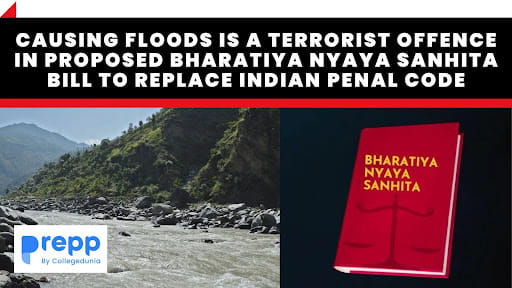
Causing Floods Is A Terrorist Offence In Proposed Bharatiya Nyaya Sanhita Bill To Replace Indian Penal Code
Relevance: GS2 - Government policies and interventions for development in various sectors and issues arising out of their design and implementation. GS 3- Disaster and Disaster Management
(Source: The Hindu, 08/23/23)
Click here for Daily Current Affairs
Why in the news?
- The recently, proposed Bharatiya Nyaya Sanhita Bill (BNS) introduced new provisions, including defining causing "floods" as a terrorist offense.
- The bill aims to replace the British-era Indian Penal Code,1860 and establishes a separate definition of terrorism within general law, distinct from the Unlawful Activities (Prevention) Act, 1967, which is focused on terrorist activities.
- The bill is currently under examination by a Parliamentary Committee on Home Affairs.
Table of Contents
Section 111(6) of Bharatiya Nyaya Sanhita Bill (BNS)
- Section 111 (6) (a) of the Bharatiya Nyaya Sanhita Bill (BNS) identifies terrorist as a any person who “develops, manufactures, possesses, acquires, transports, supplies or uses weapons, explosives, or releases nuclear, radiological or other dangerous substance, or cause fire, floods or explosions.”
What are the Concerns?
- Lack of protection against false implications: Experts argue that the proposed law lacks safeguards against false implication as available under the UAPA and the Maharashtra Control of Organised Crime Act (MCOCA).
- Under the MCOCA and the UAPA, there is a provision that before filing of FIR there has to be an approval by a senior police officer.
- The investigation can only be carried out by an officer of a particular rank and there is a bar on the court to take cognisance of the case without government sanctions. If these safeguards are not there, the trial cannot proceed.
- Any police officer can register an FIR against an individual as a terrorist without prior approval.
- The language, ingredients, and interpretation of the new law closely resemble the Unlawful Activities (Prevention) Act.
- The UAPA has often been criticised for draconian provisions. Under the anti-terror law, 4,690 persons were arrested between 2018 and 2020, but only 3% were convicted.
- The bill proposes stringent punishments for terrorist offenses, including a minimum five-year imprisonment and the possibility of the death sentence.
Other Key changes proposed in the Bharatiya Nyaya Sanhita Bill
|
(*Click this link to read prelims specific weekly current affairs articles)
FAQs
Question: What are new provisions of Bharatiya Nyaya Sanhita Bill?
Answer:
The act defines mob lynching as a crime specifying that the mob has to be a “group of five or more persons.”
- to enabling speedy justice through video trials,
- e-filing of FIRs;
- expanding the definition of sedition;
- bringing corruption, terrorism and organised crime under the penal laws;
- introducing community service and solitary confinement as new forms of punishment; holding trials in the absence of an accused; and
- expanding the scope of offence against women pertaining to sexual intercourse by employing “deceitful means”.
Question: What is Indian Penal Code?
Answer:
The Indian Penal Code (IPC) was established in 1860 on the recommendations of the first law commission of India, which was established in 1834 under the Charter Act of 1833, and under the chairmanship lord Macaulay. The Code went into effect on January 1, 1862, during British rule, and was applicable to entire then-British India, with the exception of the princely states, which had their own courts and legal systems until the 1940s.
Question: Is the Indian Penal Code part of the Constitution?
Answer:
No, it is not a part of the Indian Constitution. It is organized around a single Framework. It has the authority to rule over states and guarantee that all laws are strictly enforced. The Indian Penal Code (IPC) is the criminal code that encompasses all laws pertaining to criminal offenses as defined by the Indian Constitution.
UPSC Mains Practice Question:
|
MCQ
Question: Consider the following statements:
- A bill amending the Constitution requires a prior recommendation of the President of India.
- When a Constitution Amendment Bill is presented to the President of India, it is obligatory for the President of India to give his/her assent.
- A Constitution Amendment Bill must be passed by both the Lok Sabha and Rajya Sabha by a special majority and there is no provision for joint sitting.
Which of the statements given above are correct?
(a) 1 and 2 only
(b) 2 and 3 only
(c) 1 and 3 only
(d) 1, 2 and 3
Answer: (b) See the Explanation
- An amendment of the Constitution can be initiated only by the introduction of a bill for the purpose in either House of Parliament not in the state legislatures.
- The bill can be introduced either by a minister or by a private member and does not require prior permission of the president. statement 1 is not correct
- The bill must be passed in each House by a special majority, that is, a majority (that is, more than 50 per cent) of the total membership of the House and a majority of two-thirds of the members of the House present and voting.
- Each House must pass the bill separately. In case of a disagreement between the two Houses, there is no provision for holding a joint sitting of the two Houses for the purpose of deliberation and passage of the bill. Hence, statement 3 is correct.
- After duly passed by both the Houses of Parliament and ratified by the state legislatures, where necessary, the bill is presented to the president for assent.
- The president must give his assent to the bill (24th Constitutional Amendment Act, 1967). He can neither withhold his assent to the bill nor return the bill for reconsideration of the Parliament.Hence, statement 2 is correct
- Therefore, option (b) is the correct answer.
Download the PREPP App and attempt FREE IAS Exam Mock Tests and get complete study material!

Full Test - 04: UPSC CSE Prelims CSAT (Paper-II)
Full Test - 03: UPSC CSE Prelims CSAT (Paper-II)
UPSC CSE Prelims 2026 GS Paper 1 Question Paper (24-May-2026)
UPSC CSE Prelims 2026 CSAT Paper 2 Question Paper (24-May-2026)

17 February 2025 | The Hindu Must Read Articles | Current Affairs

16 February 2026 | The Hindu Must Read Articles | Current Affairs

13 February 2026 | The Hindu Must Read Articles | Current Affairs









Comments