The Reality Of Scholarship Schemes For Religious Minorities In India
Relevance: GS 2 - Issues relating to the development and management of Social Sector/Services relating to Health, Education, and Human Resources; Government policies and interventions for development in various sectors and issues arising out of their design and implementation; GS3 - Inclusive growth and issues arising from it.
(Source: The Hindu, 08/28/23)
Click here for Daily Current Affairs
Why in the news?
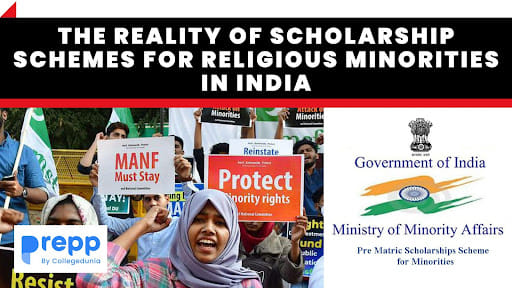
- The Indian government has faced scrutiny for discontinuing key educational schemes for religious minorities, reducing the scope of others, and cutting expenditure in the Ministry of Minority Affairs, despite a decrease in beneficiaries and underutilized funds.
- In the latest development, the budget allocation for the Ministry has been reduced by 38.3% for the fiscal year 2023-24, raising concerns about the support for minority education and welfare programs.
Table of Contents
Why were scholarships for religious minorities introduced?
- India is home to over 30 crore (20%) people from religious minority communities.
- Muslims make up the largest minority group at 14.2%, followed by Christians (2.3%), Sikhs (1.7%), Buddhists (0.7%), Jains (0.4%), and Zoroastrians (around 57,000).
- Muslims, in particular, face challenges in the economic, health, and educational sectors. Many are employed in the informal sector, characterized by low wages and limited social security.
- Educational empowerment: The Manmohan Singh-led UPA government established the Ministry of Minority Affairs in 2006.
- This dedicated ministry aimed to address the specific concerns of notified minority communities, focusing on education, economic empowerment, infrastructure development, and special needs.
- The introduction of the 15-point Programme for the Welfare of Minorities, including educational empowerment through scholarships, was a significant step in this direction.
- Sarva Shiksha Abhiyan data indicates that the highest proportion of out-of-school children belongs to the Muslim community (4.43%), followed by Hindus (2.73%), Christians (1.52%), and others (1.26%).
What were the recommendations of the Sachar Committee?
- The Sachar Committee concluded that the Muslims were deprived and neglected in almost all dimensions of development and behind the mainstream in several social and economic sectors.
- It stated that Muslims were positioned above Scheduled Castes/Scheduled Tribes but below other social groups in terms of various indicators.
Why Under Utilization of Funds?
- The number of scholarships awarded to minority students in India witnessed a steady rise from around 75,000 to over 70 lakh between 2006 and 2013.
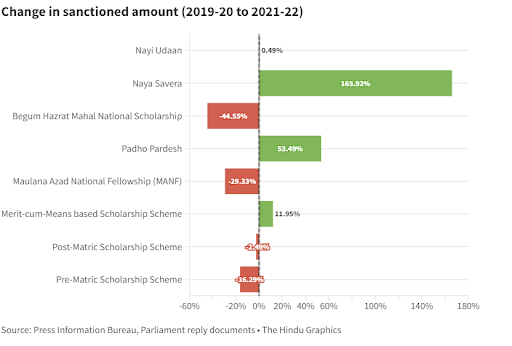
- However, the Center's commitment in 2019 to provide scholarships to one crore minority students annually remained unfulfilled due to the discontinuation of five schemes and significant reduction in funds for four other programs by the Modi government.
- The budget allocation for the Ministry of Minority Affairs in the current fiscal year decreased by 38% compared to 2022-23, with an allocation of ₹3,097 crore for 2023-24.
- Decline in beneficiaries: An analysis of recent Ministry of Minority Affairs data reveals a 7% decline in beneficiaries of the initial six central educational schemes within three years, from 2019 to 2022.
- Moreover, the utilization of the budget under the scholarship schemes appeared to be concentrated in the last quarter of each financial year, leading to beneficiaries receiving their scholarships towards the end of the academic year.
- Widen disparities: Because of the restructuring of programs, under-utilisation of funds, and reduced budgetary allocations gaps in education, the economic parameters are expected to widen.
Why does educational aid need to be strengthened?
- Niti Aayog's 2017 policy document emphasizes the need to enhance the execution of existing programs, underscoring the pivotal role of education in uplifting religious minority groups in India.
- Niti Aayog's Strategy Document 2018 highlights the urgent need for affirmative action to uplift the socio-economic status of religious minorities, particularly Muslims. This group continues to face disparities, lagging behind in various aspects.
- A 2022 report by the Centre for Budget and Governance Accountability (CBGA) underscored a "declining trend" in the proportion of the overall budget expenditure allocated to minorities.
- The CBGA observed that the allocation of funds for 2022-23 did not align with the proportional representation of minorities.
- Reduce dropout rates: A significant education gap exists between Muslims and the general population, especially in higher education. Cutting scholarships like the pre-matric and Begum Hazrat Mahal schemes could worsen this. Muslim dropout rates are 23.1%, higher than the 18.96% national average.
- The All India Survey on Higher Education (AISHE) 2020-2021 indicated a gap in higher education enrollment for Muslims. Their enrollment decreased from 5.5% (21 lakh) in 2019-20 to 4.6% (19.21 lakh) in 2020-21, compared to a 7.5% overall increase. Other minority students also saw a decline from 2.3% to 2%.
- Less than 20 lakh Muslims out of 4.13 crore college students were enrolled in higher education.
What is the way forward?
- NITI Aayog's 2018 policy recommended strengthening scholarships, including pre-matric, post-matric, merit-cum-means, Maulana Azad Fellowships, and national overseas scholarships.
- It proposed a 15% annual increase from 2019-20 and a 10% increase in scholarships for girls from minority communities.
- The Centre for Budget and Governance Accountability urges using the 15-Point Programme for tailored interventions in minority-concentrated areas.
- It emphasizes targeted schemes/programs, demand-driven scholarships, increased financial resources, and enhanced unit costs in the Ministry of Minority Affairs for addressing educational deprivation among minorities.
The Central government has implemented approximately 10 schemes to promote educational empowerment among religious minorities, over the past two decades.
|
(*Click this link to read prelims specific weekly current affairs articles)
FAQs
Question: What are the constitutional provisions of Article 29?
Answer:
It provides that any section of citizens residing in any part of India who has their own distinct language, script, or cultures all have the right to conserve the same.
It provides protection to both religious and linguistic minorities.
However, the Supreme Court ruled that the scope of this article is not necessarily restricted to minorities only, because the term "section of citizens" in the Article refers to both minorities and the majority.
Question: What is the definition of minority under Indian laws?
Answer:
The expression “minorities” appears in some Articles of the Constitution, but is not defined anywhere.
Currently, only those communities notified under section 2(c) of the National Minorities Commission Act, 1992, by the central government are regarded as minority.
Question: What is the constitutional provision of Article 350B?
Answer:
This provision was inserted by the 7th Constitutional (Amendment) Act 1956, which provides for the appointment of a Special Officer for Linguistic Minorities by the President of India.The Special Officer would be responsible for investigating all matters relevant to the constitutional safeguards for linguistic minorities.
UPSC Mains Practice Question:
|
MCQ
Question: To obtain full benefits of demographic dividend, what should India do? (UPSC-2013)
(a) Promoting skill development
(b) Introducing more social security schemes
(c) Reducing infant mortality rate
(d) Privatization of higher education
Answer: (a) See the Explanation
- The promotion of Skill Development will allow India to reap the benefits of its demographic dividend.
- A skilled younger population will help create employment and increase employability, which will ultimately increase the rate of India's Economic growth.
- Therefore, option (a) is the correct answer.
Download the PREPP App and attempt FREE IAS Exam Mock Tests and get complete study material!

Full Test - 04: UPSC CSE Prelims CSAT (Paper-II)
Full Test - 03: UPSC CSE Prelims CSAT (Paper-II)
UPSC CSE Prelims 2026 GS Paper 1 Question Paper (24-May-2026)
UPSC CSE Prelims 2026 CSAT Paper 2 Question Paper (24-May-2026)

17 February 2025 | The Hindu Must Read Articles | Current Affairs

16 February 2026 | The Hindu Must Read Articles | Current Affairs

13 February 2026 | The Hindu Must Read Articles | Current Affairs









Comments