The Importance Of States In Space Missions
Relevance: GS 3 - Awareness in the fields of Space GS 2- Government policies and interventions for development in various sectors and issues arising out of their design and implementation
(Source: The Hindu, 08/28/23)
Click here for Daily Current Affairs
Why in the news?
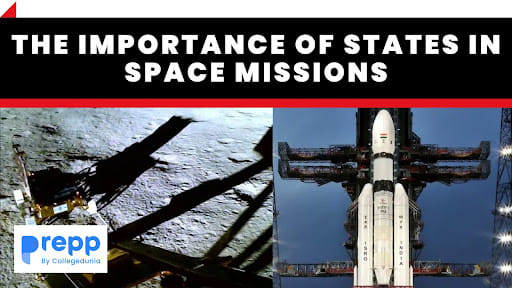
- Recently, with the successful landing of Chandrayaan-3 on the surface of the Moon, India marked its entry as the fourth country to achieve this significant feat.
- Notably, India's achievement stands out as it becomes the first and only nation to accomplish a lunar landing at the challenging South Pole region. This article delves into the pivotal factors that facilitated India's remarkable accomplishment while also addressing the challenges that were overcome in the process.
Table of Contents
What factors allow for resource-constrained economies to pull off ambitious programs?
- The USSR, with an economy 50%-60% the size of the U.S. in the 1960s, successfully landed Luna 9 on the moon.
- China achieved a moon landing with only 22% of the U.S. per capita income in 2013.
- India, with a per capita income at 10.9% of the U.S. in 2022, showcased that relative resource limitations do not always hinder ambitious scientific achievements.
- Human resources: China, India, and the U.S. have been the world’s most populous nations since the 1970s. Russia ranked in the top four in the 1970s.
- The large numbers of potential scientists and engineers in these nations have played a pivotal role in propelling their achievements in space exploration, despite economic disparities with developed nations.
- Investments in science and technology: China, Russia, and India placed a lot of importance on science and technology in their post-war/post-colonial development trajectory. Their current successes are the results of those initial investments.
- For instance, China filed the most patents in the world in 2019.
Importance of States in Space Mission
- Limitations of the Private Sector: Current global crises reveal the private sector's limitations in addressing them independently. Therefore, a true partnership is essential, with active state involvement fostering innovation.
- Role of state: The economist Mariana Mazzucatto, in her book Mission Economy, studies the role of the U.S. government and NASA in coordinating the activities of different actors and organizations, private and public, in order to achieve the Apollo moon landings.
- Triple Helix Model: In 2020, UAE launched the Hope probe with Japan's help, becoming fifth alongside Russia, the U.S., China, and India to reach Mars.
- In 2022, Omran Sharif, leader of the Emirates Mars Mission, highlighted the potency of the "triple helix model." This model fosters collaboration between the government, private sector, and academia, eliminating barriers to shared success.
Do such programs represent a diversion of resources and attention from the pressing needs of development?
- Double standards: The question primarily targets developing economies, questioning their ability to allocate resources for ambitious programs amid challenges like poverty.
- The documentary "Summer of Soul" showcased African-American participants' dissent during a 1969 Harlem music festival over Neil Armstrong's iconic moon landing. They highlighted pressing needs such as civic infrastructure and racism, asserting that the space program redirected resources and focus. Yet the Apollo missions are considered triumphs on the part of humanity.
- Missions contribution to human progress: The information acquired through these missions will contribute to human progress.
- For instance, ISRO's demonstration of its ability to launch satellites at relatively low costs
Conclusion
- India's space program, including missions to the moon and Mars, is often questioned in light of the country's poverty. However, the Indian Space Research Organisation (ISRO) argues that space research has numerous benefits, such as telecommunications, weather forecasting, GPS, and detecting water bodies and minerals.
- Additionally, even obscure research by ISRO can lead to useful products or processes, like robotic technology evolving into smart artificial limbs. ISRO's quest for sustained space habitation births numerous spinoff technologies enhancing daily life.
- Our successes in space show us the road map for navigating concerns on earth. An inclusive and secular state, committed to building the capacity required to ensure genuine human development, is the need of the hour.
(*Click this link to read prelims specific weekly current affairs articles)
FAQs
Question: What is Mars Orbiter Mission (MOM)?
Answer:
The Mars Orbiter Mission (MOM), commonly referred to as Mangalyaan-1, is a space probe launched by the Indian Space Research Organization (ISRO) on November 5, 2013. The indigenously-built space probe, which is India's first interplanetary mission, has been in the Martian orbit since September 24, 2014.
Question: What is Chandrayaan-3?
Answer:
Chandrayaan-3 is a follow-on mission to Chandrayaan-2 to demonstrate end-to-end capability in safe landing and roving on the lunar surface. It consists of Lander and Rover configuration. It will be launched by LVM3 from SDSC SHAR, Sriharikota. The propulsion module will carry the lander and rover configuration till 100 km lunar orbit.
Question: What are ISRO’s upcoming Mission?
Answer:
Aditya L1,NISAR, XPoSat, SPADEX, and Gaganyaan project. India is planning a mission to Venus, Shukrayaan I which was expected to be launched by 2024 but could be delayed due to lack of government approval.
UPSC Mains Practice Question:
|
MCQ
Question: Consider the following statements about the Mangalyaan mission launched by ISRO.
- It is also called the Mars Orbiter Mission
- It made India the second country to have a spacecraft orbit Mars after the USA.
- It made India the only country to be successful in making its spacecraft orbit Mars in its very first attempt
Which of the statement(s) given above is/are correct? (UPSC CSE 2016)
(a) 1 only
(b) 2 and 3 only
(c) 1 and 3 only
(d) 1, 2 and 3
Answer: (c) See the Explanation
- India’s Mars Orbiter Mission is also known as the Mangalyaan Misson. Hence statement 1 is correct.
- It was launched in 2013 by ISRO to trace the presence of methane in Mars’ atmosphere.
- India became the fourth country to successfully send an orbiter mission to Mars after the U.S.A., Russia, and China. Hence statement 2 is incorrect.
- India became the only country to successfully complete an orbit of Mars on its first attempt. Hence statement 3 is correct.
Therefore, option (c) is the correct answer.
Download the PREPP App and attempt FREE IAS Exam Mock Tests and get complete study material!

Full Test - 04: UPSC CSE Prelims CSAT (Paper-II)
Full Test - 03: UPSC CSE Prelims CSAT (Paper-II)
UPSC CSE Prelims 2026 GS Paper 1 Question Paper (24-May-2026)
UPSC CSE Prelims 2026 CSAT Paper 2 Question Paper (24-May-2026)

17 February 2025 | The Hindu Must Read Articles | Current Affairs

16 February 2026 | The Hindu Must Read Articles | Current Affairs

13 February 2026 | The Hindu Must Read Articles | Current Affairs









Comments