ISRO Releases Graph Of Temperature Variation Of Topsoil In Lunar South Pole
Relevance: GS3 - Space Technology; Prelims
(Source: The Hindu, 08/28/2023)
Click here for Daily Current Affairs
Why in the news?
- India on August 23rd, 2023 scripted history as ISRO’s ambitious third Moon mission Chandrayaan-3’s Lander Module (LM) touched down on the lunar surface.
- India became the fourth country to successfully complete a landing on the moon and the first country to land on the south pole of the moon.
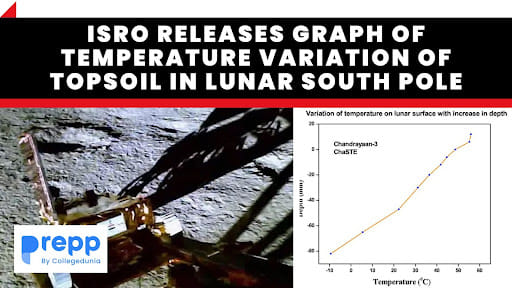
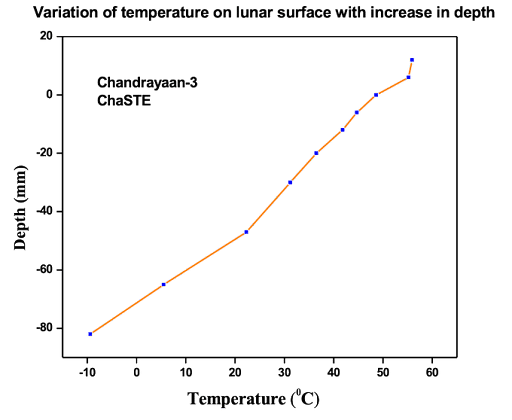
- Recently, ISRO unveiled a temperature-depth graph of the lunar surface, generated using data from the ChaSTE instrument, one of the payloads onboard Chandrayaan-3's Vikram lander module.
- The payload attached to the lander recorded the variation of temperature on the lunar surface with an increase in depth.
Table of Contents
What are the observations?
- The presented graph illustrates the temperature variations of the lunar surface/near-surface at various depths.
- The temperature on the moon is not constant, but rather varies near the surface and on the lunar surface, as recorded by the Vikram lander module.
- It was found that at a depth of 8 cm, the temperature was as low as (-) 10 degrees centigrade. With the gradual rise towards the surface, the temperature too could be seen rising.
- Above the surface, the graph showed a relative stagnancy in temperature between 50-60 degrees centigrade.
- This is the first such profile for the lunar south pole.
About ChaSTE Payload
- Chandra's Surface Thermophysical Experiment (ChaSTE) payload was attached to measure the thermal conductivity and temperature on the moon.
- ChaSTE measures the temperature profile of the lunar topsoil around the pole, to understand the thermal behaviour of the moon’s surface.
- Temperature Probe: It has a temperature probe equipped with a controlled penetration mechanism capable of reaching a depth of 10 cm beneath the surface. The probe is fitted with 10 individual temperature sensors.
- Developed by:
- The payload was developed by a team led by the Space Physics Laboratory (SPL), VSSC in collaboration with Physical Research Laboratory, Ahmedabad.
- Objective:
- The primary objective of ChaSTE is to perform in-situ measurements of thermal conductivity and temperature profile on the lunar surface to derive the vertical temperature gradient up to a depth of 100 mm at the site of landing.
- It provides thermophysical properties of a high latitude region on the Moon for the first time.
ISRO's Aditya-L1 Mission
|
(*Click this link to read prelims specific weekly current affairs articles)
FAQs
Question: What is Chandrayaan-3?
Answer:
Chandrayaan-3 is India's third lunar mission and the second attempt at achieving a soft landing on the moon's surface. Recently, India became the fourth country to successfully complete a landing on the moon and the first country to land on the south pole of the moon.
Question: What is the ChaSTE?
Answer:
The Chandra's Surface Thermophysical Experiment (ChaSTE) is an instrument mounted on the Vikram lander that helps in recording the lunar topsoil's temperature profile. The instrument is equipped with 10-high precision thermal sensors.
UPSC Mains Practice Question:
|
MCQ
Question: In the context of space technology, what is “Bhuvan”, recently in the news? (UPSC 2010)
(a) A mini satellite launched by ISRO for promoting the distance education in India
(b) The name given to the next Moon Impact Probe, for Chandrayaan-II
(c) A geoportal of ISRO with 3D imaging capabilities of India
(d) A space telescope developed by India
Answer: (c) See the Explanation
Bhuvan is a software application that lets users explore a 2D/3D representation of the Earth's surface. On August 12, 2009, ISRO released the beta version of Bhuvan, its web-based GIS tool. In comparison to other Virtual Globe Software, Bhuvan provides detailed imagery of Indian locations with spatial resolutions up to 1 metre.
Therefore, option (c) is the correct answer.
Download the PREPP App and attempt FREE IAS Exam Mock Tests and get complete study material!

Full Test - 04: UPSC CSE Prelims CSAT (Paper-II)
Full Test - 03: UPSC CSE Prelims CSAT (Paper-II)
UPSC CSE Prelims 2026 GS Paper 1 Question Paper (24-May-2026)
UPSC CSE Prelims 2026 CSAT Paper 2 Question Paper (24-May-2026)

17 February 2025 | The Hindu Must Read Articles | Current Affairs

16 February 2026 | The Hindu Must Read Articles | Current Affairs

13 February 2026 | The Hindu Must Read Articles | Current Affairs









Comments