Government Imposes Restrictions On Export Of Basmati Rice
(Source: The Hindu, 08/27/2023)
Click here for Daily Current Affairs
Why in the news?
- Recently, the Government of India prohibited the export of Basmati rice valued at less than $1,200 per metric tonne (MT).
- The Agricultural & Processed Food Products Export Development Authority (APEDA), which is the agency responsible for the regulation of the export of Basmati rice, has been directed to set up a committee to examine the variation in prices.
- According to the Union government, there has been a large variation in the contract price of exported Basmati with the lowest contract price being $359 per MT as compared to an average export price of $ 1214 per MT in August 2023.
Table of Contents
What has the government directed regarding Basmati exports?
- Ban: Exports of Basmati rice valued below $1200 per metric tonne have been prohibited.
- Directions to APEDA: The Agricultural & Processed Food Products Export Development Authority (APEDA) has been directed to only allow the registration of rice below the value of $1200/ tonne for the issue of Registration-cum-Allocation Certificates (RCAC).
- Contracts below $1200 per tonne are to be paused.
- A committee is to be set up by the Chairperson, APEDA, to examine contracts below $1200 per tonne in order to understand price variations and the use of this route for exports and submit its report within one month.
- APEDA must hold consultations with traders to sensitize them and discourage the export of non-Basmati white rice.
Similar moves
- In September 2022, the Centre had banned exports of broken rice.
- In August 2023, the Centre imposed a 20% export duty on par-boiled non-basmati rice.
Why has the Government banned exports of basmati?
- Prevent illegal shipments: The government has banned the export of basmati rice to prevent the illegal export of non-basmati white rice.
- Non-basmati white rice is being exported under the HS codes of basmati rice and par-boiled rice.
- The government banned the export of non-basmati white rice in July 2023 due to the rising domestic prices of rice.
- Control retail price: The move will increase domestic availability of rice which will lead to lower prices in the local market.
- The retail prices of rice have increased by 11.5% over the last year (July 2022-2023).
Indian Rice Exports
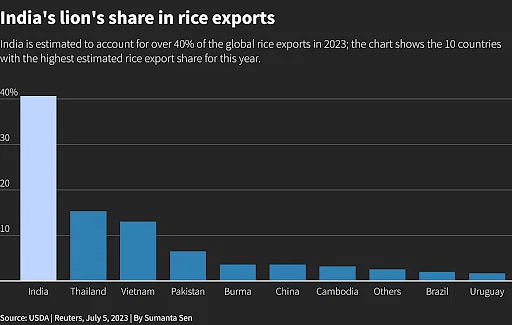
- India is the world's leading rice exporter, accounting for more than 40% of the global rice trade, as well as the second-largest producer after China.
- In 2022-23, India exported around 45.6 lakh tonnes of basmati rice valued at $4.8 billion.
- Major importers of Indian basmati are Iran, Iraq, Yemen, Saudi Arabia, the United Arab Emirates, and the United States.
APEDA
Structure of APEDAIt consists of a Chairman appointed by the Union Government, the Agricultural Marketing Advisor to the Government of India, two MPs elected by the Lok Sabha and one by the Rajya Sabha, one member representing the Niti Aayog, and other members appointed by the Government of India. |
(*Click this link to read prelims specific weekly current affairs articles)
FAQs
Question: What are HS codes?
Answer:
Harmonised System, or simply 'HS’ is a six-digit identification code developed by the World Customs Organization (WCO). The first two denote the HS Chapter, the next two give the HS heading, and the last two give the HS subheading. It is also known as the universal economic language for goods and helps in the systematic classification of goods globally.
Question: What is the ICAR?
Answer:
The Indian Council of Agricultural Research (ICAR) is a registered society under the Societies Registration Act, 1860. It is an autonomous organization under the Department of Agricultural Research and Education (DARE), Ministry of Agriculture and Farmers Welfare, Government of India. It is the apex body for coordinating, guiding, and managing research and education in agriculture including horticulture, fisheries, and animal sciences in the entire country.
MCQs
Question: According to India’s National Policy on Biofuels, which of the following can be used as raw materials for the production of biofuels? (UPSC CSE 2020)
- Cassava
- Damaged wheat grains
- Groundnut seeds
- Horse gram
- Rotten potatoes
- Sugar beet
Select the correct answer using the code given below:
(a) 1, 2, 5 and 6 only
(b) 1, 3, 4 and 6 only
(c) 2, 3, 4 and 5 only
(d) 1, 2, 3, 4, 5 and 6
Answer: (a) See the Explanation
- Under the National Policy on Biofuels, 2018, ethanol can be produced from damaged food grains like wheat, broken rice, etc., which are unfit for human consumption.
- Food commodities such as sugarcane juice, sugar beet, sweet sorghum, starch-containing materials like corn, and cassava, and damaged food grains like wheat, broken rice, and rotten potatoes can be used for ethanol production.
- Groundnut seeds and horse gram are not permitted. Hence, 1, 2, 5, and 6 are correct.
Therefore, option (a) is the correct answer
Question: Which of the following factors/policies affected the price of rice in India in the recent past?
- Minimum Support Price
- Government’s trading
- Government’s stockpiling
- Consumer subsidies
Select the correct answer using the code given below: (UPSC CSE 2020)
(a) 1, 2 and 4 only
(b) 1, 3 and 4 only
(c) 2 and 3 only
(d) 1, 2, 3 and 4
Answer: (d) See the Explanation
- Minimum support prices directly affect the price of rice as it results in the diversion of stocks from the open market. Hence statement 1 is correct.
- The maintenance of buffer stocks by the FCI is a method used to control the prices of rice and wheat in India. Hence statement 3 is correct.
- The sale of wheat and rice through the Open Market Sale Scheme (OMSS) is done to check the inflationary trend in the prices of food grains. Hence statement 3 is correct.
- Through the National Food Security Act, poor families can access subsidized rice at prices much below the market rate Hence statement 4 is correct. Therefore, option (d) is the correct answer.
Download the PREPP App and attempt FREE IAS Exam Mock Tests and get complete study material!

Full Test - 04: UPSC CSE Prelims CSAT (Paper-II)
Full Test - 03: UPSC CSE Prelims CSAT (Paper-II)
UPSC CSE Prelims 2026 GS Paper 1 Question Paper (24-May-2026)
UPSC CSE Prelims 2026 CSAT Paper 2 Question Paper (24-May-2026)

17 February 2025 | The Hindu Must Read Articles | Current Affairs

16 February 2026 | The Hindu Must Read Articles | Current Affairs

13 February 2026 | The Hindu Must Read Articles | Current Affairs









Comments