The Indian Himalayan Region Needs Its Own EIA
Relevance: GS3 - Conservation, environmental pollution and degradation, environmental impact assessment. Disaster and disaster management.
(Source: The Hindu, 10/17/2023)
Click here for Daily Current Affairs
Why in the news?
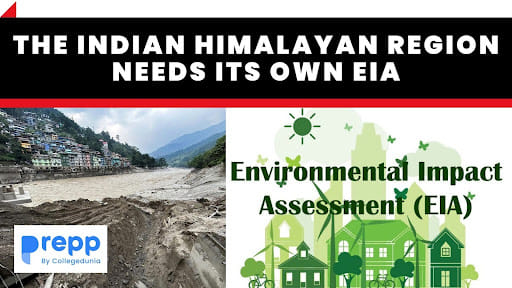
- Recently, a dam breach on the Teesta River occurred in Sikkim while floods and landslides have taken place in Himachal Pradesh, indicating the risks posed by the present development model on mountain ecosystems.
- This article discusses the need for an Environment Impact Assessment (EIA) for the region and the challenges associated with EIAs in India.
Table of Contents
What is the EIA?
- The Environment Impact Assessment (EIA) is a process established by the United Nations Environment Programme (UNEP) to evaluate the environmental, social, and economic consequences of large projects before their execution.
- The earliest instance of the EIA is the USA’s National Environment
- Policy Act (NEPA) 1969.
- As part of an EIA, various alternatives are compared, environmental impacts are predicted, and mitigation strategies are developed in the pre-planning stage itself.
- It is designed to find the most appropriate, relevant, and reliable information on the project being assessed so that decisions can be taken to reduce the adverse impacts.
- It can be a potent regulatory tool for advancing sustainable development across the world.
- However, the effectiveness of the EIA is reliant on comprehensive and accurate baseline data.
|
What are the historical perspectives of the EIA in India?
- In 1976-77, the Planning Commission directed the Department of Science and Technology to assess river valley projects from an environmental standpoint.
- This became the precursor to the EIA and was later extended to projects requiring approval from the Public Investment Board.
- The first EIA notification was promulgated under the Environment (Protection) Act 1986, by the Ministry of Environment, Forests, and Climate Change in 1994.
- This made Environmental Clearance (EC) mandatory for specific projects.
- Before this, environmental clearance was primarily an administrative decision by the central government.
- The 1994 notification was amended 12 times in 11 years before being replaced by the EIA 2006 notification.
Features of EIA 2006
- Decentralization: The EC process was decentralized with states permitted to issue EC in certain cases.
- Numerous amendments have been introduced to fine-tune the EC process.
- Procedural and Institutional framework: It lays down procedures and the institutional setup regarding the granting of environmental clearances.
- However, prior environment clearance is required only for projects listed in the schedule attached to the notification.
- As a result, many projects are exempted from the EIA process as they fall outside the scope of the notification.
- Categorization: Projects have been categorized as mining, extraction of natural resources and power generation, physical infrastructure, etc.
- However, the threshold limits for being included in the EIA are uniform across the country and do not take into account regional concerns.
What are the failings of the present approach?
- The graded approach adopted by India tailors risk management on the basis of the project’s location, i.e. risk management differs depending on whether the project is located in a protected forest, a reserved forest, a national park, or a critical tiger habitat.
- This approach aims to adopt regulations and environmental conditions in proportion to the value and sensitivity of the impacted habitat.
Differential standards of the Indian Himalayan Region
- The Indian Himalayan Region (IHR) is of immense ecological importance to the country as the water tower and provider of ecosystem services of the country.
- Despite its special needs, it is treated in a similar manner to any other part of the country.
- The inherent fragility of the Himalayas, and the increased exposure to extreme weather conditions, climate change, and seismic activity means that the absence of distinct environmental standards for the region is a significant oversight.
- This was evidenced by the occurrence of heavy rains, flash floods, and landslides in the region and the subsidence of Joshimath.
National Regulator and proactive assessment
- In the Lafarge Umiam Mining (P) Ltd.; T.N. Godavarman Thirumulpad vs Union of India cases, the Supreme Court has suggested the establishement of a national regulator.
- The regulator could provide independent, objective, and transparent appraisal of projects for ECs and ensure compliance with conditions.
- However, no such regulator has yet been established at the national level.
- At present, the EIA process reacts to development proposals rather than anticipating them.
- As a result, project proponents are favored due to their financing of the EIA.
Concerns associated with the EIA
- Exemptions: The exemptions in the EIA effectively does away with the need for green clearance.
- Time-consuming: The EIA process which is sometimes excessively focused on scientific investigation, takes time and causes project delays.
- Public participation: Public participation in the EIA implementation process and the compliance monitoring following the EIA has been found to be poor.
- Limited scope: Generally, biodiversity issues and cumulative impacts have been ignored in the EIA .
Way Forward
- Differentiated standards: There is an urgent need for differentiated standards that align with the region's ecological needs in order to mitigate the effects of the increasing frequency of disasters in the region.
- If this ecologically relevant model is adopted, the needs of the mountains could be addressed at all four stages of the EIA.
- Alternative tools: Alternative tools like strategic environmental assessment which account for the cumulative impact of development in a region must be adopted.
- Such an approach is especially relevant in areas with multiple projects such as the Himalayas as it will help in addressing the specific needs of the IHR and safeguard the ecological integrity of the Himalayas while ensuring sustainable development in the region.
- Himalaya-specific conditions: A clause about the IHR or mountains above a certain threshold altitude or characteristics can be included in the general conditions mandated for all projects.
To learn more about the EIA, click the link.
(*Click this link to read prelims specific weekly current affairs articles)
FAQs
Question: What are environmental clearances?
Answer:
Environmental clearance is the procedure to get clearance from the government for the installation and modification of certain projects. It is mandatory for 29 types of projects and is valid for 10 years for river projects, 30 years for mining projects and 7 years for other projects and activities.
Question: What projects require an EIA?
Answer:
EIAs are mandated for 39 different development projects moslty those in Schedule I. These include huge projects with clear environmental impacts, such crude oil refineries, nuclear power plants and further nuclear reactors.
UPSC Mains Practice Question:
|
MCQs
Question: Consider the following statements:
The Environment Protection Act, 1986 empowers the Government of India to
- state the requirement of public participation in the process of environmental protection, and the procedure and manner in which it is sought.
- Lay down the standards for emission or discharge of environmental pollutants from various sources
Which of the statements given above is/ are correct? (UPSC CSE 2019)
(a) 1 only
(b) 2 only
(c) Both 1 and 2
(d) Neither 1 nor 2
Answer: (b) See the Explanation
- The Environment Protection Act, 1986 does not mention the requirement of public participation. Hence statement 1 is incorrect.
- The EPA, 1986 empowers the Union government to lay down the standards for emission or discharge of environmental pollutants from various sources. Hence statement 2 is incorrect.
Therefore, option (b) is the correct answer.
Download the PREPP App and attempt FREE IAS Exam Mock Tests and get complete study material!

Full Test - 04: UPSC CSE Prelims CSAT (Paper-II)
Full Test - 03: UPSC CSE Prelims CSAT (Paper-II)
UPSC CSE Prelims 2026 GS Paper 1 Question Paper (24-May-2026)
UPSC CSE Prelims 2026 CSAT Paper 2 Question Paper (24-May-2026)

17 February 2025 | The Hindu Must Read Articles | Current Affairs

16 February 2026 | The Hindu Must Read Articles | Current Affairs

13 February 2026 | The Hindu Must Read Articles | Current Affairs









Comments