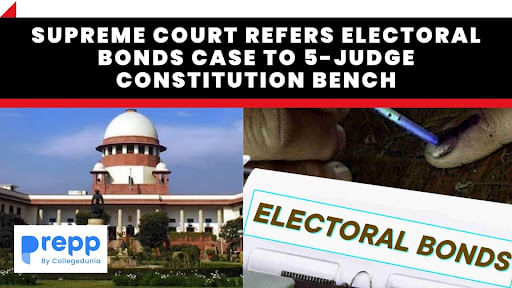
Supreme Court Refers Electoral Bonds Case To 5-Judge Constitution Bench
Relevance: GS2 - Government policies and interventions for development in various sectors and issues arising out of their design and implementation, Salient features of the Representation of People’s Act. Important aspects of governance, transparency and accountability, e-governance- applications, models, successes, limitations, and potential; citizens charters, transparency & accountability and institutional and other measures.
(Source: The Hindu, 10/17/2023)
Click here for Daily Current Affairs
Why in the news?
- Recently, the Chief Justice of India D.Y. Chandrachud referred the petition challenging the validity of the electoral bonds scheme to a five-judge Constitution Bench.
- The electoral bonds scheme has been challenged for facilitating anonymous donations to political parties.
Table of Contents
What did the Supreme Court state on the Electoral Bonds case?
- Five-judge bench: The Electoral Bonds validity case was referred to a five-judge Constitutional bench of the Supreme Court following a plea filed by the petitioner to refer the case to a larger bench from the previous three-judge bench.
- Hearing: The Court acknowledged the seriousness of the matter and stated that the first hearing would be on October 31st.
- Delays: The petitioner - NGO Association for Democratic Reforms - had asked the court to hear and decide the issue before the Lok Sabha election in 2024.
- The Court stated that it would not delay the formation of the bench as the case has been pending before the Supreme Court for the last eight years.
- Issues of focus: The Supreme Court agreed with the petitioner’s plea to focus on two issues concerning the violation of Articles 19, 14, and 2.
- Anonymity: Legalization of anonymous donations to political parties
- Right to know: Violation of citizens’ right to information about the funding of political parties, promoting corruption.
- However, the five-judge Bench may not consider the legal question related to the passage of the electoral bonds scheme as a Money Bill but wait for the verdict of the seven-judge Bench on the designation of a bill as a Money Bill.
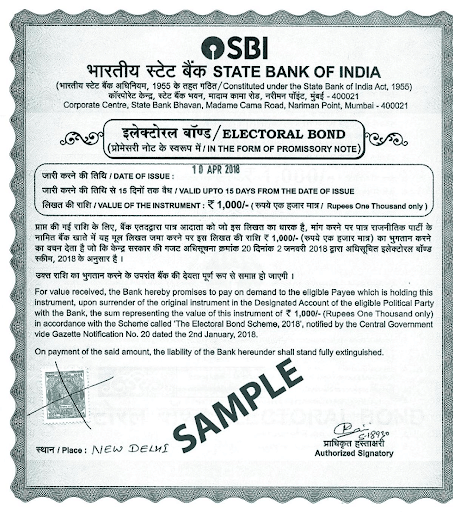
Progress in the electoral bonds case
- In 2017, the NGO Association for Democratic Reforms filed a petition on the alleged corruption and subversion of democracy through illicit and foreign funding of political parties and lack of transparency in the accounts of all political parties.
- In 2022, an interim application was filed seeking that the window for sale of electoral bonds not reopened before the assembly polls in West Bengal and Assam.
- According to the petitioners, electoral bond data for 2017-18 and 2018-19, revealed that the ruling party received more than 60% of total electoral bonds issued to date, exposing a significant disparity.
- In 2019, the Supreme Court directed political parties to furnish details of funds received through electoral bonds to the Election Commission in a sealed cover.
- In 2021, the Supreme Court refused to grant an interim stay on the scheme and sought the response of the Union government and the EC.
What are the arguments made by the petitioners?
- Anonymity of donations: The scheme had completely anonymized and sanitized political donations.
- As a result, the public lacked information about the donations to political parties.
- Amendments were introduced in the Companies Act to allow companies to obfuscate donations to political parties via the purchase of electoral bonds.
- Cap on donations: Amendments made via the Finance Acts of 2016 and 2017 which were both passed as Money Bills, enabled unlimited political donations via electoral bonds.
- The amendments removed the limits on campaign donations by companies and exempted donations from disclosure under the Representation of Peoples Act, 1951.
- This has enabled funding to political parties to be unchecked, anonymous, and unregulated.
- Foreign influence: The Finance Act, 2016 amended the Foreign Contribution Regulation Act, 2010 to allow foreign companies with Indian subsidiaries to fund Indian political parties.
- This has exposed Indian politics and democracy to international lobbyists and funds.
Electoral Bonds
Features
Advantages
Concerns
|
(*Click this link to read prelims specific weekly current affairs articles)
FAQs
Question: What is a Constitutional Bench?
Answer:
A constitution bench is a bench of the Supreme Court of India constituted by the Chief Justice of India to hear cases involving a substantial question of law as to the interpretation of the Constitution as per Article 145(3).
Question: Which parties can accept electoral bonds?
Answer:
Only political parties registered under Section 29A of the Representation of the People Act, 1951, and have secured not less than 1% of votes polled in the last general election to the Lok Sabha or Assembly election are eligible.
UPSC Mains Practice Question:
|
MCQs
Question: Hawala transactions relate to payments: (UPSC CSE 1996)
(a) received in rupees against overseas currencies and vice versa without going through the official channels
(b) received for sale/transfer of shares without going through the established stock exchanges
(c) received as commission for services rendered to overseas investors/buyers/sellers in assisting them to get over the red tape and/or in getting preferential treatment
(d) made to political parties or to individuals for meeting election expenses
Answer: (a) See the Explanation
- Hawala, meaning trust, is an illegal method of remittance across countries. There are money brokers who are the middlemen who undertake hawala transfers.
- This method of remittance does not involve the physical movement of cash and is also known as Hundi.
- It works outside the banking system and legal financial systems. The remittance happens based on communication between the hawala agents.
Therefore, option (a) is the correct answer.
Question: Consider the following statements about Electoral bonds.
- Electoral bonds are issued by the State Bank of India.
- It can be issued in multiples of ₹100, ₹1,000, ₹10,000, ₹ 1 lakh, ₹10 lakh, and ₹1 crore.
- They can be purchased only six months before an election to the Lok Sabha or state Assembly.
How many of the above statements is/are correct?
(a) Only 1 statement
(b) Only 2 statements
(c) All 3 statements
(d) None of the above
Answer: (a) See the Explanation
- Electoral bonds are issued and encashed by the State Bank of India. Hence statement 1 is correct.
- They are available in multiples of ₹ 1,000, ₹ 10,000, ₹ 1 lakh, ₹ 10 lakh, and ₹ 1 crore. ₹100 denominations are not available. Hence statement 2 is incorrect.
- They can be purchased within a 10-day window at the beginning of each quarter of the financial year and an additional Union government-designated term of 30 days during a Lok Sabha Election year. Hence statement 3 is incorrect.
Therefore, option (a) is the correct answer.
Download the PREPP App and attempt FREE IAS Exam Mock Tests and get complete study material!

Full Test - 04: UPSC CSE Prelims CSAT (Paper-II)
Full Test - 03: UPSC CSE Prelims CSAT (Paper-II)
UPSC CSE Prelims 2026 GS Paper 1 Question Paper (24-May-2026)
UPSC CSE Prelims 2026 CSAT Paper 2 Question Paper (24-May-2026)

17 February 2025 | The Hindu Must Read Articles | Current Affairs

16 February 2026 | The Hindu Must Read Articles | Current Affairs

13 February 2026 | The Hindu Must Read Articles | Current Affairs









Comments