Palliative Care, A Way To Reduce Financial Distress For People With Life Limiting Diseases
Relevance: GS2 - Issues Relating to Development and Management of Social Sector/Services relating to Health.
(Source: The Hindu, 10/17/2023)
Click here for Daily Current Affairs
Why in the news?
- This article is based on ‘Palliative care, a way to reduce financial distress for people with life limiting diseases,’ which was published in ‘The Hindu,’ on 10/17/2023.
- It has addressed the financial burden imposed by non-communicable diseases (NCDs) on Indian patients, highlighting the need for palliative care to alleviate this burden.
Table of Contents

Key Points
- It is estimated that nearly 5.5 crore people fall below the poverty line every year due to out-of-pocket healthcare expenditure.
- Out of these, 3.8 crore people become poor only because of the expenditure on medicines.
- India is witnessing a growing prevalence of non-communicable diseases, and a significant number of patients suffering from conditions such as cancer, cardiac disease, renal failure, or stroke will eventually progress to incurable stages.
What is Palliative Care?
- Palliative care is a form of medical care that prioritizes enhancing the quality of life for individuals with serious illnesses.
- It aims to alleviate suffering, identify excessive and ineffective medical treatments, and address physical, psychological, spiritual, and social needs in conditions such as heart failure, kidney failure, neurological diseases, and cancer, among others.
- According to WHO, each year an estimated 40 million people are in need of palliative care, 78% of whom live in low- and middle-income countries, and worldwide only about 14% of people who need palliative care currently receive it.
The Rising Cost of Health
- The rising cost of healthcare, especially for non-communicable diseases, is driving people into poverty. Lifelong treatment and health check-ups create "financial toxicity," including bankruptcy risk, reduced treatment satisfaction, delays in seeking care, and poor quality of life.
- Despite 1.35% of GDP allocated to government health services, patients bear most expenses, even in government hospitals due to travel costs, medicine purchases, and lost wages.
- A study in India revealed significant expenses: cancer patients spend ₹8,035 per outpatient visit and ₹39,085 per hospitalization, while outpatient visits for diabetes and hypertension cost ₹4,381 and ₹1,427, respectively.
- The financial burden often forces caregivers to sell assets and halt children's education, with over 65% of last-stage cancer patients facing impoverishment due to healthcare costs.
Status of Palliative Care in India
- Palliative care in India is primarily available in urban areas and at tertiary healthcare facilities. Only 1-2% of the estimated 7-10 million people in India who need palliative care have access to it.
- Status of NCDs in India: A study by Indian Council of Medical Research (ICMR) estimated that the proportion of deaths due to NCDs in India have increased from 37.9% in 1990 to 61.8% in 2016. According to WHO, over 60.46 lakh people died due to NCDs in India in 2019.
What are the Challenges?
- Lack of Awareness: There is a significant lack of awareness about palliative care among both healthcare workers and the general public in India. Many people equate palliative care with end-of-life care and are unaware of its holistic approach to improving the quality of life for patients with serious illnesses.
- Limited Insurance Coverage: Palliative care is not covered under most insurance schemes in India. This lack of coverage can create a financial burden on patients and their families, making it difficult for them to access these services.
- Inadequate Funding: Palliative care services in public health centers are often underfunded and not consistently supported. The lack of a reliable funding mechanism makes it challenging to provide these services consistently and plan for long-term sustainability.
- Unavailability in Public Health Centers: Despite its inclusion in the Ayushman Bharat program, the provision of palliative care services in primary and secondary health centers remains a distant reality. This lack of infrastructure and trained healthcare providers in these centers hinders access to palliative care.
- Private Healthcare Prioritization: The increasingly privatized Indian healthcare system tends to prioritize profit-generating specialties over palliative care, which is viewed as an expense-saving service. As a result, palliative care services are not widely available in the private sector.
- Training and Workforce Shortages: India faces a shortage of trained palliative care professionals, including doctors, nurses, and counselors. Addressing this gap is essential to providing quality palliative care services.
- Integration with Existing Healthcare Systems: Integrating palliative care into existing healthcare systems, especially in a country as diverse and large as India, presents logistical challenges. Coordinating care across different regions and healthcare facilities can be complex.
Significance of Palliative Care
- Enhancing Quality of Life: Palliative care focuses on enhancing the quality of life for individuals with life-limiting conditions such as cancer, end-stage kidney disease, and severe brain disorders. It distinguishes itself by addressing uncontrollable symptoms, reducing unnecessary medical interventions, and considering social and economic factors.
- Economic Benefits of Early Palliative Care: Early introduction of palliative care for advanced diseases has the potential to reduce healthcare costs by as much as 25%. Palliative care is administered through outpatient, inpatient, and home-based services, alleviating the financial burden of travel for home-bound patients.
- Holistic Approach: Palliative care not only attends to the physical well-being but also considers the social and economic aspects of patients and their families.
- Empowering Patients with Vocational Support: It incorporates vocational rehabilitation and social reintegration, offering opportunities for self-sufficiency and dignity. Vocational support, such as teaching basic skills or small-scale animal husbandry, helps patients generate income.
Palliative Care Program in India
- The National Programme for Prevention & Control of Cancer, Diabetes, Cardiovascular Diseases & Stroke (NPCDCS), now known as the National Programme for Prevention & Control of Non-Communicable Diseases (NP-NCD), focuses on chronic illnesses that contribute significantly to healthcare expenses.
- These diseases reach a stage where palliative care becomes more important than curative treatment.
- It was launched in 2010 to address the growing burden of noncommunicable diseases in the country, the program aimed to provide promotive, preventive, and curative healthcare services across all levels of care, from primary to tertiary institutions, ensuring a comprehensive approach to healthcare delivery.
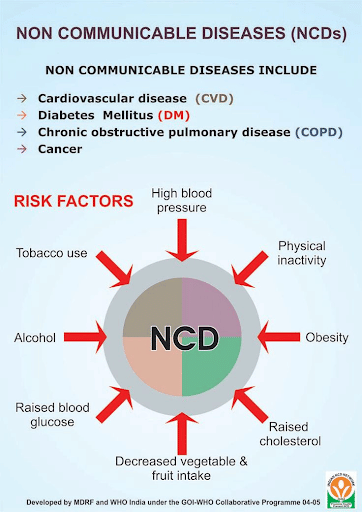
What are Noncommunicable diseases (NCDs)?
|
(*Click this link to read prelims specific weekly current affairs articles)
FAQs
Question: What is Palliative Care?
Answer:
Palliative care is explicitly recognized under the human right to health and it is a type of medical care that focuses on improving the quality of life for people with serious illnesses.
Question: What are Non-Communicable Diseases (NCDs)?
Answer:
Non-Communicable Diseases (NCDs) are chronic diseases that are not transmissible from one person to another. NCDs include a wide spectrum of medical disorders, both acute and chronic, like Cancers, Diabetes, Hypertension, Cardiovascular Diseases etc.
MCQs
Question: In the context of hereditary diseases, consider the following statements: (UPSC 2021)
- Passing on mitochondrial diseases from parent to child can be prevented by mitochondrial replacement therapy either before or after in vitro fertilization of the egg.
- A child inherits mitochondrial diseases entirely from mother and not from father.
Which of the statements given above is/are correct?
(a) 1 only
(b) 2 only
(c) Both 1 and 2
(d) Neither 1 nor 2
Answer: (c) See the Explanation
Mitochondrial replacement therapy (MRT) is an IVF technique that involves replacing a woman's defective mitochondrial DNA (mtDNA) with healthy donor mtDNA. Techniques used in MRT include spindle transfer (ST), pronuclear transfer (PNT), and polar body transfer (PBT). MRT can address maternal mitochondrial gene defects, as mitochondria are the only organelles, aside from the nucleus, that contain DNA and genes. Since sperm have a low number of mitochondria and mitochondrial genes, fathers with mitochondrial gene defects cannot pass the disease to their offspring.
Therefore, option (c) is the correct answer.
Download the PREPP App and attempt FREE IAS Exam Mock Tests and get complete study material!

Full Test - 04: UPSC CSE Prelims CSAT (Paper-II)
Full Test - 03: UPSC CSE Prelims CSAT (Paper-II)
UPSC CSE Prelims 2026 GS Paper 1 Question Paper (24-May-2026)
UPSC CSE Prelims 2026 CSAT Paper 2 Question Paper (24-May-2026)

17 February 2025 | The Hindu Must Read Articles | Current Affairs

16 February 2026 | The Hindu Must Read Articles | Current Affairs

13 February 2026 | The Hindu Must Read Articles | Current Affairs









Comments