Bengaluru’s Waste Management Plan
Relevance: GS3 - Conservation, Environment Pollution and Degradation
(Source: The Hindu, 10/17/2023)
Click here for Daily Current Affairs
Why in the news?
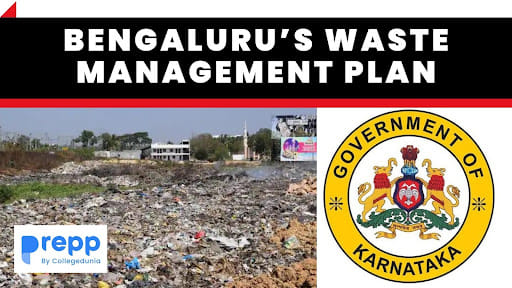
- This article mentions the case study about Waste Management Bengaluru City and the recent move of Karnataka Government considering the possibility of moving waste processing facilities currently located within Bengaluru to areas on the city's outskirts.
- According to a report by The Energy and Resources Institute (TERI), India generates over 62 million tons (MT) of waste in a year.
Table of Contents
What is the Status of Waste Management in India?
- Responsibility for Waste Management: The 2000 Municipal Solid Waste Management Handling Rules mandated that Urban Local Bodies (ULBs) are responsible for the collection, transportation, disposal, and segregation of solid waste in India.
- Waste Generation: India generates a significant amount of waste, with an annual total of 62 million tonnes. Of this, approximately 70% (43 million tonnes) is collected, but only 12 million tonnes are effectively treated, while the remaining 31 million tonnes are dumped in landfill sites.
- Rapid Urbanization and Growth: Due to changing consumption patterns and rapid economic growth, it is projected that urban municipal solid waste generation will rise to an estimated 165 million tonnes by 2030.
- Landfill Overload: Many of India's landfill sites have surpassed their capacity limits and height restrictions, with some exceeding 20 meters. These landfill sites occupy more than 10,000 hectares of urban land, leading to environmental and space-related concerns.
What are the Challenges to Waste Management in India?
- Population Growth: India is the second-most populous country in the world, and its population is still increasing. The sheer volume of waste generated puts immense pressure on waste management systems.
- Urbanization: Rapid urbanization leads to increased waste generation, particularly in cities. Many urban areas lack proper waste disposal facilities and are often overwhelmed by the amount of waste produced.
- Lack of Infrastructure: Inadequate waste management infrastructure, such as collection, transportation, and disposal facilities, is a significant issue. Many towns and cities lack proper waste collection systems and disposal sites.
- Waste Composition: The composition of waste is changing due to evolving consumption patterns. There's a growing volume of electronic waste (e-waste) and hazardous waste, which requires specialized handling.
- Regulatory Challenges: There are often gaps in waste management regulations, enforcement, and compliance. This leads to illegal dumping and improper waste handling.
- Land Scarcity: Finding suitable land for waste disposal sites is increasingly challenging due to land scarcity and urban sprawl. This can lead to overburdening existing landfill sites.
- Odor and Leachate Management: Odors often result from high moisture content during composting, and leachate issues can affect the environment and nearby communities.
What is Bengaluru’s Waste Management Plan?
Capacity of Existing Waste Processing Facilities in Bengaluru
|
What is the significance of Waste Management Plan in india?
- Environmental Protection: India is facing significant environmental challenges, including pollution of water bodies, soil, and air due to improper waste disposal. A waste management plan helps mitigate these issues by promoting responsible waste handling and disposal methods.
- Health and Sanitation: Proper waste management is crucial for public health and sanitation. Inadequate waste disposal can lead to the spread of diseases, pests, and contamination of water sources, which can have severe health consequences for the population.
- Resource Conservation: Waste management plans can include strategies for recycling and resource recovery. By recycling materials like paper, plastics, and metals, India can conserve valuable resources and reduce the need for virgin raw materials.
- Economic Benefits: An effective waste management plan can create economic opportunities through waste-to-energy projects, composting, and recycling initiatives. These projects can generate income and employment while reducing waste-related costs for municipalities.
- Sustainable Development: Sustainable waste management practices align with the goals of sustainable development by promoting responsible consumption and production (SDG 12), clean water and sanitation (SDG 6), and good health and well-being (SDG 3), among others.
- Urban Planning and Aesthetics: Proper waste management contributes to cleaner and more aesthetically pleasing urban environments. It enhances the quality of life for residents and visitors and promotes tourism and economic development in cities.
- Long-term Sustainability: Developing a comprehensive waste management plan is an investment in the long-term sustainability of communities. It ensures that waste is managed in a way that doesn't harm the environment, public health, or the economy and helps prepare for future challenges in waste management.
Some Initiatives Related to Waste Management in India
- Solid Waste Management Rules 2016: These rules emphasize waste segregation, manufacturer responsibility for disposal, and user fees for waste collection and processing.
- Waste to Wealth Portal: A platform for technology development to convert waste into energy, recycle materials, and extract valuable resources.
- Waste to Energy: Plants that convert solid waste into electricity and heat for industrial use.
- Plastic Waste Management (PWM) Rules, 2016: Focus on reducing plastic waste generation, preventing littering, and ensuring segregated storage at the source.
- Plastic Waste Management (Amendment) Rules, 2022: Specifies responsibilities of manufacturers, importers, retailers, and consumers for proper plastic waste management.
- Project REPLAN: It aims to create carry bags by mixing processed plastic waste with cotton fiber rags.
- The Swachh Bharat Mission, which has led to a significant increase in the number of toilets and the coverage of door-to-door waste collection.
(*Click this link to read prelims specific weekly current affairs articles)
FAQs
Question: What is Waste Management?
Answer:
Waste management or Waste disposal is all the activities and actions required to manage waste from its inception to its final disposal. This includes amongst other things, collection, transport, treatment and disposal of waste together with monitoring and regulation.
Question: What is Karnataka’s recent waste management plan?
Answer:
The Karnataka Government is currently considering the possibility of moving waste processing facilities currently located within Bengaluru to areas on the city's outskirts.
Question: What is Project Replan?
Answer:
Project RePLAN (REducing PLastic in Nature) was launched in 2018 in line with the ‘Swachh Bharat Abhiyaan’. Its primary objective is to remove the existing waste plastic material from nature and use it in a semi-permanent manner.
UPSC Mains Practice Question:
|
MCQs
Question: In the context of solving pollution problems, what is/are the advantage/ advantages of bioremediation techniques? (UPSC 2017)
- It is a technique for cleaning up pollution by enhancing the same biodegradation process that occurs in nature.
- Any contaminant with heavy metals such as cadmium and lead can be readily and completely treated by bioremediation using microorganisms.
- Genetic engineering can be used to create microorganisms specifically designed for bioremediation.
Select the correct answer using the code given below:
(a) 1 only
(b) 2 and 3 only
(c) 1 and 3 only
(d) 1, 2 and 3
Answer: (c) See the Explanation
- Utilising naturally existing organisms, bioremediation transforms harmful compounds into less toxic or non-toxic forms. It breaks down organic pollutants in soil, groundwater, sludge, and solids using microorganisms.
- By accelerating the natural biodegradation process, the bioremediation approach removes contaminants from the environment. Hence, statement 1 is correct.
- The use of microorganisms in bioremediation makes not all pollutants easily treatable. For instance, bacteria are not easily able to absorb or ingest heavy metals like lead and cadmium.
- Only biodegradable substances can be cleaned up by bioremediation. Hence, statement 2 is incorrect.
- Utilising microorganisms, mostly bacteria and fungus, to transform environmental pollutants into less hazardous forms is known as bioremediation.
- Microorganisms created by genetic engineering can be employed for bioremediation. Hence, statement 3 is correct.
Therefore, option (c) is the correct answer.
Question: As per the Solid Waste Management Rules, 2016 in India, which one of the following statements is correct? (UPSC 2019)
(a) Waste generator has to segregate waste into five categories.
(b) The Rules are applicable to notified urban local bodies, notified towns and all industrial townships only.
(c) The Rules provide for exact and elaborate criteria for the identification of sites for landfills and waste processing facilities.
(d) It is mandatory on the part of the waste generator that the waste generated in one district cannot be moved to another district.
Answer: (c) See the Explanation
The Solid Waste Management Rules 2016 mandate the establishment of waste processing facilities for local bodies with a population of 1 million or more within two years. For census towns below 1 million population, common or standalone sanitary landfills must be set up by local bodies with a population of 0.5 million or more within three years. The rules provide detailed criteria for identifying landfill sites and waste processing facilities.
Therefore, option (c) is the correct answer.
Download the PREPP App and attempt FREE IAS Exam Mock Tests and get complete study material!

Full Test - 04: UPSC CSE Prelims CSAT (Paper-II)
Full Test - 03: UPSC CSE Prelims CSAT (Paper-II)
UPSC CSE Prelims 2026 GS Paper 1 Question Paper (24-May-2026)
UPSC CSE Prelims 2026 CSAT Paper 2 Question Paper (24-May-2026)

17 February 2025 | The Hindu Must Read Articles | Current Affairs

16 February 2026 | The Hindu Must Read Articles | Current Affairs

13 February 2026 | The Hindu Must Read Articles | Current Affairs









Comments