State Council of Ministers - State Executive - Indian Polity Notes
State Council of Ministers headed by the Chief Minister is the real executive authority in the political-administrative set up of a state under Part VI, Article 163 of the Constitution. It is constituted and function in the same manner as the council of ministers at the Centre. It is collectively responsible to the legislative assembly of the State. The UPSC Indian Polity and Governance Syllabus includes the State Council of Ministers which is described in this article.
Table of Contents

State Council of Ministers – Constitutional Provisions
| Article | Provisions |
|---|---|
| Article 163 |
|
| Article 164 |
|
| Article 166 |
|
| Article 167 | It shall be the duty of the Chief Minister of each State
|
| Article 177 |
|
Appointment to the State Council of ministers
- The Chief Minister is appointed by the governor.
- The other ministers are appointed by the governor on the advice of the chief minister.
- The governor can appoint only those persons as ministers who are recommended by the chief minister.
Removal
- Members of the state council of ministers can hold office during the pleasure of the governor, but the governor exercises his power on the recommendation of the chief minister.
|
“State Council of Ministers headed by the Chief Minister is the real executive authority in the political-administrative set up of a state under Part VI, Article 163 of the Constitution.” |
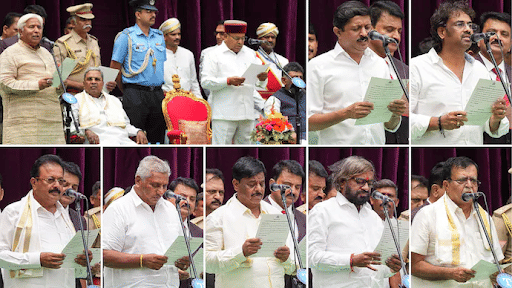
Composition of Council of Ministers
- The Constitution has not specified the size of the state council of ministers or ranking of the ministers.
- Analogous to centre, the state council of ministers consists of three categories of ministers ie. cabinet ministers, ministers of state, and deputy ministers.
- The distinction between them is found in their rankings, emoluments and political importance.
- The cabinet ministers are in charge of the major departments.
- The independent charge is normally assigned to ministers of state.
- Cabinet ministers are assisted by deputy ministers.
- Council of ministers may also include deputy chief minister.
Functions of the State Council Of Ministers
- Policy Formulation: The Council of Ministers is responsible for formulating and implementing policies and programs for the development and welfare of the state. This includes deciding on matters related to education, health, agriculture, infrastructure, and other key sectors.
- Administration: The Council of Ministers oversees the administration of the state government. It ensures that government departments and agencies function effectively and efficiently to deliver public services.
- Legislation: The Council of Ministers plays a crucial role in the legislative process. Ministers introduce bills and resolutions in the state legislature, participate in debates, and work towards passing laws that benefit the state and its citizens.
- Budget Management: Ministers are involved in preparing the budget, allocating funds to different sectors, and ensuring proper utilization of financial resources.
- Representation: Ministers represent the state government in various forums and meetings. They engage with central government authorities, other state governments, and international agencies on behalf of the state.
Nature of advice by Ministers
- Article 163 provides for the Council of Ministers with the Chief Minister at the head to aid and advise the Governor in the exercise of his functions except the discretionary ones.
- If a question arises whether a matter falls within the governor’s discretion or not, the decision of governor is final governor.
- Supreme Court has clarified that except in areas where the governor is to act in his discretion, the governor has to act on the aid and advice of the council of ministers in the exercise of his/her powers and functions
Types of Responsibilities
There are two types of responsibilities :
- Collective responsibility
- Individual responsibility
Collective Responsibility
- Article 164 clearly states the council of ministers is collectively responsible to the legislative assembly of the state.
- This means that all ministers have shared responsibility for all their actions of omission and commission
- They work as a team and sink or swim together.
- When the legislative assembly approves no-confidence motions against the council of ministers, all ministers, including those on the legislative council, are required to resign.
- The notion of collective responsibility also indicates that a cabinet decision binds all cabinet ministers (and other ministers), even if they deferred in cabinet.
- It is the responsibility of all ministers to support cabinet decisions both inside and outside the state legislature. A minister must resign if he disagrees with a cabinet decision.
Individual responsibility
- Individual accountability is likewise enshrined in Article 164. The ministers serve at the governor’s pleasure.
- This means that the governor can dismiss a minister even if the council of ministers has the legislative assembly's confidence. But, he can remove a minister only on the advice of the chief minister.
- In the event of a disagreement or unhappiness with a minister's performance, the chief minister may ask him to quit or advise the governor to remove him.
Conclusion
Overall, the State Council of Ministers is pivotal in the functioning of the state government, responsible for policy-making, administration, legislation, budgeting, and representing the state's interests in various forums.
FAQs
Q1: What is the State Council of Ministers?
Answer: The State Council of Ministers is a body of elected officials in a state government responsible for making decisions on various administrative matters. It aids the Chief Minister in the administration and governance of the state.
Q2: Who appoints the members of the State Council of Ministers?
Answer: The members of the State Council of Ministers are appointed by the Governor of the state, based on the advice of the Chief Minister. The council usually includes cabinet ministers, ministers of state, and deputy ministers.
Q3: What is the role of the Chief Minister in the State Council of Ministers?
Answer: The Chief Minister is the head of the State Council of Ministers and plays a pivotal role in decision-making, coordinating the activities of various ministers, and implementing government policies.
Q4: How does the State Council of Ministers function in the legislative process?
Answer: The State Council of Ministers plays a crucial role in the legislative process by proposing bills, formulating policies, and ensuring the implementation of laws passed by the state legislature. They also represent the government in the assembly.
Q5: What is the significance of the State Council of Ministers in Indian democracy?
Answer: The State Council of Ministers is significant in Indian democracy as it ensures the representation of elected officials in governance, helps in the execution of state policies, and acts as a link between the executive and the legislature.
MCQs
- Who is the head of the State Council of Ministers in a state?
a) Governor
b) Chief Minister
c) President
d) Speaker of the Assembly
Answer: (B) See the Explanation
- Which body appoints the members of the State Council of Ministers?
a) State Legislature
b) Chief Minister
c) Governor
d) Prime Minister
Answer: (C) See the Explanation
- What is the primary function of the State Council of Ministers?
a) Conduct elections
b) Formulate and implement policies
c) Draft the constitution
d) Manage the judiciary
Answer: (B) See the Explanation
- How many types of ministers can be part of the State Council of Ministers?
a) Two
b) Three
c) Four
d) Five
Answer: (B) See the Explanation
- What is the significance of the State Council of Ministers in the Indian political system?
a) It represents the judiciary.
b) It is responsible for foreign affairs.
c) It links the executive with the legislature.
d) It conducts local elections.
Answer: (C) See the Explanation
GS Mains Questions and Model Answers
Q1: Evaluate the role of the State Council of Ministers in the Indian political system.
Answer: The State Council of Ministers plays a crucial role in the Indian political system by acting as the executive body responsible for implementing government policies and administering the state. Comprising the Chief Minister and other ministers, this council is pivotal in decision-making and policy formulation. The council facilitates communication between the legislature and the executive, ensuring that the government's agenda is aligned with legislative intent. Additionally, the council is responsible for drafting bills, managing state budgets, and overseeing the functioning of various departments. Its effectiveness directly impacts governance and development at the state level, making it a vital component of India’s federal structure.
Q2: Discuss the powers and responsibilities of the Chief Minister within the State Council of Ministers.
Answer: The Chief Minister holds a central position in the State Council of Ministers, possessing significant powers and responsibilities. As the head of the council, the Chief Minister is responsible for convening meetings, setting the agenda, and ensuring collective decision-making. The Chief Minister also coordinates between different ministries, fostering collaboration to achieve the state government’s objectives. Additionally, they represent the state government in the legislative assembly, defending policies and addressing queries from opposition members. The Chief Minister’s ability to effectively manage the council influences governance and the successful implementation of policies, thereby impacting the overall development of the state.
Q3: Analyze the significance of the State Council of Ministers in ensuring accountability and transparency in state governance.
Answer: The State Council of Ministers is integral in promoting accountability and transparency in state governance. By being collectively responsible to the state legislature, the council ensures that ministers are answerable for their actions and decisions, thus fostering a culture of accountability. Regular sessions of the legislative assembly provide a platform for opposition members to question ministers about their departmental activities, budgets, and policies. This scrutiny is essential for democratic governance, as it compels ministers to maintain transparency in their functioning. Moreover, the council’s decisions and policies are subject to public debate and criticism, allowing citizens to engage in the democratic process and hold their elected representatives accountable.
Previous Year Questions on State Council of Ministers
1. UPSC CSE 2022
Question: Examine the structure and functions of the State Council of Ministers in India.
Answer: In responding to this question, candidates should outline the composition of the State Council of Ministers, detailing the roles of the Chief Minister and various types of ministers. The functions, including policy formulation and implementation, should be discussed to highlight the council's significance in state governance.
2. UPSC CSE 2021
Question: Discuss the relationship between the State Council of Ministers and the State Legislature.
Answer: Candidates are expected to analyze how the State Council of Ministers interacts with the State Legislature, focusing on accountability mechanisms, legislative responsibilities, and the impact of this relationship on governance. The answer should emphasize the council's role in representing the executive in the legislature and how it facilitates effective governance.
*email: contactus@prepp.in
Download the PREPP App and attempt FREE IAS Exam Mock Tests and get complete study material!

Full Test - 04: UPSC CSE Prelims CSAT (Paper-II)
Full Test - 03: UPSC CSE Prelims CSAT (Paper-II)
UPSC CSE Prelims 2026 GS Paper 1 Question Paper (24-May-2026)
UPSC CSE Prelims 2026 CSAT Paper 2 Question Paper (24-May-2026)

17 February 2025 | The Hindu Must Read Articles | Current Affairs

16 February 2026 | The Hindu Must Read Articles | Current Affairs

13 February 2026 | The Hindu Must Read Articles | Current Affairs









Comments