Seven-Judge Bench Agrees To Take A Call On Giving Money Bill Case Priority
Relevance: GS2 - Polity & Governance; Indian Constitution - historical underpinnings, evolution, features, amendments, significant provisions and basic structure
(Source: The Hindu, 10/13/2023)
Click here for Daily Current Affairs
Why in the news?
- Recently, the Chief Justice of India announced that a seven-judge bench will be constituted to address a series of pleas challenging the government’s use of the money bill route to enact certain key legislations.
- This decision is a response to increasing apprehensions regarding the legality and constitutional suitability of this legislative method.
- The constitutionality of three key legislations, including the Prevention of Money Laundering Act (PMLA) Amendments, will be examined afresh by the larger bench in the light of whether these laws qualified as a money bill.
Table of Contents
What are the challenged legislations?
- Prevention of Money Laundering Act (PMLA) Amendments: In July 2022, a three-judge bench, composed of Justices A. M. Khanwilkar, Dinesh Maheshwari, and CT Ravikumar, upheld the PMLA's extensive powers held by the Enforcement Directorate (ED). However, they left the validity of amendments introduced via the Money Bill route open for review by a larger Constitution bench. The Finance Acts passed in 2015, 2016, 2018, and 2019 introduced significant changes to the PMLA, raising concerns about the constitutionality of their passage.
- Aadhaar Act Challenge: In 2018, the Supreme Court, with a 4:1 majority, upheld the Aadhaar Act as a valid money bill under Article 110 of the Constitution. Justice Chandrachud dissented, calling it a "fraud on the Constitution" and "subterfuge." The government's argument was based on the distribution of subsidies from the Consolidated Fund of India to validate its classification as a Money Bill.
- Tribunal Reform: In the case of Roger Matthew vs. Union of India in November 2019, the Supreme Court addressed changes in the service conditions of tribunal members introduced as a money bill in the Finance Act, 2017. While a five-judge bench deemed the law unconstitutional for impinging on judicial independence, it referred the money bill aspect to a larger constitution bench. This move also raised questions about the correctness of the five-judge Constitution Bench's 2018 verdict upholding the Aadhaar Act as a money bill.
What is a Money Bill?
- Article 110 of the Constitution pertains to Money Bills. A Money Bill, as determined by the Speaker of the Lok Sabha, addresses matters related to taxation or the allocation of public funds, including the Consolidated Fund of India and the Contingency Fund of India.
- A money bill can only be introduced in the Lok Sabha, and the Speaker categorising a bill as a “money bill” means that it need not be passed by the Rajya Sabha.
- The union budget, for example, is a money bill.
- Other Examples: Salary, Allowances and Pension of Members of Parliament (Amendment) Bill 2020, Appropriation Bill 2021, Aadhaar and other laws (Amendment) Bill, 2019, The High Court and the Supreme Court Judges (Salaries and Condition of service) Amendment Bill 2017.
- Article 110 is similar to Section 1 of the Parliament Act, 1911, of the United Kingdom.
Rules for Money Bills in the Indian Parliament
- In India, most bills require approval from both the Lok Sabha and the Rajya Sabha to become law. However, there is a category of bills known as Money Bills that can only be introduced in the Lok Sabha.
- The Rajya Sabha does not have the authority to amend or reject Money Bills. It can only suggest amendments, but the final decision lies with the Lok Sabha.
- If there is a dispute regarding whether a bill qualifies as a Money Bill, the decision of the Lok Sabha Speaker is considered conclusive.
Criteria for a bill to be designated as a Money Bill
- The bill must pertain to the imposition, abolition, remission, alteration, or regulation of taxes.
- It should address the regulation of government borrowing or guarantees.
- The bill must concern the management of the Consolidated Fund or the Contingency Fund of India, encompassing deposits, withdrawals, or payments into these funds.
- It should involve the allocation of funds from the Consolidated Fund of India.
- The bill should declare specific expenditures as charges on the Consolidated Fund of India or the increasing of the amount of any such expenditure.
- The receipt of money on account of the Consolidated Fund of India or the public account of India or the custody or issue of such money.
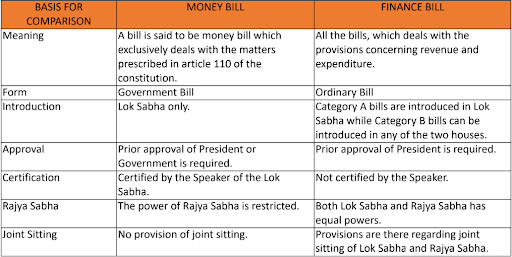
Comparison between Money Bill and Finance Bill
Conclusion
The Chief Justice's decision to convene a seven-judge bench indicates the significance and complexity of the legal questions surrounding these challenged legislations and the classification of money bills. The outcome of these cases will have far-reaching implications for the legislative process and the balance of power between the two houses of Parliament in India.
(*Click this link to read prelims specific weekly current affairs articles)
FAQs
Question: What is meant by money bill?
Answer:
A Money Bill means a Public Bill which in the opinion of the Speaker of the House of Commons contains only provisions dealing with all or any of the following subjects, namely, the imposition, repeal, remission, alteration, or regulation of taxation;
Question: In which house can a money bill be introduced?
Answer:
A Bill may be introduced in either House of Parliament. However, a Money Bill can not be introduced in Rajya Sabha. It can only be introduced in Lok Sabha with prior recommendation of the President for introduction in Lok Sabha.
Question: Is the budget a money bill?
Answer:
Budget is classified as a 'money Bill' by the Speaker of the Lok Sabha, as per Article 110 of the Constitution. It also means that the Rajya Sabha can only make non-binding recommendations for changes, and it does not have the power to veto it.
MCQ
Question: What will follow if the money bill is substantially amended by the Rajya Sabha? (UPSC 2013)
(a) The Lok Sabha may send the bill to the Rajya Sabha for reconsideration
(b) The Lok Sabha may still proceed with the bill, accepting or not accepting the recommendations of the Rajya Sabha
(c) The president may call a joint sitting for passing the Bill
(d) The Lok Sabha cannot consider the bill further
Answer: (b) See the Explanation
Without the recommendation of the President, the Money bill cannot be introduced in the Lok Sabha. The Rajya Sabha cannot introduce a Money Bill, nor can it reject or amend one that has already been passed by the Lok Sabha. After the Rajya Sabha returns a Money Bill within 14 days after receiving it, the Lok Sabha may accept any of its recommendations.
Therefore, option (b) is the correct answer.
Download the PREPP App and attempt FREE IAS Exam Mock Tests and get complete study material!

Full Test - 04: UPSC CSE Prelims CSAT (Paper-II)
Full Test - 03: UPSC CSE Prelims CSAT (Paper-II)
UPSC CSE Prelims 2026 GS Paper 1 Question Paper (24-May-2026)
UPSC CSE Prelims 2026 CSAT Paper 2 Question Paper (24-May-2026)

17 February 2025 | The Hindu Must Read Articles | Current Affairs

16 February 2026 | The Hindu Must Read Articles | Current Affairs

13 February 2026 | The Hindu Must Read Articles | Current Affairs









Comments