Migratory Birds Arrive In Odisha’s Chilika Before Winter; Is Climate Change To Blame?
Relevance: GS3 - Biodiversity & Conservation; Prelims
(Source: DTE, 10/11/2023)
Click here for Daily Current Affairs
Why in the news?
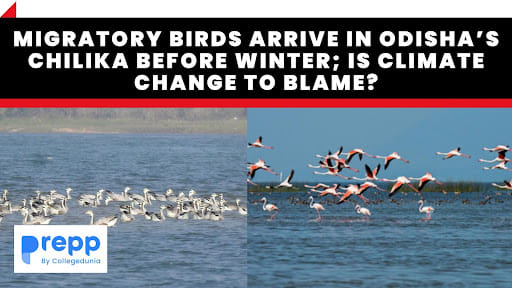
- Recently, migratory birds have begun their annual journey to Chilika, India's largest waterbird habitat in Odisha, in advance of winter this year.
- Approximately 50 migratory birds, including ducks and wigeon species, were spotted in the Nalabana bird sanctuary area within Chilika on October 7, 2023.
Table of Contents
Bird Migration to India
- Migratory birds at Chilika come from regions beyond the Himalayas in Northern Eurasia, including Siberia, Kazakhstan, and remote areas of Russia.
- In the last winter, as many as 1,131,929 birds of 184 different species had visited Chilika. This included 1,093,049 migratory birds from 105 various species and 38,859 resident birds belonging to 79 species.
- While in the previous year, the initial group of migratory birds was observed in the second week of October, when temperatures exceeded 30 degrees Celsius,
- This year they arrived even earlier, in the first week of October, with temperatures in the region and its vicinity ranging between 33°C and 35°C.
Factors influencing Bird Migration
- Natural Disaster Impact: Recent natural disasters in the Himalayan regions, such as the flash floods in Uttarakhand and Sikkim, have potentially disrupted the habitats of various bird species. The adverse effects of these calamities may have driven them to explore alternative locations, with Chilika emerging as a significant destination.
- Food Scarcity and Migration: Another crucial factor influencing bird migration is the availability of food in their native habitats. The scarcity of resources in their original surroundings has likely compelled these birds to embark on long and arduous journeys in search of suitable wetlands. Chilika, renowned for its rich biodiversity and abundant food sources, has become a preferred destination for these migrating birds.
- Climate change is causing significant alterations in weather patterns, which, in turn, have a profound impact on the migration patterns of various species, including birds, mammals, and even insects.
Why is Odisha's Chilika Lake a highly suitable habitat for Migratory Birds?
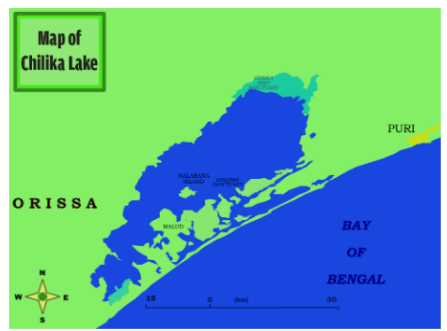
- Wetland Habitat: Chilika Lake is the largest coastal lagoon in India, covering approximately 1,100 square kilometers. It is a dynamic and diverse wetland habitat that includes shallow and deep areas, mudflats, reed beds, and open water. This diversity of habitats provides ample opportunities for various bird species to find suitable foraging and roosting sites.
- Mild Winter Climate: The lake is located in a region with a relatively mild winter climate compared to the birds' native habitats, such as Northern Eurasia, the Caspian region, Siberia, Kazakhstan, Lake Baikal, and remote areas of Russia and neighboring countries. The relatively warm winter temperatures in Odisha make it an attractive destination for migratory birds seeking to escape the colder weather in their native regions.
- Abundant Food Resources: Chilika Lake is rich in aquatic life, including fish, crustaceans, and various invertebrates, which serve as a vital food source for the migratory birds. The lake's ecosystem provides a consistent and abundant food supply for the birds throughout the winter, supporting their survival and energy requirements.
- Protected Environment: Chilika Lake and its surrounding areas are designated as a protected wildlife habitat, ensuring that the birds are safe from human disturbances, such as poaching. The local authorities implement stringent protection measures to prevent illegal activities that could harm the birds and their habitat.
- Geographic Location: Chilika Lake's geographic location, along the East Coast of India, makes it an essential stopover for migratory birds traveling along the East Asian-Australasian Flyway. It serves as a critical rest and refueling point for these birds during their long journeys.
About Chilika Lake
|
Measures for the Protection of Migratory Birds
- Inclusion in Schedule-I of the Wild Life (Protection) Act, 1972: Rare and endangered species of birds, including migratory birds, are listed in Schedule-I of this act, which provides them with the highest level of legal protection.
- Stringent Penalties: The Wild Life (Protection) Act, 1972 includes severe penalties for violations, discouraging activities that may harm migratory birds or their habitats.
- Designation of Protected Areas: Important bird habitats, including those used by migratory birds, are declared as Protected Areas under the Wild Life (Protection) Act. This designation aims to enhance conservation and safeguard the birds and their habitats.
- Financial and Technical Support: State and Union Territory governments receive financial and technical assistance for the protection and management of these Protected Areas, ensuring proper conservation measures are in place.
- Wildlife Crime Control Bureau: The establishment of the Wildlife Crime Control Bureau is focused on combating the illegal trade in wildlife and its products, which can negatively impact migratory birds through activities like poaching and smuggling.
- India has also launched the National Action Plan for the conservation of migratory species under the Central Asian Flyway as India is a party to Convention on Migratory Species (CMS).
(*Click this link to read prelims specific weekly current affairs articles)
FAQs
Question: What are Migratory Species?
Answer:
The term "migratory species" refers to any species or lower taxon of wild animals whose population, or any geographically distinct portion of its population, regularly and predictably crosses one or more national jurisdictional lines.
Question: What is Convention on the Conservation of Migratory Species (CMS)?
Answer:
The Convention on the Conservation of Migratory Species of Wild Animals, generally known as the Bonn Convention or CMS, is an intergovernmental agreement signed under the auspices of the United Nations Environment Programme.
Question: Where is Chilika Lake?
Answer:
Chilika Lake, the largest lagoon in Asia and the second-largest in the world, in the state of Odisha and is renowned for its ecological significance and natural beauty.
MCQ
Question: If you walk through the countryside, you are likely to see some birds stalking alongside the cattle to seize the insects disturbed by their movement through grasses.
Which of the following is/are such bird/birds? (UPSC 2014)
- Painted Stork
- Common Myna
- Black-necked Crane
Select the correct answer using the code given below.
(a) 1 and 2
(b) 2 only
(c) 2 and 3
(d) 3 only
Answer: (b) See the Explanation
- Common Myna: Common Myna, disturbed by grazing cattle, is an opportunistic feeder on insects. It is an omnivorous bird of open woods with a robust sense of territoriality. It has adapted to urban settings remarkably well.
- Painted Stork: Fish is the main source of food for the Painted Stork. The Painted Stork doesn't eat insects for food. Hence it is not the correct answer.
- Black-necked Crane: The Trans-Himalayan region is where one can find the Black-necked Crane. They can be found in and around Ladakh and Arunachal Pradesh. Therefore, it is unlikely to be found in all states and locations while strolling around the "countryside. This is also not the correct answer.
Therefore, option (b) is the correct answer.
Download the PREPP App and attempt FREE IAS Exam Mock Tests and get complete study material!
Live Test : UPSC IAS : GS - Modern History - Subject Knowledge Test

Live Test : UPSC CSE Prelims CSAT (Paper-II) (Oct 14 - 17)
Full Test - 04: UPSC CSE Prelims CSAT (Paper-II)
Full Test - 03: UPSC CSE Prelims CSAT (Paper-II)
UPSC CSE Prelims 2026 GS Paper 1 Question Paper (24-May-2026)
UPSC CSE Prelims 2026 CSAT Paper 2 Question Paper (24-May-2026)

17 February 2025 | The Hindu Must Read Articles | Current Affairs

16 February 2026 | The Hindu Must Read Articles | Current Affairs

13 February 2026 | The Hindu Must Read Articles | Current Affairs









Comments