India Ranks 111 Out Of 125 Countries In Global Hunger Index
Relevance: GS2 - Issues relating to poverty and hunger, Reports, and Indices in the news Prelims - Current events of national importance
(Source: The Hindu, 10/13/2023)
Why in the news?
- Recently, India was ranked 111th out of a total of 125 countries in the Global Hunger Index (GHI) 2023.
- This followed a global trend in which progress in combating hunger has stagnated since 2015.
- India has contested the ranking which it says is based on flawed methodology.
Table of Contents
How has India performed on the Global Hunger Index?
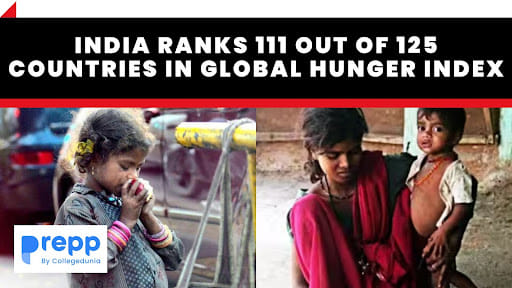
- Rank: India has been ranked 111th out of 125 placed in the 2023 Global Hunger Index.
- Score and severity: India scored 28.7 out of a total of 100 points and the severity of hunger in the country has been rated as “severe”.
- Child wasting: India’s child wasting rate of 18.7% is the highest recorded by the index.
- Undernourishment: The rate of undernourishment in India is 16.6%.
- Child mortality: The Index found the under-five mortality in India to be 3.1%.
- Anemia: In women between the ages of 15 and 24 years, the prevalence of anemia was 58.1%.
- Performance since 2015: Between 2000 and 2015, India’s score had improved from 38.4 to 29.2.
- However, since 2015, India’s GHI score has only improved by 0.5 points.
Global performance
- The 2023 GHI score for the world is 18.3 and has been classified as the “moderate” category.
- Best performers: Belarus, Bosnia & Herzegovina, Chile, China, and Croatia respectively occupied the top 5 places in the 2023 GHI.
- Europe and Central Asia scored 6.0 (low hunger) making it the best-performing region followed by East and Southeast Asia.
- Worst performers: South Asia and sub-Saharan Africa are the world regions with the highest hunger levels, each with a GHI score of 27 (serious hunger).
- Lesotho (35.5), the Dem. Rep. of the Congo (35.7), Yemen (39.9), Madagascar (41), and the Central African Republic (42.3) were the worst-performing countries.
- West Asia and North Africa have the third-highest hunger levels with a score of 11.9 (moderate).
- India’s Neighbors: Pakistan has been ranked 102nd, Bangladesh 81st, Nepal 69th, and Sri Lanka 60th in the index.
- Undernourishment: The share of the undernourished population has risen from 7.5% in 2017 to 9.2% in 2022, which accounts for around 735 million people.
Why has India contested the Index?
- Flawed methodology: According to the Union Ministry of Women and Child Development, the Index uses a flawed measure of hunger that does not accurately reflect India’s position.
- Discrepancies in data: According to the Poshan Tracker portal, the prevalence of child wasting is 7.2% among a total of 7.24 crore under-five-year-olds.
- However, the GHI uses a score of 18.7%, which has been obtained from NFHS-5 (2019-2021)after it was reported in the Joint Malnutrition Estimates Joint Data Set Including Survey Estimates, a global repository established to ensure harmonized child nutrition estimates.
- According to the GHI, it uses the same data sources for all countries to ensure that all the rates used have been produced using comparable methodologies and any exceptions would compromise the index.
- Telephone-based opinion poll: The MoWCD has alleged that the GHI uses a telephone-based opinion poll to calculate undernourishment.
- However, the GHI claims that undernourishment is calculated using data from India’s Food Balance Sheet.
- Sample size: Only a small sample size of 3,000 is used for the “Proportion of Undernourished Population” indicator against the crores of Indian people.
- Child mortality: India has also challenged the claim that child mortality is solely an outcome of hunger.
- Instead factors like poverty, inequality, and conflict all contribute to child mortality.
- Western bias: India and other critics have criticized the report for having a Western bias and being a tool of Western hegemony.
- Other reports like the World Banks’s Ease of Doing Business report have also been similarly criticized.
Why has the fight against hunger stagnated?
- According to the GHI 2023 report, the global fight against hunger has stagnated due to a number of overlapping crises.
- The global GHI score has improved only from 19.1 to 18.3 since 2015.
- Factors: COVID-19 pandemic, Russia-Ukraine war, economic stagnation, climate change, regional or domestic conflict.
- These factors have individually and combined exhausted the coping capacity of many countries and led to a cost of living crisis, which has diverted resources away from the fight against hunger.
Global Hunger Index
Indicators
|
(*Click this link to read prelims specific weekly current affairs articles)
FAQs
Question: What is the Poshan Tracker?
Answer:
Poshan Tracker is an application to provide a 360-degree view of the activities of the Anganwadi Centre. It was launched by the Ministry of Women and Child Development (MoWCD) for the dynamic identification of stunting, wasting, and under-weight prevalence among children and last-mile tracking of nutrition service delivery.
Question: What is the cost of living crisis?
Answer:
A ‘cost of living crisis’ refers to a fall in ‘real’ disposable incomes, which means the cost of everyday essentials like energy and food rises much faster than average household incomes. It is one of the primary reasons for hunger, as the cost of food rises above purchasing capacities.
Question: What is a food balance sheet?
Answer:
A food balance sheet provides a comprehensive picture of a country's food supply pattern over a specified time period. It specifies the source of the supply and how it is used in each food category.
UPSC Mains Practice Question:
|
MCQs
Question: Which of the following is/are the indicator/indicators used by IFPRI to compute the Global Hunger Index Report? (UPSC CSE 2016)
- Undernourishment
- Child stunting
- Child mortality.
Select the correct answer using the code given below.
(a) 1 only
(b) 2 and 3 only
(c) 1, 2 and 3
(d) 1 and 3 only
Answer: (c) See the Explanation
- The four Indicators used by the IFPRI to calculate the Global Hunger Index are undernourished population, wasting in Under 5 children; stunting in under 5 children; and under 5 mortality rate.
Therefore, option (c) is the correct answer.
Question: Which of the following are the objectives of the 'National Nutrition Mission'?
- To create awareness relating to malnutrition among pregnant women and lactating mothers.
- To reduce the incidence of anemia among young children, adolescent girls, and women.
- To promote the consumption of millets, coarse cereals, and unpolished rice.
- To promote the consumption of poultry eggs.
Select the correct answer using the code given below: (UPSC CSE 2017)
(a) 1 and 2 only
(b) 1, 2 and 3 only
(c) 1, 2 and 4 only
(d) 3 and 4 only
Answer: (a) See the Explanation
- National Nutrition Mission or Poshan Abhiyaan was implemented with the objectives of
- creating awareness about malnutrition in pregnant women and lactating mothers. Hence statement 1 is correct.
- reducing the incidence of anemia among young children, adolescent girls, and women. Hence statement 2 is correct.
- Improving maternal and child undernutrition in 200 high-burden districts.
- The objectives of the mission do not explicitly mention promoting the consumption of millets, coarse cereals, unpolished rice, and poultry eggs. Hence statements 3 and 4 are incorrect.
Therefore, option (a) is the correct answer.
Download the PREPP App and attempt FREE IAS Exam Mock Tests and get complete study material!
Live Test : UPSC IAS : GS - Modern History - Subject Knowledge Test

Live Test : UPSC CSE Prelims CSAT (Paper-II) (Oct 14 - 17)
Full Test - 04: UPSC CSE Prelims CSAT (Paper-II)
Full Test - 03: UPSC CSE Prelims CSAT (Paper-II)
UPSC CSE Prelims 2026 GS Paper 1 Question Paper (24-May-2026)
UPSC CSE Prelims 2026 CSAT Paper 2 Question Paper (24-May-2026)

17 February 2025 | The Hindu Must Read Articles | Current Affairs

16 February 2026 | The Hindu Must Read Articles | Current Affairs

13 February 2026 | The Hindu Must Read Articles | Current Affairs









Comments