India Reiterates Call For ‘Sovereign, Independent, Viable State Of Palestine’
(Source: The Hindu, 10/13/2023)
Click here for Daily Current Affairs
Why in the news?
- Recently, India reiterated its call for the creation of a sovereign Palestinian state.
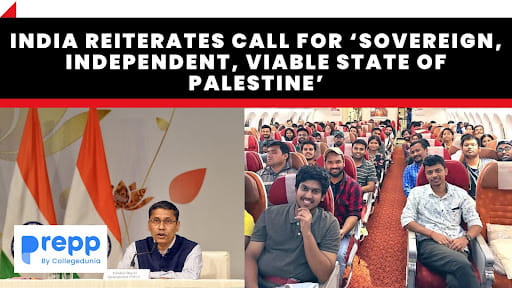
- India also announced Operation Ajay, the mission to rescue Indian citizens in Israel, was scheduled to begin on 12th October.
Table of Contents
What has the Indian External Affairs Minister said about the Israel-Palestine crisis?
- Palestine: India reiterated its long-standing demand for the creation of a sovereign, independent, and viable Palestine state with secure and recognized borders that could co-exist with Israel.
- There was no change in India’s long-standing and consistent position on Palestine.
- Hamas: According to India, the attacks on Israel by Hamas were a “terrorist attack”.
- India condemned terrorism and expressed solidarity with the Israeli people
- However, the MEA did not clarify whether it considered Hamas a terror organization as the classification of terror outfits was the responsibility of other departments.
- Humanitarian law: India emphasized the “universal obligation” to observe humanitarian law while also recognizing the need to fight against international terrorism.
Operation Ajay
- India’s humanitarian mission to repatriate its citizens from conflict-ridden Israel and Palestine via chartered flights has been named Operation Ajay.
- Presently, there are around 18,000 Indians in Israel, including a dozen in the West Bank, and at least four in the Gaza Strip.
- Additionally, there are around 85,000 Jews of Indian origin in Israel according to the Indian Embassy.
- The first flight from Israel as part of Operation Ajay is expected to evacuate around 230 passengers.
- India has also committed to using its Navy ships to repatriate its citizens if necessary.
India’s position on Palestine
- India's stance on the Israeli-Palestinian conflict has evolved over the years, with a consistent commitment to the "2-state solution" and the establishment of a sovereign, viable, and independent Palestinian state.
- India’s position is rooted in India's historical support for self-determination, influenced by its own struggle for independence.
- In the initial years after Independence, India opposed the UN's Partition Plan in 1947, drawing parallels with its own experience.
- The Indian political leadership actively supported the Palestinian cause and maintained limited diplomatic relations with Israel.
- India recognized Israel in 1950 but also became the first non-Arab country to recognize the Palestine Liberation Organization (PLO) as the sole representative of the Palestinian people.
- India's recognition of Palestinian statehood in 1988 further underscored its commitment to the Palestinian people.
- While India has maintained its historical moral support for Palestinian self-determination, its approach to Israel's treatment of Palestinians has undergone some dilution in recent years.
- In 2014, India supported a UN Human Rights Council (UNHRC) resolution to probe Israel's human rights violations in Gaza, though it abstained from voting against Israel in UNHRC in 2015.
- The abstention was partly due to concerns regarding the reference to the International Criminal Court (ICC).
- In 2018, India adopted the "Link West Policy," which de-hyphenated its relationship with Israel and Palestine and treated both nations as independent entities.
- This marked a shift towards engaging in military, economic, and strategic relations with Israel while maintaining its historical support for Palestinian self-determination.
- India continues to advocate for dialogue and diplomacy as the primary means of resolving the Israeli-Palestinian conflict.
Other important operations by India
| Operation | Year | Reason |
|---|---|---|
| Operation Poomalai | 1987 | Airdropping supplies to support Tamil Tigers in Jaffna |
| Kuwait Airlift | 1990 | India evacuated over 1,70,000 stranded citizens during the Iraqi invasion of Kuwait. |
| Operation Sukoon or Beirut Sealift | 2006 | Naval rescue mission during the Israel-Lebanon conflict. |
| Operation Safe Homecoming | 2011 | Evacuation of 15,400 Indian nationals from conflict-torn Libya. |
| Operation Maitri | 2015 | Joint relief and rescue operation following the Nepal earthquake, which repatriated over 5,000 Indians and other foreign nationals. |
| Operation Raahat | 2015 | Evacuation of around 5,600 people from Yemen |
| Operation Sankat Mochan | 2016 | Evacuation of Indian citizens from South Sudan. |
| Operation Insaniyat | 2017 | Assisted Myanmar refugees in Bangladesh with humanitarian aid. |
| Operation Nistar | 2018 | Evacuation of Indian nationals from Yemen's cyclone-hit Socotra island. |
| Operation Samudra Setu | 2020 | Repatriation of 3,992 Indian citizens during the COVID-19 pandemic. |
| Operation Vande Bharat | 2020 | Repatriation of Indians stranded overseas due to the pandemic. |
| Operation Devi Shakti | 2021 | Evacuation of Indians from Afghanistan following Taliban takeover. |
| Operation Ganga | 2022 | Repatriate Indians stranded in Ukraine |
| Operation Dost | 2023 | Search and rescue efforts after the earthquake in Syria and Turkey |
| Operation Kaveri | 2023 | Rescue Indians stranded in Sudan |
(*Click this link to read prelims specific weekly current affairs articles)
FAQs
Question: What is humanitarian law?
Answer:
International humanitarian law is a set of rules which aims to limit the effects of armed conflict for humanitarian reasons. It protects persons who are not or are no longer participating in the hostilities and restricts the means and methods of warfare.
Question: What is the Link West Policy?
Answer:
The Link West Policy was suggested by Prime Minister Narendra Modi at a Make in India Conference in 2014 with the aim of strengthening ties with its Western neighbors. It was proposed as a complement to the Act East Policy, which targeted East Asia. The "Link West" policy is mainly focused on the Middle-Eastern nations.
UPSC Mains Practice Question:
|
MCQs
Question: What was the purpose of Operation Sukoon launched by the Government of India? (UPSC CSE 2007)
(a) Helping Indonesia in its efforts to rehabilitate the victims of the earthquake in that country
(b) Evacuating the Indian Nationals from Lebanon during the conflict in the Middle East
(c) Assisting the United Nations in its efforts to help the civil war victims in the Darfur region of North Africa
(d) Providing a relief package to farmers after a spate of suicides by other farmers in Andhra Pradesh
Answer: (b) See the Explanation
Operation Sukoon was an operation launched by the Indian Navy to evacuate Indian, Sri Lankan, and Nepalese nationals, as well as Lebanese nationals with Indian spouses from the conflict zone during the 2006 Lebanon War.
Therefore, option (b) is the correct answer.
Question: The term "two-state solution" is sometimes mentioned in the news in the context of the affairs of (UPSC CSE 2018)
(a) China
(b) Israel
(c) Iraq
(d) Yemen
Answer: (b) See the Explanation
The two-state solution demands the creation of the Palestine state in the Gaza Strip and West Bank, alongside the state of Israel as a solution to the conflict in the region.
Therefore, option (b) is the correct answer.
Download the PREPP App and attempt FREE IAS Exam Mock Tests and get complete study material!
Live Test : UPSC IAS : GS - Modern History - Subject Knowledge Test

Live Test : UPSC CSE Prelims CSAT (Paper-II) (Oct 14 - 17)
Full Test - 04: UPSC CSE Prelims CSAT (Paper-II)
Full Test - 03: UPSC CSE Prelims CSAT (Paper-II)
UPSC CSE Prelims 2026 GS Paper 1 Question Paper (24-May-2026)
UPSC CSE Prelims 2026 CSAT Paper 2 Question Paper (24-May-2026)

17 February 2025 | The Hindu Must Read Articles | Current Affairs

16 February 2026 | The Hindu Must Read Articles | Current Affairs

13 February 2026 | The Hindu Must Read Articles | Current Affairs









Comments