NASA Finds Proof of Carbon, Water in Asteroid Bennu Samples
Relevance: Prelims, GS 3 Space, Science and Technology, OSIRIS-REx Mission, Space Technology and its applications, Space Research and Exploration, Asteroid Bennu, Achievements of NASA
(Source: Down to Earth, 12/10/2023)
Click here for Daily Current Affairs
Why in the news?
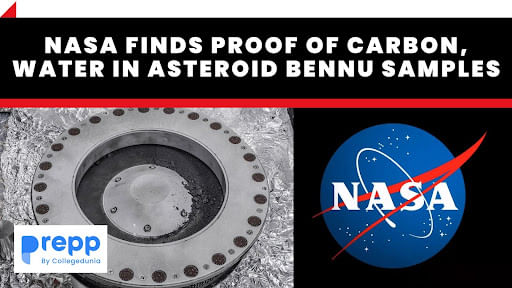
- Recently, NASA has announced that samples collected from the 4.5-billion-year-old asteroid Bennu may provide insights into the building blocks of life on Earth.
- Evidence of high-carbon content and water-bearing clay minerals has been shown by initial studies on the samples that were collected in space and were recently brought back to earth.
Table of Contents
About Asteroid Bennu
- Bennu is a small near-Earth asteroid that passes close to Earth every six years.
- A 4.5 billion-year-old remnant from the early days of our solar system, asteroid Bennu has seen it all.
- Bennu's current composition was developed within 10 million years after the birth of our solar system.
- Bennu is a roughly spheroidal asteroid, measuring about 500 meters in diameter. Its surface is covered in boulders, and it has a very dark appearance, suggesting a rich composition of carbonaceous materials.
- Studying such asteroids can provide insights into the conditions and materials present when the planets were forming.
- Furthermore, the carbon-rich nature of Bennu means it might contain organic molecules, which are of interest in studies of astrobiology and the origins of life.
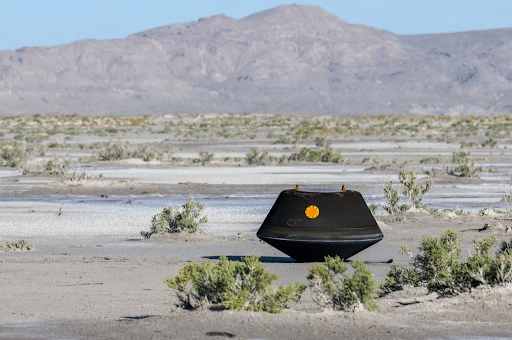
Sample return capsule from NASA's OSIRIS-REx Mission
OSIRIS-REx Mission
- NASA launched the OSIRIS-REx (Origins, Spectral Interpretation, Resource Identification, Security, Regolith Explorer) mission in 2016 to study Bennu in detail and return a sample to Earth.
- The spacecraft arrived at Bennu in 2018, spent several years surveying the asteroid, and successfully collected a sample from its surface in 2020.
- The spacecraft returned to Earth on September 24, 2023, to deliver Bennu samples. After sample delivery, it continued its journey to explore asteroid Apophis.
- The mission aimed to better understand the asteroid's composition, structure, and potential resources, as well as to refine predictions about its future orbit and any potential Earth impact risk.
- Additionally, the returned samples will give scientists the opportunity to study pristine material from the early solar system, which could yield insights into its formation and evolution, as well as the origins of life.
Details on the Collected Sample
- The objective was to collect 60 grams, but the actual sample weight is around 250 grams.
- Initial analysis included scanning electron microscope images, infrared measurements, X-ray diffraction, and chemical element analysis.
- Computed topography was used to create a 3D computer model of a particle, which revealed abundant carbon and water evidence.
Significance of the Collected Sample
- Pristine Solar System Material: The material from Bennu is believed to be a relic from the early solar system, largely unaltered for over 4.5 billion years. Analyzing this sample can offer a window into the conditions and processes present during the early stages of our solar system's formation.
- Origins of Life: Carbonaceous asteroids like Bennu are thought to contain organic molecules. By studying the sample, scientists can gain insights into the types and distribution of organic compounds present. This could shed light on the availability of the building blocks of life and potentially the origins of life on Earth.
- Planetary Defense: Understanding the composition of asteroids is crucial for planetary defense strategies. If humanity ever needs to deflect an asteroid on a collision course with Earth, knowledge about its composition can inform the techniques used.
- Resource Utilization: As space agencies and private entities consider future deep space missions, asteroids are eyed as potential sources of resources. Knowing the composition of asteroids can help in determining their potential for mining resources, be it water (for life support and fuel) or valuable metals.
- Understanding Surface Regolith: The physical properties of the asteroid regolith, such as its cohesiveness, granularity, and behavior in microgravity, have implications for future missions that might land on or interact with asteroid surfaces.
- Collaborative Analysis: The samples from Bennu will not only be studied by NASA but will be shared with international partners and researchers worldwide.
Important Space Missions Targeting Asteroids and Comets
| Mission Name | Agency | Target | Key Achievements |
|---|---|---|---|
| Hayabusa (MUSES-C) | JAXA | Asteroid Itokawa | First controlled landing on an asteroid, returned samples in 2010 |
| Hayabusa2 | JAXA | Asteroid Ryugu | Collected and returned samples in December 2020 |
| Stardust | NASA | Comet Wild 2 | Returned samples of comet dust to Earth in 2006 |
| Rosetta | ESA | Comet 67P/Churyumov–Gerasimenko | Deployed Philae lander onto comet in 2014 |
| Deep Space 1 | NASA | Comet Borrelly (after asteroid Braille) | Technology demonstration, successful flybys |
| Deep Impact | NASA | Comet Tempel 1 | Launched projectile into comet, flyby of Comet Hartley 2 |
| NEAR Shoemaker | NASA | Asteroid Eros | First spacecraft to orbit and land on an asteroid in 2001 |
| Giotto | ESA | Comet Halley | Conducted a flyby in 1986, provided close-up images |
| DART (Future Mission) | NASA | Moonlet of Didymos system | Will test kinetic impactor technique for planetary defense |
Conclusion
The collection and analysis of samples from asteroid Bennu offer a unique opportunity to understand the early solar system and potentially the origins of life on Earth. With the successful return of a substantial sample by OSIRIS-REx, NASA continues its tradition of pioneering space exploration and research, building on the legacy of past sample-gathering missions.
(*Click this link to read prelims specific weekly current affairs articles)
FAQs
Question: What is Asteroid Bennu?
Answer:
Bennu is a small near-Earth asteroid that passes close to Earth every six years. A 4.5 billion-year-old remnant from the early days of our solar system, asteroid Bennu has seen it all. According to scientists, Bennu's current composition was developed within 10 million years after the birth of our solar system.
Question: What is OSIRIS-REx Mission?
Answer:
OSIRIS-REx, or the Origins, Spectral Interpretation, Resource Identification, and Security-Regolith Explorer, is the first United States mission to collect a sample from an asteroid. The mission aims to understand the origins of life and the nature of asteroids by examining the samples from asteroid Bennu, which serves as a time capsule from the earliest days of our solar system.
Question: What is Hayabusa2?
Answer:
The Japanese state space agency JAXA is in charge of the Hayabusa2 asteroid sample-return mission. It is the successor mission to the Hayabusa mission, which returned the first asteroid samples in June 2010. Hayabusa2 is a Japanese spacecraft that examined the asteroid Ryugu, took samples, and returned them to Earth for study. The spacecraft is on a long-duration mission to the asteroid 1998 KY26.
UPSC Mains Practice Question:
|
MCQs
Question: Consider the following statements about asteroid Bennu:
- It passes close to Earth every six years.
- It is a 2 billion-year-old relic of our solar system.
- Bennu's composition was established within 10 million years of the formation of our solar system.
- The material from Bennu can help answer questions about the origins of life.
How many of the above statements are incorrect?
(a) Only one
(b) Only two
(c) Only three
(d) All four
Answer: (a) See the Explanation
Bennu is a small near-Earth asteroid that passes close to Earth every six years. Hence, statement 1 is correct.
A 4.5 billion-year-old relic of our solar system's early days, asteroid Bennu has seen it all. Hence, statement 2 is incorrect.
Bennu’s current composition, according to scientists, was established within 10 million years of the formation of our solar system. Hence, statement 3 is correct.
The material collected from the asteroid acts as a time capsule from theearliest days of our solar systemand can help us answer big questions about the origins of life and the nature of asteroids. Hence, statement 4 is correct.
Therefore, option (a) is the correct answer.
Question: OSIRIS-REx spacecraft is going to study which of the following?
(a) A star
(b) A planet in our solar system
(c) An asteroid
(d) A planet outside our solar system
Answer: (c) See the Explanation
The OSIRIS-REx spacecraft was launched on September 8, 2016, with the mission to collect a sample from asteroid Bennu.
Therefore, option (c) is the correct answer.
Download the PREPP App and attempt FREE IAS Exam Mock Tests and get complete study material!

Full Test - 04: UPSC CSE Prelims CSAT (Paper-II)
Full Test - 03: UPSC CSE Prelims CSAT (Paper-II)
UPSC CSE Prelims 2026 GS Paper 1 Question Paper (24-May-2026)
UPSC CSE Prelims 2026 CSAT Paper 2 Question Paper (24-May-2026)

17 February 2025 | The Hindu Must Read Articles | Current Affairs

16 February 2026 | The Hindu Must Read Articles | Current Affairs

13 February 2026 | The Hindu Must Read Articles | Current Affairs









Comments