Sendai Framework for Disaster Risk Reduction - Environment Notes
The Sendai Framework for Disaster Risk Reduction is an international agreement adopted at the third UN World Conference on Disaster Risk Reduction on March 18, 2015, in Sendai, Japan. It focuses on adopting disaster risk measures. The 3 dimensions of these measures are exposure to hazards, vulnerability & capacity, and the nature of the hazard. The Sendai Framework aims to significantly reduce disaster risk and losses to people's lives, livelihoods, & health and to the economic, physical, social, cultural, and environmental assets of individuals, enterprises, communities, and nations in the following 15 years. The topic “Sendai Framework for Disaster Risk Reduction ” is an important part of the UPSC/IAS Exam 2023 Disaster Management syllabus which is discussed in this article in detail.
Table of Contents
What exactly is the Sendai Framework for Disaster Risk Reduction?
- The Sendai Framework for Disaster Risk Reduction is an international agreement adopted at the third UN World Conference on Disaster Risk Reduction on March 18, 2015, in Sendai, Japan.
- This framework is a 15-year, voluntary, non-binding agreement with the goal of assisting nations in lowering their disaster risk and increasing their capacity to face disasters.
- It includes both natural and man-made hazards and disaster risk reduction into policies and plans for sustainable development.
- This framework’s implementation is monitored by Sendai Framework Monitor. It tracks progress towards global goals of lowering disaster deaths, affected populations, economic losses, and damage caused to critical structures.
- This oversight provides accountability and directs nations' efforts to reach the established goals.
| Other Relevant Links | |
|---|---|
| India's GreenHouse Gas Emissions | Net Zero Pledges |
| Karakoram Anomaly | HPCL - Cow Dung to Compressed Biogas Project |
| Triple Planetary Crisis | Arctic Amplification |
| CO2 Equivalent | Carbon Dioxide Levels -Keeling Curve |
| Updated NDCs | Panchamrit |
| UNEP Production Gap Report | UN World Water Conference |
| Global Alliance for Industry Decarbonisation | Green Coal |
4 Key Areas of Sendai Framework
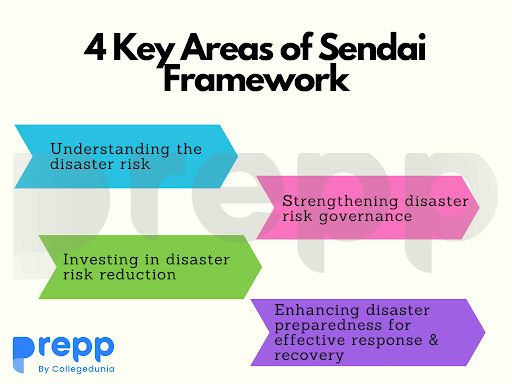
The four key priority areas of action under the Sendai Framework are as follows
Understanding disaster risk
Understanding disaster risk involves upgrading early warning systems, risk assessments, and gathering and analysis of disaster-related data. It emphasizes how crucial it is to spread knowledge and information about the risk of disaster.
Strengthening disaster risk governance
This area focuses on the importance of strong leadership, coordination, and collaboration among various parties involved in disaster risk reduction, including governments, local governments, and communities. It encourages disaster risk reduction in all levels of policies, plans, and programs.
Investing in disaster risk reduction
This priority area highlights the importance of funding initiatives that mitigate and avoid the risk of disaster, such as infrastructure development, training, research, and innovation. It promotes allocating funds for disaster risk reduction and putting in place financial tools for resilience-building.
Enhancing disaster preparedness for effective response and recovery
Enhancing preparedness strategies, emergency response skills, and the recovery and rehabilitation of disaster-affected communities are all part of this. It encourages the establishment of regional and local disaster risk reduction strategies as well as the participation of vulnerable populations in preparation and response activities.
7 Global Targets of Sendai Framework
The seven global targets of the Sendai Framework are
Global Target A
Reduce global disaster mortality: The goal is to significantly lower the number of deaths brought on by disasters, with an emphasis on vulnerable groups.
Global Target B
Reduce the number of affected people: The objective is to lower the number of impacted individuals, including those who are displaced, hurt, or in need of immediate help.
Global Target C
Reduce direct economic losses: The goal is to significantly minimise the economic impacts of disasters by reducing the direct economic losses they produce as a percentage of the world's gross domestic product (GDP).
Global Target D
Reduce critical infrastructure damage from disasters and the disruption of essential services: The emphasis is on avoiding and minimizing damage to vital infrastructure, including hospitals, schools, and transit systems, as well as minimizing delays to crucial services during catastrophes.
Global Target E
Increase the number of countries with national and local disaster risk reduction strategies: This objective promotes the development and application of regional and local disaster risk reduction strategies, ensuring that nations have elaborate plans in place to deal with disaster hazards.
Global Target F
Strengthen international cooperation with developing countries: In order to support developing nations in their attempts to improve their capacity for disaster risk reduction through financial, technical, and technological assistance, this aim emphasizes the need for expanded international cooperation.
Global Target G
Significantly expand the accessibility to and availability of multi-hazard early warning systems: To enable quick and efficient steps to lower the risk of disaster, it is important to increase the accessibility and availability of early warning systems for diverse hazards, including meteorological, hydrological, and geological concerns.
Significance of Sendai Framework for Disaster Risk Reduction
- The Sendai Framework for Disaster Risk Reduction provides a standard global framework and recommendations for addressing disaster risk reduction and resilience, ensuring a coordinated strategy to handle the difficulties brought on by disasters.
- It advocates a multi-hazard strategy to improve overall resilience and acknowledges the need to manage both natural and man-made risks.
- Instead of only responding and recovering, the framework focuses a heavy emphasis on preventive and proactive approaches.
- It emphasises the value of comprehending and evaluating disaster risks, supporting early warning systems, and putting safety measures in place to lessen vulnerabilities and exposure to hazards.
- The Sendai Framework recognizes that vulnerable populations, including women, children, the elderly, and people with disabilities, are disproportionately affected by disasters.
- The SDGs and the 2030 Agenda for Sustainable Development are closely tied with the Sendai Framework.
- It promotes the incorporation of risk reduction into development plans and policies by highlighting the connections between disaster risk reduction and sustainable development.
- In order to increase global resilience, it promotes information, resource, and technological exchange between nations.
Conclusion
In conclusion, the Sendai Framework for Disaster Risk Reduction is a landmark international agreement that provides nations and stakeholders a road map for reducing disaster risk and boosting resilience. It emphasizes the importance of understanding disaster risk, increasing governance, investing in risk reduction, and enhancing preparedness and response skills with its four main areas of action.
FAQs
Question. What are Tundra Forests?
Answer: Tundra forests are unique ecosystems characterized by their cold climate, lack of large trees, and dominance of low-growing vegetation such as mosses, lichens, and shrubs. These forests are typically found in the Arctic and alpine regions.
Question. What are the climatic conditions of the tundra region?
Answer: Tundra regions experience extremely cold temperatures, with long, harsh winters and short, cool summers. Precipitation is low, mostly in the form of snow, and the subsoil remains permanently frozen, known as permafrost.
Question. Why are trees absent in Tundra Forests?
Answer: The absence of trees in tundra forests is due to the harsh climate, permafrost, and short growing seasons, which prevent the growth of deep-rooted and tall vegetation.
Question. What are the primary flora and fauna found in the tundra biome?
Answer: Tundra vegetation includes mosses, lichens, sedges, and dwarf shrubs, while the fauna consists of animals like Arctic foxes, polar bears, caribou, and migratory birds adapted to cold climates.
Question. Why are tundra forests ecologically significant?
Answer: Tundra forests play a crucial role in regulating the Earth's climate by acting as a carbon sink and influencing global temperatures. They also provide habitats for unique species adapted to extreme conditions.
MCQs
- Which of the following regions is characterized by tundra forests?
A) Sahara Desert
B) Amazon Rainforest
C) Arctic regions
D) Temperate grasslands
Answer: (C) See the Explanation
Tundra forests are found in the Arctic and alpine regions where the climate is extremely cold and harsh.
- What is the main reason for the absence of large trees in tundra forests?
A) Low soil fertility
B) High temperatures
C) Permafrost and short growing seasons
D) Excessive rainfall
Answer: (C) See the Explanation
The permanently frozen subsoil (permafrost) and short growing seasons prevent the growth of large, deep-rooted trees in tundra forests.
- Which of the following is a common plant species found in the tundra biome?
A) Pine trees
B) Mangroves
C) Mosses and lichens
D) Bamboo
Answer: (C) See the Explanation
Mosses and lichens dominate the tundra biome due to their ability to survive in cold, nutrient-poor conditions.
- What type of soil is typically found in tundra regions?
A) Lateritic soil
B) Black cotton soil
C) Frozen soil with permafrost
D) Sandy loam
Answer: (C) See the Explanation
The soil in tundra regions is frozen year-round (permafrost) and is not conducive to the growth of deep-rooted plants.
- What is one of the primary ecological roles of tundra forests?
A) Enhancing soil fertility
B) Acting as a carbon sink
C) Supporting tropical biodiversity
D) Regulating ocean currents
Answer: (B) See the Explanation
Tundra forests help regulate global temperatures by storing large amounts of carbon in their vegetation and soil.
GS Mains Questions and Model Answers
Q1. Discuss the characteristics and ecological significance of tundra forests.
Answer: Tundra forests are found in Arctic and alpine regions, characterized by extremely cold climates, permafrost, and low-growing vegetation such as mosses, lichens, and dwarf shrubs. These forests have long winters and short summers, with minimal precipitation. Ecologically, tundra forests act as carbon sinks, regulating global temperatures and mitigating climate change. They provide unique habitats for cold-adapted species and play a critical role in maintaining ecological balance. However, rising global temperatures threaten these fragile ecosystems by accelerating permafrost thawing, releasing stored carbon, and altering biodiversity.
Q2. Analyze the impact of climate change on tundra forests.
Answer: Climate change poses significant threats to tundra forests, primarily through rising temperatures that accelerate permafrost thawing. This process releases stored greenhouse gases like methane and carbon dioxide, exacerbating global warming. Additionally, changing temperatures disrupt the delicate balance of tundra ecosystems, leading to the migration or extinction of species adapted to cold climates. Increased vegetation growth due to warming alters the region's albedo, further contributing to warming. Protecting these ecosystems is essential for climate stability and biodiversity conservation.
Q3. Evaluate the role of tundra forests in global carbon sequestration.
Answer: Tundra forests play a vital role in global carbon sequestration by storing large amounts of carbon in their vegetation and frozen soils. The permafrost acts as a carbon reservoir, preventing the release of greenhouse gases into the atmosphere. However, with rising temperatures, permafrost is thawing, releasing significant amounts of stored carbon and methane, contributing to climate change. Strengthening global efforts to mitigate climate change is crucial to preserving the carbon storage capacity of tundra forests and maintaining their ecological functions.
Previous Year Questions on Tundra Forests
1. UPSC CSE (IAS) Prelims 2020
Question: What are the primary characteristics of the tundra biome?
Answer: The tundra biome is characterized by extremely cold climates, long winters, short summers, and permanently frozen subsoil called permafrost. It supports low-growing vegetation like mosses, lichens, and shrubs and is home to cold-adapted fauna such as Arctic foxes, polar bears, and migratory birds. Due to its harsh environment, the tundra plays a critical role in regulating global temperatures and acting as a carbon sink.
2. UPSC CSE (IAS) Mains 2019
Question: Analyze the importance of tundra forests in mitigating climate change.
Answer: Tundra forests significantly contribute to climate change mitigation by acting as carbon sinks, storing vast amounts of carbon in their vegetation and permafrost. They regulate global temperatures and provide a buffer against the rising levels of greenhouse gases. However, climate change-induced permafrost thawing is releasing stored carbon, creating a feedback loop that accelerates global warming. Preserving tundra forests through international climate agreements and promoting sustainable practices is essential for maintaining their ecological balance and mitigating climate impacts.
Download the PREPP App and attempt FREE IAS Exam Mock Tests and get complete study material!

Full Test - 04: UPSC CSE Prelims CSAT (Paper-II)
Full Test - 03: UPSC CSE Prelims CSAT (Paper-II)
UPSC CSE Prelims 2026 GS Paper 1 Question Paper (24-May-2026)
UPSC CSE Prelims 2026 CSAT Paper 2 Question Paper (24-May-2026)

17 February 2025 | The Hindu Must Read Articles | Current Affairs

16 February 2026 | The Hindu Must Read Articles | Current Affairs

13 February 2026 | The Hindu Must Read Articles | Current Affairs









Comments