Prohibition of Traffic in Human Beings and Forced Labour (Article 23) - Indian Polity Notes
Article 23 prohibits the trafficking of human beings, begar, and any similar form of forced labor. It also states that any contravention of this provision is punishable by the law. However, the Constitution also states that this article does not prevent the state to impose compulsory services for public purposes without any discrimination on certain grounds. This Article is a very important topic for the UPSC Exam as the issue of trafficking and forced labor is in news frequently.
Table of Contents
Constitutional Provisions
- Article 23 prohibits human trafficking, begar (forced labour), and other types of forced labour. Any violation of this article is an offence punishable by law. Both citizens and non-citizens have this right.
- It safeguards the individual not just against the State, but also against private individuals.
- The term "human trafficking" refers to the (a) selling and purchasing of men, women, and children as commodities; (b) immoral trafficking in women and children, including prostitution; (c) devadasis; and (d) slavery.
- The Immoral Traffic (Prevention) Act, 1956 was passed by Parliament to penalise these actions.
- Exploitation: It implies the misuse of others’ services by force and/or labour without payment which is prohibited by Article 23.
- Begar: Labour without payment is known as beggar. There were many marginalised communities in India who were forced to engage in manual and agricultural labour without any payment.
- Forced Labour: It is considered forced labour if the less-than-minimum wage is paid. Also, one cannot be forced to engage in labour against his/her will even if remuneration is given which is unconstitutional.
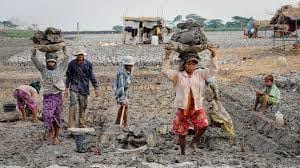
- Bonded labour: It is when a person is forced to offer services out of a loan/debt that cannot be repaid. ‘Bonded labour’ is declared unconstitutional in Article 23.
- This even covers slavery under it though it is not explicitly not mentioned in the constitution.
- Coercion: It is forcing landless persons into labour. This along with forcing helpless women into prostitution is unconstitutional.
- Trafficking: This involves the buying and selling of men and women for illegal and immoral activities.
- Article 23 protects citizens both from the State as well as the private citizens.
- The State must take punitive actions to protect its citizens from exploitation and forced labour.
- Clause 2 implies that compulsory services for public purposes (such as conscription to the armed forces) are not unconstitutional and the state can make use of it in exigent circumstances.
|
Article 23 states that: (1) Traffic in human beings and beggars and other similar forms of forced labor are prohibited and any contravention of this provision shall be an offense punishable in accordance with the law. (2) Nothing in this article shall prevent the State from imposing compulsory service for public purposes, and in imposing such service the State shall not make any discrimination on grounds only of religion, race, caste or class or any of them |
| Other Relevant Links | |
|---|---|
| Right to Privacy | Protection of Life and Personal Liberty |
| Right to Education (Article 21A) | Prohibition of Employment of Children in Factories, etc (article 24) |
|
“Article 23 prohibits trafficking in human beings, including trafficking for the purpose of forced labor, slavery, or exploitation.” |
Constituent Assembly Debates
- Prof. KT Shah argued that even ‘devadasi’ must be added to the specific mention of ‘begar’, however other members felt that the practice of devadasi is declining and ordinary legislation is sufficient to ban the practice.
- Sardar Bhopinder Singh had an opinion that the state must compensate adequately in case of compulsory service which was rejected.
Important Supreme Court Judgements
Bandhua Mukti Morcha v. Union of India, AIR 1984 SC 802.
- Bandhua Mukti Morcha was an organization working towards the eradication of Bonded Labour.
- They sent a letter to Justice Bhagwati and the Court treated it as a Public Interest Litigation and looked at the organization’s observations based on a survey it conducted of some stone quarries employing Bonded Labours.
- The Court established rules for determining bonded laborers and stated that it is the state government's responsibility to identify, release, and rehabilitate bonded laborers.
Dulal Samanta v. D.M., Howrah, AIR 1958 Cal. 365
- In this case, the petitioner was served with a notice appointing him as a special police officer for three months however he complained that this violated his fundamental right as it results in “forced labor”
- The Court disregarded his appeal and held that conscription for services of police cannot be considered as either begar, traffic, or forced labor.
Legislations to enforce this Article
Immoral Traffic (Prevention) Act, 1956
- This statute penalizes trafficking for commercial sexual exploitation.
- The act, which was originally known as the All India Suppression of Immoral Traffic Act (SITA), was altered to become the current law. The rules were designed to systematically criminalise various types of sex work in order to reduce and finally eliminate prostitution in India.
- Anyone participating in any stage of the chain of events, such as recruiting, transporting, transferring, harbouring, or receiving persons for the purpose of prostitution, is subject to prosecution.
Bonded Labour System (Abolition) Act, 1976
- The implementing authority to look into prevention and rehabilitation of Bonded labour was vested with the District Magistrate.
- It provided stricter punishment of up to 3 years for people rendering bonded labour.
- It establishes a district-level institutional structure in the shape of Vigilance Committees.
- Vigilance committees assist District Magistrate (DM) on how to appropriately apply the requirements of this legislation.
- For the trial of offences under this Act, the State Governments/UTs may delegate to an Executive Magistrate the powers of a Judicial Magistrate of the first or second class.
The Indian Penal Code
Sections 366(A) and 372 of the IPC, prohibit kidnapping and selling minors into prostitution respectively.
Conclusion
The practice of exploitation is widespread in India as the strong have always exploited the weak since ancient ages.In several parts of the country, "untouchables" have been exploited in various ways by upper castes and wealthier people. For example, many Bangladeshi and Nepali migrants are forced to work in India's brick kilns, carpet weaving, embroidery, and other industries. Therefore, it is of utmost importance that this type of exploitation must be eradicated.
FAQs
Question 1: What does Article 23 of the Indian Constitution prohibit?
Answer: Article 23 of the Indian Constitution prohibits traffic in human beings, begar (forced labour), and other similar forms of forced labour. It mandates that any contravention of this provision is an offense punishable by law.
Question 2: What are the key terms associated with Article 23?
Answer: Key terms under Article 23 include:
- Human Trafficking: Refers to the selling and purchasing of men, women, and children for exploitation.
- Begar: Refers to forced labour without payment.
- Bonded Labour: Refers to forced labour due to debt, which is unconstitutional.
Question 3: How does Article 23 protect citizens from forced labour?
Answer: Article 23 safeguards citizens from forced labour by making it unconstitutional. It protects individuals from being coerced into working without payment or under exploitative conditions, ensuring that no one can be forced into labour against their will.
Question 4: What exceptions exist under Article 23?
Answer: Article 23 allows for the imposition of compulsory services for public purposes, such as conscription during emergencies. However, the state must ensure no discrimination on the basis of religion, race, caste, or class.
Question 5: What laws enforce the provisions of Article 23?
Answer: Laws enforcing Article 23 include:
- Immoral Traffic (Prevention) Act, 1956: This law targets human trafficking.
- Bonded Labour System (Abolition) Act, 1976: This act addresses bonded labour and ensures the rehabilitation of bonded labourers.
MCQs
- What does Article 23 of the Indian Constitution prohibit?
A) Only human trafficking
B) Forced labour and trafficking
C) Discrimination in employment
D) Employment of children
Answer: (B) See the Explanation
Article 23 specifically prohibits traffic in human beings and forced labour, ensuring no one is forced into servitude or exploitation.
- What is "Begar" as per Article 23?
A) Forced marriage
B) Forced labour without payment
C) Bonded labour
D) Trafficking of minors
Answer: (B) See the Explanation
Begar refers to labour performed without any payment, often due to coercion, and is explicitly prohibited by Article 23.
- Which of the following is true regarding bonded labour under Article 23?
A) Bonded labour is legal in India if compensated
B) Bonded labour is abolished and unconstitutional
C) Bonded labour is restricted to certain industries
D) Bonded labour is permissible for public work
Answer: (B) See the Explanation
Bonded labour is unconstitutional under Article 23 and the Bonded Labour System (Abolition) Act, 1976.
- Which of the following is an exception to the prohibition of forced labour under Article 23?
A) Compulsory service for public purposes like military conscription
B) Voluntary unpaid internships
C) Labour for family members
D) All of the above
Answer: (A) See the Explanation
Article 23 allows the state to impose compulsory service for public purposes like military service, provided there is no discrimination.
- Which Act addresses human trafficking as per Article 23?
A) Immoral Traffic (Prevention) Act, 1956
B) Bonded Labour System (Abolition) Act, 1976
C) Indian Penal Code
D) Child Labour (Prohibition) Act, 1986
Answer: (A) See the Explanation
The Immoral Traffic (Prevention) Act, 1956 specifically addresses human trafficking and related offenses.
GS Mains Questions and Model Answers
Q1: Discuss the significance of Article 23 in protecting human rights in India.
Answer: Article 23 of the Indian Constitution plays a pivotal role in safeguarding human rights by prohibiting traffic in human beings and forced labour. Its significance includes:
- Protection Against Exploitation: It ensures that no individual can be forced to work against their will or under exploitative conditions, ensuring dignity and equality.
- Legal Framework: By making trafficking and forced labour punishable offenses, Article 23 provides a legal framework to combat human exploitation.
- Social Justice: The provision is essential for marginalized communities, who are vulnerable to exploitation in the form of begar or bonded labour.
- International Commitments: Article 23 aligns with global human rights standards, promoting India's commitment to eradicating modern slavery and human trafficking.
In conclusion, Article 23 is a fundamental human right that provides legal recourse for individuals subjected to exploitation, ensuring a fair and just society.
Q2: Evaluate the role of legislations in enforcing Article 23 of the Indian Constitution.
Answer: Several key legislations are crucial for enforcing Article 23 of the Indian Constitution:
- Immoral Traffic (Prevention) Act, 1956: This law specifically targets the trafficking of women and children for sexual exploitation, aiming to curb prostitution and trafficking networks.
- Bonded Labour System (Abolition) Act, 1976: This act seeks to eliminate bonded labour, which forces individuals to work to repay debts, and provides mechanisms for rehabilitation.
- Indian Penal Code (IPC): Provisions under sections 366(A) and 372 penalize the kidnapping and selling minors for prostitution, further strengthening the protections against human trafficking.
- Right to Education Act, 2009: The Act ensures free education for children, preventing forced child labour in the name of education.
These laws work together to create a robust framework for the protection of individual freedoms and to combat human trafficking, forced labour, and exploitation.
Q3: Analyze the challenges in eradicating forced labour and human trafficking in India despite Article 23 and its enforcement.
Answer: Despite the strong legal framework under Article 23 and several legislations, forced labour and human trafficking remain persistent challenges in India due to:
- Lack of Awareness: Many people, especially in rural areas, remain unaware of their rights, making them vulnerable to exploitation and forced labour.
- Weak Implementation: Although the laws are in place, the enforcement remains weak due to insufficient resources, lack of trained personnel, and corruption in some areas.
- Social and Economic Factors: Poverty, lack of education, and social inequality create an environment where exploitation can flourish. Vulnerable individuals are often coerced into forced labour or trafficked for economic survival.
- Cultural and Traditional Practices: Practices like devadasi and caste-based exploitation continue to perpetuate forms of forced labour and human trafficking despite legal prohibitions.
- Lack of Rehabilitation: Even when victims are rescued, there is often insufficient rehabilitation and support systems, leaving many victims vulnerable to being trafficked again or forced into labour.
Overcoming these challenges requires stronger implementation of laws, public awareness campaigns, and a holistic approach to poverty alleviation, education, and social reform.
Previous Year Questions on Prohibition of Traffic in Human Beings and Forced Labour
1. UPSC CSE 2020
Question: "What are the provisions under Article 23 of the Indian Constitution regarding human trafficking and forced labour?"
Answer: Article 23 prohibits human trafficking, forced labour, and begar. It makes such activities punishable under the law. However, it allows for compulsory services for public purposes, such as military conscription, as long as there is no discrimination.
2. UPSC CSE 2019
Question: "Discuss the impact of the Immoral Traffic (Prevention) Act, 1956, on addressing human trafficking in India."
Answer: The Immoral Traffic (Prevention) Act, 1956 has been crucial in combating human trafficking for commercial sexual exploitation. The Act penalizes various forms of trafficking, including prostitution, and provides a framework for rehabilitating victims, reducing the prevalence of sexual exploitation in India.
*email: contactus@prepp.in
Download the PREPP App and attempt FREE IAS Exam Mock Tests and get complete study material!
UPSC IAS : CSAT - Mini Live Test

Live Test : UPSC CSE Prelims CSAT (Paper-II) (Oct 20 - 23)
Full Test - 04: UPSC CSE Prelims CSAT (Paper-II)
Full Test - 03: UPSC CSE Prelims CSAT (Paper-II)
UPSC CSE Prelims 2026 GS Paper 1 Question Paper (24-May-2026)
UPSC CSE Prelims 2026 CSAT Paper 2 Question Paper (24-May-2026)

17 February 2025 | The Hindu Must Read Articles | Current Affairs

16 February 2026 | The Hindu Must Read Articles | Current Affairs

13 February 2026 | The Hindu Must Read Articles | Current Affairs









Comments