PM Modi Flags Off Country’s First Namo Bharat Train
Relevance: GS3 - Infrastructure: Railways, GS2 - Government policies and interventions for development in various sectors and issues arising out of their design and implementation.
(Source: The Hindu, 10/21/2023)
Click here for Daily Current Affairs
Why in the news?
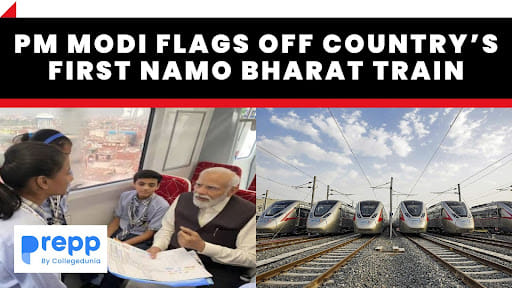
- Recently, Prime Minister Narendra Modi flagged off India’s first Regional Rapid Transport System, named the Namo Bharat train.
- It is a state-of-the-art regional mobility solution and is of a similar level as the best in the world.
Table of Contents
What is the Namo Bharat train?
- The Namo Bharat train is India’s first Regional Rapid Transport System (RRTS).
- It was earlier named RapidX by the National Capital Region Transport Corporation (NCRTC), which is implementing the project.
- It has been indigenously manufactured at a cost of more than ₹30,000 crores as a new rail-based, semi-high-speed, high-frequency commuter transit system.
- Aim: It is a regional development initiative that aims to provide intercity train commuting at a fifteen-minute frequency, rising to five minutes.
- Inspiration: A study conducted by the Indian Railways in 1998-99 identified RRTS as an option for connecting regions of the NCR via high-speed commuter trains.
- It was later adopted by the National Capital Region Planning Board NCRPB in its “Functional Plan on Transport for NCR-2032”.
- It has been modeled on systems such as the RER in Paris, Regional Express trains in Germany and Austria, and the SEPTA Regional Rail in the USA.
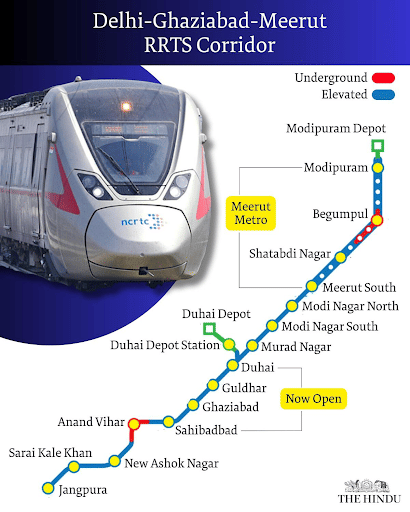
- Phase-I: Eight RRTS corridors have been identified for development in the National Capital Region of which the Delhi-Ghaziabad-Meerut; Delhi-Gurugram-SNB-Alwar; and Delhi-Panipat corridors have been prioritized in Phase-I.
- Status: The 17-km stretch from Sahibabad to Duhai Depot in Uttar Pradesh was inaugurated by the Prime Minister.
- The full 82-km Delhi-Ghaziabad-Meerut corridor is estimated to be functional by 2025.
- Integration with PM GatiShakti: As per the PM Gati Shakti National Master Plan, the RRTS network will have extensive multi-modal integration with the railway and metro stations, and bus services in the country.
- Expansion: The Prime Minister stated that the project will be expanded to connect parts of Delhi, Uttar Pradesh, Haryana, and Rajasthan.
- He also stated that similar systems will be developed in other parts of the country
Key features
- Capacity: The train is capable of holding 1700 passengers, including both sitting and standing.
- The train consists of six coaches with 72 seats in the normal coach and 62 seats in the premium coach.
- Facilities: Coaches in Namo Bharat are equipped with facilities such as Wi-Fi, CCTV cameras, emergency talkback buttons, information screens, charging ports, and storage areas.
- Disabled friendly: Wheelchairs and stretchers will be provided in the last car of the trains.
- Speed: The train has a design speed potential of 180 kmph and an operational speed potential of 160 kmph.
What is the significance of the RRTS?
- Sustainable development: It aims to improve connectivity and access across urban, industrial (SEZs/industrial parks), regional, and sub-regional centers in the NCR in order to ensure sustainable development.
- Multi-modal connectivity: The RRTS project aims to improve multi-modal connectivity in the NCR through existing transportation hubs.
- Build awareness on public transportation: It aims to encourage commuters to adopt public transportation which will help relieve the road/rail/metro congestion in the region.
- Boost to the economy: The project will open new commercial hubs along the NCR allowing those in the suburban regions to participate in economic activity in the capital without having to relocate.
- This will increase employment opportunities in the region as large companies would be attracted to the region by the high-quality infrastructure.
- Improved productivity: Shorter travel times will increase the overall economic productivity of the region and encourage the spread of economic activity across the adjoining regions as well.
- Better quality of life: The Prime Minister claimed that the Namo Bharat project would improve civic infrastructure, thereby ensuring a better quality of life for Indian citizens.
- Transit times of office goers would also drop, improving their familial bonds.
- Security for travelers: The RRTS would offer a safe, cost-effective, and timely option for working women to travel between their residences and their workplaces.
How does it differ from existing railway or metro systems in the country?
- Speed: The RRTS system is much faster than the existing metro or railway services in the country.
- It will operate at a speed of 160 km/hour as compared to the 100 km/hour to 120 km/hour of the Delhi Metro.
- Coverage: The RRTS train will cover relatively smaller distances than the Indian Railways and with a higher frequency.
- Comfort: The RRTS services are expected to provide relatively more comfort and facilities than the average Railways coach.
- This will allow it to compete with world-class services in the sector in other countries.
What else did the Prime Minister say about railways in India?
- The Prime Minister described the present decade as a decade of transformation of the Indian Railways.
- He stated that a trinity of projects - Amrit Bharat, Vande Bharat, and Namo Bharat - would lead to the modernization of the Indian railways.
- Amrit Bharat Station Scheme: It was launched in 2023 by the Union Ministry of Railways to redevelop 1309 stations across the country by providing modern passenger amenities, well-designed traffic circulation, inter-modal integration, and signage and designs based on local culture and heritage.
- Vande Bharat Scheme: It is an indigenously designed semi-high-speed, self-propelled train manufactured by the Integral Coach Factory (ICF), Chennai, as part of the ‘Make in India’ programme.
To learn more about the Vande Bharat, click the link.
What is the NCRTC?
|
(*Click this link to read prelims specific weekly current affairs articles)
FAQs
Question: What is the National Capital Region Planning Board?
Answer:
The National Capital Region Planning Board (NCRPB) is a statutory body under the Union Ministry of Housing and Urban Development. It was constituted by an Act of Parliament in 1985 and is responsible for developing policies to control land use and infrastructural development in the National Capital Region.
Question: What is the Gati Shakti Master plan?
Answer:
The Gati Shakti Master plan is a ₹100 lakh-crore project of the Government of India for developing holistic infrastructure and execution of infrastructure projects. It is a digital platform that connects 16 ministries including Roads and Highways, Railways, Shipping, Petroleum and Gas, Power, Telecom, Shipping, and Aviation. It will enable easier interconnectivity between road, rail, air, and waterways to reduce travel time and improve industrial productivity.
UPSC Mains Practice Question:
|
MCQs
Question: National HighwayCities connected (UPSC CSE 2014)
- NH 4: Chennai and Hyderabad
- NH 6: Mumbai and Kolkata
- NH 15: Ahmedabad and Jodhpur
Which of the above pairs is/are correctly matched?
(a) 1 and 2 only
(b) 3 only
(c) 1, 2 and 3
(d) None of the above
Answer: (d) See the Explanation
- National Highway 4 is the major highway in the Andaman and Nicobar Islands which connects Port Blair to Diglipur. Hence pair 1 is incorrect.
- National Highway 6 is from Surat in Gujarat to Kolkata in West Bengal. Hence pair 2 is incorrect.
- National Highway 15 connects Baihata in Assam with Wakro in Arunachal Pradesh. Hence pair 3 is incorrect.
Therefore, option (d) is the correct answer.
Question: Consider the following statements:
- Amrit Bharat Scheme has been launched by the Indian Railways to develop a semi-high-speed, high-frequency commuter transit system in the NCR.
- The National Capital Region Transport Corporation (NCRTC) is implementing the Regional Rapid Transit System in the NCR.
Which of the above statements is/are correct?
(a) 1 only
(b) 2 only
(c) 1 and 2
(d) None of the above
Answer: (b) See the Explanation
- Amrit Bharat Stations scheme aims to develop railway stations on a continuous basis with a long-term approach. Hence statement 1 is incorrect.
- The Namo Bharat train is the semi-high-speed, high-frequency commuter transit system in the NCR.
- The National Capital Region Transport Corporation (NCRTC) is implementing India's first semi-high-speed regional rail service project in the NCR. Hence statement 2 is correct.
Therefore, option (b) is the correct answer.
Download the PREPP App and attempt FREE IAS Exam Mock Tests and get complete study material!

Full Test - 04: UPSC CSE Prelims CSAT (Paper-II)
Full Test - 03: UPSC CSE Prelims CSAT (Paper-II)
UPSC CSE Prelims 2026 GS Paper 1 Question Paper (24-May-2026)
UPSC CSE Prelims 2026 CSAT Paper 2 Question Paper (24-May-2026)

17 February 2025 | The Hindu Must Read Articles | Current Affairs

16 February 2026 | The Hindu Must Read Articles | Current Affairs

13 February 2026 | The Hindu Must Read Articles | Current Affairs









Comments