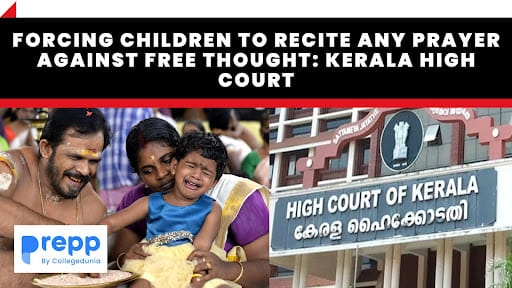
Forcing Children to Recite Any Prayer Against Free Thought: Kerala High Court
Primary Source: The Hindu
Click here for Daily Current Affairs
Prepp Prelims Booster: Fundamental Rights
Prepp Mains Booster: Fundamental Rights, Directive Principles of State Policy, Fundamental Duties, Constitutional rights of citizens
Why in the news?
- Recently, the Kerala High Court has ruled that forcing or persuading children to recite any prayer against their parents' preference during the Vidyarambham ceremony is against the principles of free thought and freedom of belief.
- The court discussed the matter while considering a petition against an application format issued by the Mattannur municipality's library committee.
Table of Contents
Context of the Case
- Justice Devan Ramachandran examined a writ petition that challenged the format of an application issued by the library committee of the Mattannur municipality in Kannur.
- The petition contended that the application format was constructed in a manner that could potentially humiliate certain sections of people.
- The application was related to the Vidyarambham ceremony, an event to introduce children to the world of letters.
What is Vidyarambham Ceremony?
|
What is a Writ Petition?
- A writ petition is a formal written request made to a court, asking it to issue a specific order, usually in the form of a writ.
- Writs are specific orders or directives that the court can issue under its special authority, usually to a government agency or official, directing them to do (or refrain from doing) a specific act.
- The Constitution of India provides for the issuance of different types of writs. These are:
- Habeas Corpus: This writ is an order from a court to a person (often a prison warden) who has a person in their custody, to produce the prisoner before the court to determine if the detention is lawful.
- Mandamus: A writ of mandamus is an order from a court to a government official ordering the official to properly fulfill their official duties or correct an abuse of discretion.
- Prohibition: This writ is issued by a higher court to a lower court or tribunal to prevent it from exceeding its jurisdiction or usurping a jurisdiction that it does not possess.
- Certiorari: This writ is issued by a higher court to a lower court or tribunal directing it to send the record of a proceeding for review. Often used to correct gross errors or prevent violations of fundamental rights.
- Quo Warranto: This writ is used to prevent unlawful occupation of a public office by someone. It inquires into the legality of the claim of a person to a public office.
- In India, the right to seek these writs is a fundamental right, enshrined under Article 32 of the Constitution for the Supreme Court and under Article 226 for High Courts.
- This means that if a person's fundamental rights are violated, they can directly approach the Supreme Court or the respective High Court by filing a writ petition seeking the enforcement of their rights.
Observations of the High Court
- India's Religious Pluralism: The court pointed out that India is a land characterized by religious pluralism. This means that India has historically embraced and accepted diverse philosophies, beliefs, and ethos.
- Importance of Individual Choices: The court emphasized the importance of the Mattannur municipality and its library committee to respect and understand the individual choices made by parents for their children, especially in the context of the Vidyarambham ceremony.
- Caution Against Disrupting Constitutional Fabric: The Kerala High Court warned the municipality and its library committee against taking any actions that might damage the constitutional provisions which ensure liberty in terms of thought, expression, belief, faith, and worship for every citizen.
- Assurance of No Compulsion: Reflecting on the submissions of the counsel for the municipality and the library committee, the court noted their assurance that there wouldn't be any force applied on parents regarding their children's participation or choice of prayers.
India as a Land of Religious Pluralism
The term "religious pluralism" refers to the existence, acceptance, and support of multiple religious traditions within a single jurisdiction or society. When we describe India as a land of religious pluralism, we're referring to the following attributes of the country:
- Diverse Religious Traditions: India is home to a myriad of religious traditions and faiths. While Hinduism is the majority religion, there are significant populations of Muslims, Christians, Sikhs, Buddhists, Jains, and others. There are also several tribal and indigenous religions practiced in various parts of the country.
- Historical Coexistence: For centuries, India has been a place where different religious communities have coexisted relatively peacefully. Historically, empires and kingdoms in India have often been characterized by a degree of religious tolerance.
- Intermingling of Traditions: Over the millennia, different religious traditions in India have influenced each other, leading to syncretic practices and beliefs. For instance, the Bhakti and Sufi movements are examples of how spiritual ideas transcended traditional religious boundaries.
- Legal and Constitutional Recognition: The Constitution of India recognizes the right to religious freedom. Every citizen has the right to practice, propagate, and profess their religion. This constitutional provision ensures that there's no official state religion and that all religions are treated equally before the law.
- Cultural Celebrations: Festivals from various religions are celebrated with enthusiasm across the country, often with participation from people of other religions. For instance, Diwali, Eid, Christmas, and Vaisakhi are celebrated by people across different communities.
- Places of Worship: India is dotted with temples, mosques, churches, gurdwaras, monasteries, and other places of worship, often coexisting side-by-side in cities and towns.
Important Constitutional Provisions
- Article 14 - Right to Equality: This Article guarantees equality before the law and equal protection of the law to all persons.
- Article 19 - Protection of certain rights regarding freedom of speech, etc.: Under Article 19(1)(a), all citizens shall have the right to freedom of speech and expression.
- Article 21 - Protection of life and personal liberty: This Article provides that no person shall be deprived of his life or personal liberty except according to the procedure established by law.
- Article 25 - Freedom of conscience and free profession, practice, and propagation of religion: Article 25(1) guarantees to every person, and not just citizens, the freedom of conscience and the right to profess, practice, and propagate religion.
- Article 29 - Protection of interests of minorities: Article 29(1) provides that any section of the citizens residing in any part of India having a distinct language, script, or culture of its own, shall have the right to conserve the same. Discriminating against certain sections based on their beliefs would contravene this provision.
Conclusion
The Kerala High Court underlined the paramount importance of safeguarding free thought and freedom of belief for children. The court emphasized that parents should have full authority over their children's participation and prayer choices during ceremonies.
(*Click this link to read prelims specific weekly current affairs articles)
FAQs
Question: What is a writ petition?
Answer:
A writ petition is a formal written request made to a court, asking it to issue a specific order, usually in the form of a writ. Writs are specific orders or directives that the court can issue under its special authority, usually to a government agency or official, directing them to do (or refrain from doing) a specific act.
Question: What is religious pluralism?
Answer:
The term "religious pluralism" refers to the existence, acceptance, and support of multiple religious traditions within a single jurisdiction or society.
Question: What are the different types of writs?
Answer:
The Constitution of India provides for the issuance of different types of writs. These are:
- Habeas Corpus: This writ is an order from a court to a person (often a prison warden) who has a person in their custody, to produce the prisoner before the court to determine if the detention is lawful.
- Mandamus: A writ of mandamus is an order from a court to a government official ordering the official to properly fulfill their official duties or correct an abuse of discretion.
- Prohibition: This writ is issued by a higher court to a lower court or tribunal to prevent it from exceeding its jurisdiction or usurping a jurisdiction that it does not possess.
- Certiorari: This writ is issued by a higher court to a lower court or tribunal directing it to send the record of a proceeding for review. Often used to correct gross errors or prevent violations of fundamental rights.
- Quo Warranto: This writ is used to prevent unlawful occupation of a public office by someone. It inquires into the legality of the claim of a person to a public office.
UPSC Mains Practice Question:
|
MCQs
Question: The power of the Supreme Court of India to decide disputes between the Centre and the States falls under its: (UPSC 2014)
(a) advisory jurisdiction
(b) appellate jurisdiction
(c) original jurisdiction
(d) writ jurisdiction
Answer: (c) See the Explanation
The Supreme Court of India has the original jurisdiction to decide disputes between the center and the states. The power to hear and decide a matter in the first instance is referred to as original jurisdiction. Article 131 of the Indian Constitution governs this. The Supreme Court has been granted exclusive original jurisdiction over disputes:
- between the Government of India and one or more states
- between the Government of India and one or more states on one side and one or more states on the other
- between two or more states
Therefore, option (c) is the correct answer.
Question: Which of the following statements correctly differentiates between the powers of the Supreme Court and High Courts in India concerning writ petitions?
(a) Only the Supreme Court can issue writs for the enforcement of fundamental rights.
(b) High Courts can issue writs only for the violation of legal rights, while the Supreme Court can issue writs for the violation of fundamental rights.
(c) The Supreme Court can issue writs only under Article 32 of the Constitution, while High Courts can do so under both Article 226 and Article 32.
(d) The Supreme Court's power to issue writs is geographically limited to the territory of Delhi, while High Courts have jurisdiction over their respective states.
Answer: (b) See the Explanation
Both the Supreme Court and High Courts have the power to issue writs for the enforcement of fundamental rights. However, the Supreme Court exercises this power under Article 32 of the Constitution, which is specific to the enforcement of fundamental rights. On the other hand, High Courts, under Article 226, have wider powers and can issue writs not only for the enforcement of fundamental rights but also for any other purpose, which includes the enforcement of legal rights. Thus, the jurisdiction of High Courts concerning writs is wider than that of the Supreme Court.
Therefore, option (b) is the correct answer.
Download the PREPP App and attempt FREE IAS Exam Mock Tests and get complete study material!

Full Test - 04: UPSC CSE Prelims CSAT (Paper-II)
Full Test - 03: UPSC CSE Prelims CSAT (Paper-II)
UPSC CSE Prelims 2026 GS Paper 1 Question Paper (24-May-2026)
UPSC CSE Prelims 2026 CSAT Paper 2 Question Paper (24-May-2026)

17 February 2025 | The Hindu Must Read Articles | Current Affairs

16 February 2026 | The Hindu Must Read Articles | Current Affairs

13 February 2026 | The Hindu Must Read Articles | Current Affairs









Comments