From Nov 1, Only Electric, CNG, BS-VI Diesel Buses To Be Allowed To Run In NCR
Relevance: GS3 - Infrastructure: Roads, Conservation, environmental pollution and degradation, environmental impact assessment.
(Source: The Hindu, 10/21/2023)
Click here for Daily Current Affairs
Why in the news?
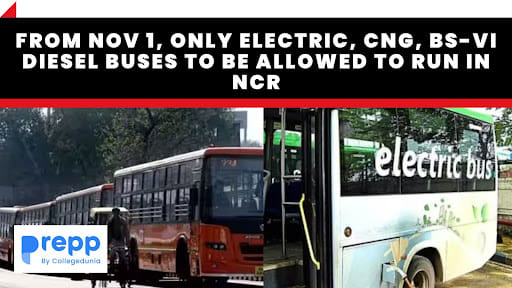
- Recently, the Commission for Air Quality Management announced that only electric, CNG, and BS-VI diesel-compliant buses can ply between Delhi and the NCR (National Capital Region) states.
- The directive aims to prevent the pollution caused by diesel buses in the heavily polluted and populated NCR.
Table of Contents
What is the decision of the Commission for Air Quality Management?
- The Commission for Air Quality Management announced that only electric, CNG, and BS stage-VI compliant diesel buses would be allowed to run between Delhi and other NCR regions.
- It stated that cleaner and more sustainable public transport services had to be provided within the NCR in order to reduce emissions and improve air quality.
- It issued directives to the governments of Haryana, Rajasthan, and Uttar Pradesh to implement a comprehensive plan to enhance the efficiency and eco-friendliness of the inter-city and inter-state bus services in the region.
- The states were directed to ensure that only compliant buses were used in services between cities and towns in the states and Delhi.
- The decision would be applicable to both the public and private sector entities and the respective governments must ensure strict compliance through regular monitoring of implementation by the traffic police and transport departments.
Three tier plan
- The plan adopts a three-tier approach for transitioning to cleaner bus services.
- Short-term: Permit only electric, CNG and BS-VI diesel buses in Delhi
- Medium-term: Focus on EVs and CNG buses, which must be achieved in three years.
- Long-term: Convert the entire NCR’s bus fleet to electric vehicles, which must be achieved in 15 years.
- Status: Haryana, Rajasthan, and U.P. have committed to phasing out older BS-III and BS-IV diesel buses and replacing them with new BS-VI ones.
- Procurement of CNG buses and EVs, as per respective state EV policies, is also underway.
Air pollution in Delhi
- Air quality in the national capital was recorded in the 'moderate' category with a score of 173 on the Air Quality Index (AQI).
- However, the System of Air Quality and Weather Forecasting and Research recorded air quality in the 'poor' and ‘very poor’ categories in some parts of Delhi.
What is the Commission for Air Quality Management?
- The Commission for Air Quality Management (CAQM) is a statutory body established in 2011 to monitor air quality in the National Capital Region.
- It was established under the Commission for Air Quality Management in National Capital Region and Adjoining Areas, Act 2021.
- Objective: Enhance coordination, conduct research, and identify and address issues related to air quality in the NCR and its neighboring regions including Punjab, Haryana, Uttar Pradesh, and Rajasthan.
- It replaced the Environment Pollution (Prevention and Control) Authority (EPCA) which had been appointed by the Supreme Court and was operational for 22 years as the Union government felt the EPCA had become redundant
- Functions:
- The Commission is a powerful entity whose rulings will supersede any other law or other body in matters of air pollution.
- It is authorized to take measures, issue directions, and entertain complaints to protect and improve the quality of air in the NCR.
- It will coordinate action taken by states on air pollution and establish parameters for air quality and emissions.
- It can restrict industries in any area, conduct random inspections, and stop electricity and water connections of any premises
- It can monitor the actions taken by states to prevent stubble burning.
- Non-compliance with the Commission’s orders or directions can lead to a prison term of up to five years and/or a fine of up to ₹1 crore.
- Only the National Green Tribunal possesses the authority to hear cases involving the CAQM, excluding the civil courts.
- Structure:
- Chairperson: He/she must have at least 15 years of experience in the field of environmental protection and pollution control or administrative experience of at least 25 years.
- The Chairperson will hold office for a term of three years or up to the age of 70 years.
- Members: An official from the Environment Ministry; one full-time member who is or has been a joint secretary; five ex-officio members who are either chief secretaries or secretaries from Delhi, Punjab, Haryana, Rajasthan, and Uttar Pradesh; three full-time independent technical members who are experts in air pollution; one technical member each from the CPCB and ISRO; one representative of the NITI Aayog; and three members from air pollution-related NGOs.
- The commission will also include three members from sectors like industry, agriculture, transport or construction and representatives of ministries like Power, Road Transport & Highways, Housing & Urban Affairs, Petroleum & Natural Gas, Commerce and Industry, and Agriculture and Farmers’ Welfare.
- It will also have representatives from any association from the commerce or industry sector.
- Subcommittees: The CAQM will have a minimum of three sub-committees - monitoring and identification, research and development, and safeguarding and enforcement.
- Chairperson: He/she must have at least 15 years of experience in the field of environmental protection and pollution control or administrative experience of at least 25 years.
Criticism
- Lack of a time-bound committment: No specific schedules have been set to solve the crisis of air pollution in the NCR despite the urgency.
- Scepticism about its working: Critics have claimed that there is only token representation for environmental bodies and NGOs while bureaucrats are overwhelmingly represented.
- Over centralisation: State governments have only one representative each, while the central government has a large representation.
- Dissolution of EPCA: By forming a new commission, the government has taken the issue of air pollution out of the purview of the judiciary despite improper implementation of earlier regulations.
Other steps to control pollution in the NCR
- In April 2020, the Government of India had directed that all vehicles sold in India must comply with Bharat Stage-VI (BS-VI) emission standards.
- BS-VI standards impose legal limits on the amount of air pollutants that vehicles in India can emit.
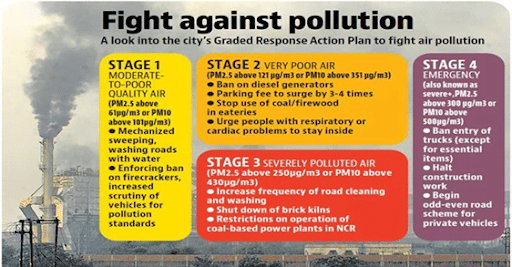
- GRAP: The Graded Response Action Plan (GRAP) is a set of emergency measures taken to reduce air pollution in the NCR once it crosses a certain threshold.
- It was approved by the Supreme Court in 2016 after the Supreme Court’s order in M. C. Mehta vs. Union of India (2016) and notified in 2017.
- Stage I (Poor Air Quality - AQI 201-300): Enforce NGT or SC’s order on over aged diesel / petrol vehicles.
- Stage II (Very Poor- AQI 301-400): Targeted actions to combat air pollution at identified hotspots in the region.
- Stage III ('Severe'- AQI 401-450): Impose strict restrictions on BS III petrol and BS IV diesel four-wheelers in certain areas and may suspend physical classes in schools for primary grade children up to Class 5.
- Stage IV (Severe Plus- AQI greater than 450): Four-wheelers registered outside Delhi, except for electric vehicles, CNG vehicles, and BS-VI diesel vehicles and vehicle carrying essential commodity, will not be allowed to enter the city.
- In October 2023, the CAQM directed authorities in the NCR to enforce a ban on the use of coal in hotels and restaurants and take punitive measures against polluting industries and thermal power plants.
- Red Light On, Gaadi Off Campaign: It was launched by the Delhi government to combat air pollution wiith Volunteers holding placards asking commuters to turn off their cars' engines while the signal is red.
- National Clean Air Program: It is a five-year action plan to reduce air pollution, create an India-wide network for air quality monitoring, and raise public awareness, that was introduced by the government in January 2019.
- It seeks to cut PM2.5 levels by 20–30% by 2024 as compared to 2017 levels.
To learn more about steps to reduce air pollution in NCR, click the link.
Conclusion
- The measures taken by the Commission for Air Quality Management to restrict the operation of only electric, CNG, and BS-VI diesel buses in the NCR region are a significant step toward addressing air pollution and improving air quality by commiting to sustainable and cleaner public transport.
- However, authorities will have to ensure strict compliance and set clear timelines in order to combat air pollution effectively.
(*Click this link to read prelims specific weekly current affairs articles)
FAQs
Question: What is the SAFAR?
Answer:
The System of Air Quality and Weather Forecasting and Research (SAFAR) is a national initiative introduced by the Ministry of Earth Science to measure the overall pollution level and the location-specific air quality of the city. It was developed by the Indian Institute of Tropical Meteorology, Pune and operated by the Indian Meteorological Department.
Question: What is the AQI?
Answer:
The Air Quality Index is a measure of air quality launched by the central government in 2014 as part of the Swachh Bharat campaign. There are six categories in the AQI - Good (0-50), Satisfactory (50-100), Moderately polluted (100-200), Poor (200-300), Very Poor (300-400), and Severe (400-500).
MCQs
Question: In the context of In WHO Air Quality Guidelines, consider the following statements:
- The 24-hour mean of PM2.5 should not exceed 15 ug/m3 and annual mean of PM2.5 should not exceed 5 µg/m³.
- In a year, the highest levels of ozone pollution occur during the periods of inclement weather.
- PM10 can penetrate the lung barrier and enter the bloodstream.
- Excessive ozone in the air can trigger asthma.
Which of the statements given above are correct? (UPSC CSE 2022)
(a) 1, 3 and 4 only
(b) 1 and 4 only
(c) 2, 3 and 4 only
(d) 1 and 2 only
Answer: (b) See the Explanation
- According to the WHO guidelines, the annual average for PM2.5 should not exceed 5 micrograms per cubic metre of air, while the 24-hour average should not exceed 15 micrograms per cubic metre. Hence statement 1 is correct.
- Ozone at ground level is formed by the reaction with sunlight (photochemical reaction) of pollutants such as nitrogen oxides (NOx) from vehicle and industry emissions and volatile organic compounds (VOCs) emitted by vehicles, solvents and industry.
- As a result, the highest levels of ozone pollution occur during periods of sunny weather. Hence statement 2 is incorrect.
- While particles with a diameter of 10 microns or less, (≤ PM10) can penetrate and lodge deep inside the lungs, particles with a diameter of 2.5 microns or less, (≤ PM2.5) are more dangerous as they can penetrate the lung barrier and enter the blood system. Hence statement 3 is incorrect.
- Excessive ozone in the air can cause breathing problems, trigger asthma, reduce lung function and cause lung diseases. Hence statement 4 is correct.
Therefore, option (b) is the correct answer.
Question: In the cities of our country, which among the following atmospheric gases are normally considered in calculating the value of Air Quality Index? (UPSC CSE 2016)
- Carbon dioxide
- Carbon monoxide
- Nitrogen dioxide
- Sulfur dioxide
- Methane
Select the correct answer using the code given below.
(a) 1, 2 and 3 only
(b) 2, 3 and 4 only
(c) 1, 4 and 5 only
(d) 1, 2, 3, 4 and 5
Answer: (b) See the Explanation
- The AQI level is based on the level of 8 atmospheric pollutants:
- sulfur dioxide (SO2)
- nitrogen dioxide (NO2)
- PM 10
- PM 2.5
- NH3
- Pb
- carbon monoxide (CO)
- ozone (O3
Therefore, option (b) is the correct answer.
Download the PREPP App and attempt FREE IAS Exam Mock Tests and get complete study material!

Full Test - 04: UPSC CSE Prelims CSAT (Paper-II)
Full Test - 03: UPSC CSE Prelims CSAT (Paper-II)
UPSC CSE Prelims 2026 GS Paper 1 Question Paper (24-May-2026)
UPSC CSE Prelims 2026 CSAT Paper 2 Question Paper (24-May-2026)

17 February 2025 | The Hindu Must Read Articles | Current Affairs

16 February 2026 | The Hindu Must Read Articles | Current Affairs

13 February 2026 | The Hindu Must Read Articles | Current Affairs









Comments