Eradicate Manual Scavenging, SC Tells Centre, States
Relevance: GS1 - Social empowerment, communalism, regionalism & secularism GS2 - Government policies and interventions for development in various sectors and issues arising out of their design and implementation, Welfare schemes for vulnerable sections of the population by the Centre and States and the performance of these schemes;
(Source: The Hindu, 10/21/2023)
Click here for Daily Current Affairs
Why in the news?
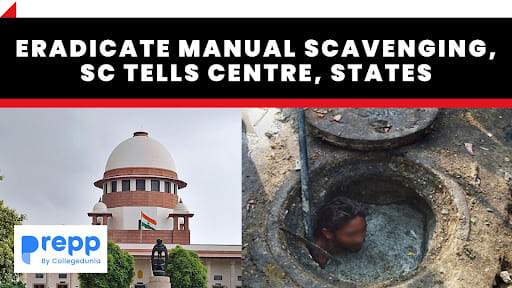
- The Supreme Court, in a recent judgment, emphasized the need to completely eradicate the inhumane practice of manual scavenging, which still persists even after being outlawed.
- The court had taken judicial notice of the petition filed in 2020 by Balram Singh, which brought to its attention the alarming fact that despite the ban on the practice, individuals were still losing their lives in sewers.
Table of Contents
What did the Supreme Court say?
- The court held that the Union and States are responsible for ensuring strict implementation of the Prohibition of Employment as Manual Scavengers and their Rehabilitation Act, 2013.
- The Supreme Court emphasized that ideals of fraternity, equality, and dignity for all citizens remain elusive as long as a significant portion of our society is compelled to engage in the hazardous and inhumane occupation of manual scavenging, even years after its prohibition.
- Justice S.R. Bhat, leading the bench, expressed that society owes a debt to this marginalized population who have long been invisible and unheard.
- The court increased the compensation for sewer deaths to ₹30 lakh from the previous ₹10 lakh.
What is Manual Scavenging?
- Manual scavenging refers to the practice of manually cleaning, handling, and disposing of human excreta and other waste materials from dry latrines, open drains, and sewers.
- It is defined as ‘the removal of human excrement from public streets and dry latrines, cleaning septic tanks, gutters and sewers’.
- Manual scavenging and deaths of people trapped in sewer lines continue though the practice was banned with the introduction of the Employment of Manual Scavengers and Construction of Dry Latrines (Prohibition) Act, 1993 and the Prohibition of Employment as Manual Scavengers and Their Rehabilitation Act, 2013.
How does Manual Sacvenging effect individuals?
- Health Hazards: Manual scavengers are exposed to grave health risks due to their direct contact with human waste and harmful substances. They are highly susceptible to contracting diseases like cholera, typhoid, hepatitis, and respiratory infections. The lack of proper protective equipment and unsanitary conditions further intensify these health hazards, resulting in a higher incidence of illnesses and untimely deaths among manual scavengers.
- Dignity and Human Rights Violations: Manual scavenging constitutes a blatant violation of the dignity and human rights of those engaged in this occupation. It subjects individuals to degrading and inhumane conditions, compelling them to handle human waste without adequate protection and depriving them of basic sanitation facilities. This occupation perpetuates social stigma, discrimination, and marginalization, often rooted in caste-based oppression.
- Psychological and Emotional Trauma: Engaging in manual scavenging inflicts severe psychological and emotional distress on those involved. The constant exposure to filth, the indignity of the work, and the discrimination they face take a substantial toll on their mental well-being. Manual scavengers frequently experience feelings of shame, low self-esteem, and depression, which can lead to long-term psychological trauma.
What are the Constitutional Safeguards for Manual Scavengers?
- Article 14: Equality before the law and equal protection of the laws.
- Article 17: Abolition of untouchability and prohibition of its practice in any form.
- Article 21: Protection of life and personal liberty.
- Article 23: Prohibition of traffic in human beings and forced labour.
Government’s Initiatives to Curb Manual Scavenging
- Employment of Manual Scavengers and Construction of Dry Latrines (Prohibition) Act, 1993: It banned the practice of manual scavenging.
- Prohibition of Employment as Manual Scavengers and Their Rehabilitation Act, 2013: In 2013, the Government introduced this act which reinforced the ban on the practice and aimed to rehabilitate those employed as manual scavengers.
- National Commission for Safai Karamcharis (NCSK): In 1993, NCSK was established under the provisions of the NCSK Act, 1993 to recommend specific programmes for the welfare of the Safai Karamcharis.
- National Safai Karamcharis Finance and Development Corporation: It was formed as a not-for-profit company under the Ministry of Social Justice and Empowerment. Its objective is to socially and economically uplift the Safai Karamcharis, scavengers, and their dependents.
- Swachhta Abhiyan App: The government introduced the Swachhta Abhiyan App which was developed to identify and geotag data related to insanitary latrines and manual scavengers. This would enable the replacement of the insanitary latrines with sanitary latrines and the rehabilitation of the manual scavengers and assure them of a life with dignity.
- Supreme Court Judgement:
- The Supreme Court of India had in its 2014 judgment in the Safai Karamchari Andolan and Others vs Union of India reaffirmed the prohibition on manual scavenging and directed the government to rehabilitate those employed traditionally or otherwise in the practice on the basis of the principles of justice and transformation.
- In its judgment in the Delhi Jal Board vs National Campaign for Dignity and Rights of Sewerage and Allied Workers & Ors (2011), the Supreme Court stated that the human beings who are employed as sewer cleaners cannot be treated as mechanical robots who are unaffected by poisonous gases.
Some Schemes
- NAMASTE Scheme: It was launched in 2022 as a Central Sector Scheme. The scheme is being undertaken jointly by the Ministry of Housing and Urban Affairs and the Ministry of Social Justice & Empowerment (MoSJE) and aims to eradicate unsafe sewer and septic tank cleaning practices.
- Rashtriya Garima Abhiyan: Rashtriya GarimaAbhiyan (National Campaign for Dignity and Eradication of Manual Scavenging) aims eradication of inhuman practice of manual scavenging and comprehensive rehabilitation of manual scavengers in India.
- Atal Mission for Rejuvenation and Urban Transformation: It has led to the development of infrastructure such as sewerage networks, sewerage treatment plants across 500 cities.
Way Ahead
- It is crucial for nations to accurately assess and take ownership of the issue by determining the exact number of workers involved in cleaning up toxic waste. It is essential for understanding the scale of the problem, identifying the affected individuals, and planning effective interventions and policies.
- The Swachh Bharat Mission, recognized as a top priority and the availability of funds for smart cities and urban development present a compelling opportunity to address the issue of manual scavenging.
- To address the deeply rooted social stigma associated with manual scavenging, it is essential to acknowledge and understand why this practice continues to be intertwined with the caste system.
- Implementing stringent legal measures that obligate government institutions to provide sanitation services rather than relying on manual scavengers is a critical step in safeguarding the rights of these workers.
(*Click this link to read prelims specific weekly current affairs articles)
FAQs
Question: What is Manual Scavenging?
Answer:
Manual scavenging refers to the practice of manually cleaning, handling, and disposing of human excreta and other waste materials from dry latrines, open drains, and sewers.
Question: Is Manual Scvenging banned in India?
Answer:
Manual scavenging and deaths of people trapped in sewer lines continue though the practice was banned with the introduction of the Employment of Manual Scavengers and Construction of Dry Latrines (Prohibition) Act, 1993 and the Prohibition of Employment as Manual Scavengers and Their Rehabilitation Act, 2013.
Question: What is National Commission for Safai Karamcharis (NCSK)?
Answer:
The National Commission for Safai Karamcharis (NCSK) is currently a temporary non-statutory body that investigates the conditions of Safai Karamcharis (waste collectors) in India and makes recommendations to the Government of India.
UPSC Mains Practice Question:
|
MCQ
Question: ‘Rashtriya Garima Abhiyaan’ is a national campaign to (UPSC 2016)
(a) rehabilitate the homeless and destitute persons and provide them with suitable sources of livelihood
(b) release the sex workers from their practice and provide them with alternative sources of livelihood
(c) eradicate the practice of manual scavenging and rehabilitate the manual scavengers
(d) release the bonded labourers from their bondage and rehabilitate them
Answer: (c) See the Explanation
Rashtriya Garima Abhiyaan is a national campaign for dignity and eradication of manual scavenging launched by Jan Sahas in 2001.
Therefore, option (c) is the correct answer.
Download the PREPP App and attempt FREE IAS Exam Mock Tests and get complete study material!

Full Test - 04: UPSC CSE Prelims CSAT (Paper-II)
Full Test - 03: UPSC CSE Prelims CSAT (Paper-II)
UPSC CSE Prelims 2026 GS Paper 1 Question Paper (24-May-2026)
UPSC CSE Prelims 2026 CSAT Paper 2 Question Paper (24-May-2026)

17 February 2025 | The Hindu Must Read Articles | Current Affairs

16 February 2026 | The Hindu Must Read Articles | Current Affairs

13 February 2026 | The Hindu Must Read Articles | Current Affairs









Comments