Depression Over Arabian Sea Likely To Intensify Into Cyclonic Storm: IMD
Relevance: GS1 - Important Geophysical phenomena such as earthquakes, Tsunami, Volcanic activity, cyclone etc.,
Why in the news?
- Recently, the Indian Meteorological Department (IMD) notified that a depression over the southeast Arabian Sea, south of Porbandar, is likely to move northwestward and intensify into a cyclonic storm.
- The cyclonic storm, named Tej is likely to intensify into a severe cyclonic storm.
Table of Contents
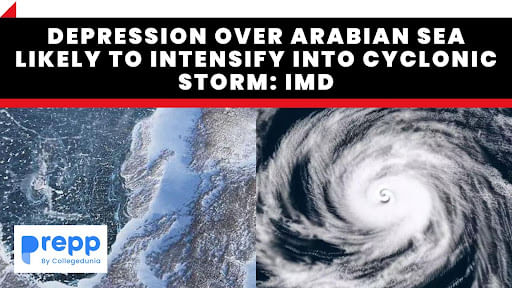
Recent cyclonic activity near India
- Depression in the Arabian Sea: A depression has developed from the low pressure region in the southwest and southeast Arabian Sea.
- The low pressure region is centered around 900 km east-southeast of Socotra, 1,170 km southeast of Oman and 1,260 km east-southeast of Al Ghaidah (Yemen).
- Cyclone: The depression is expected to intensify into a cyclonic storm named ‘Tej’.
- It is the second cyclonic storm forming in the Arabian Sea this year.
- The cyclonic storm is expected to further transition into a severe cyclonic storm and move towards Oman and Yemen.
- Projected path: A majority of models indicate that the storm is moving towards the Yemen-Oman coast.
- According to the Global Forecast System models, a recurvature in the path of the cyclone could steer it towards Pakistan and Gujarat.
- Cyclonic activity in the Bay of Bengal: The IMD observed a low-pressure area over the southwest and southeast Bay of Bengal.
- It cautioned that the low-pressure region is likely to intensify into a depression over the west-central Bay of Bengal.
- The system is likely to move west-northwestwards and then recurve north-northeastwards towards the Bangladesh coast.
What are cyclones?
- Cyclones are a type of low-pressure environment with rapid inward air circulation.
- Formation: An area of low pressure is formed when warm and moist air rises up and away from the ocean surface.
- Air from surrounding areas with higher pressure then moves towards the low-pressure area.
- In a continuous cycle, this cool air becomes warm and moist and rises up.
- The warm moist air which rises up, cools the water in the air and results in the formation of clouds.
- This whole system of clouds and winds spins and grows and the cycle results in a cyclone.
- This process is known as cyclogenesis.
- Types of cyclones: Cyclones are mainly of two types:
- Tropical cyclones: It refers to weather systems with winds greater than 'Gale Force' (minimum of 63 km per hour) that occur in the region between the Tropic of Cancer and the Tropic of Capricorn.
- Extratropical cyclones: Extratropical cyclones are active above the mid-latitudinal region between 35° and 65° latitude in both the hemispheres.
- Local names for cyclones:
- In the Atlantic and Eastern Pacific, they are known as Hurricanes.
- In Southeast Asia, they are also known as Typhoons
- In the Indian Ocean and the Western Pacific region, they are also known as Cyclones.
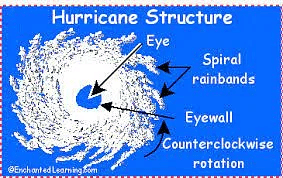
Classification of cyclones
- The IMD classifies cyclones on the basis of wind speed:
| Category | Wind speed |
|---|---|
| Depression | Between 31–49 km/h |
| Deep Depression | Between 50-61 km/h |
| Cyclonic Storm | Between 62–88 km/h |
| Severe Cyclonic Storm | Between 89-117 Km/h |
| Very Severe Cyclonic Storm | Between 118-166 Km/h |
| Extremely Severe Cyclonic Storm | Between 166-221 Km/h |
| Super Cyclonic Storm | Above 222 Km/h |
How are cyclones in the Indian Ocean named?
- There are 6 Regional Specialised Meteorological Centres in the world and 4 regional Tropical Cyclone Warning Centres.
- The Regional Specialised Meteorological Centre (RSMC), Tropical Cyclones, New Delhi, is responsible for giving a tropical cyclone formed over the Indian Ocean a name from a given list.
- The World Meteorological Organisation/ United Nations Economic and Social Commission for Asia and the Pacific panel countries adopted a list of names for cyclones in the north Indian Ocean in April 2020.
- This includes cyclones that occur in the Bay of Bengal anf the Arabian Sea.
- The 13 panel countries — Bangladesh, India, Iran, Maldives, Myanmar, Oman, Pakistan, Qatar, Saudi Arabia, Sri Lanka, Thailand, United Arab Emirates and Yemen — submitted a list of 13 names each.
- Once the first set of names is used, names from the remaining 12 sets will be used.
- The names of tropical cyclones will not be repeated.
- Earlier, only feminine names were used storms but by the 1900’s masculine names began to be used for cyclones taking place in the southern hemisphere.
- However, names chosen from cyclones now have a maximum of eight letters and are neutral and chosen in a way that does not affect the sentiments of any group.
To know more about cyclones, click the link.
(*Click this link to read prelims specific weekly current affairs articles)
FAQs
Question: What is a depression?
Answer:
According to the IMD, a depression is a low pressure which has an associated wind speed of 32-50km/hour. Under favourable conditions, a low pressure over the sea intensifies into a depression, then into a deep depression and then into a cyclonic storm.
Question: What is the United Nations Economic and Social Commission for Asia and the Pacific?
Answer:
The United Nations Economic and Social Commission for Asia and the Pacific (ESCAP) is the regional development arm of the United Nations for the Asia-Pacific region that was established in 1947 with its headquarters in Bangkok. It has 62 member states and addresses issues such as address issues for regional cooperation.
UPSC Mains Practice Question:
|
MCQs
Question: Consider the following statements: (UPSC CSE 2020)
- Jet streams occur in the Northern Hemisphere only.
- Only some cyclones develop an eye.
- The temperature inside the eye of a cyclone is nearly 10C lesser than that of the surroundings.
Which of the statements given above is/are correct:
(a) 1 only
(b) 2 and 3 only
(c) 2 only
(d) 1 and 3 only
Answer: (c) See the Explanation
- Jet Stream occur in both the northern and southern hemispheres. Hence statement 1 is incorrect.
- Extra-tropical cyclones do not necessarily have an eye. Hence statement 2 is correct.
- The eye of the cyclone is warmer than the surrounding areas. Hence statement 3 is incorrect.
Therefore, option (c) is the correct answer.
Question: Which of the following is not an ideal condition for the foration of tropical cyclones?
(a) Large sea surface with temperatures lower than 27° C.
(b) Presence of the Coriolis force.
(c) Small variations in the vertical wind speed.
(d) A pre-existing weak low- pressure area.
Answer: (a) See the Explanation
- Tropical cyclones originate and intensify over warm tropical oceans.
- The conditions favourable for the formation and intensification of tropical storms are:
- Large sea surface with temperature higher than 27° C.
- Presence of the Coriolis force.
- Small variations in the vertical wind speed.
- A pre-existing weak low- pressure area or low-level-cyclonic circulation.
- Upper divergence above the sea level system.
Therefore, option (a) is the correct answer.
Download the PREPP App and attempt FREE IAS Exam Mock Tests and get complete study material!

Full Test - 04: UPSC CSE Prelims CSAT (Paper-II)
Full Test - 03: UPSC CSE Prelims CSAT (Paper-II)
UPSC CSE Prelims 2026 GS Paper 1 Question Paper (24-May-2026)
UPSC CSE Prelims 2026 CSAT Paper 2 Question Paper (24-May-2026)

17 February 2025 | The Hindu Must Read Articles | Current Affairs

16 February 2026 | The Hindu Must Read Articles | Current Affairs

13 February 2026 | The Hindu Must Read Articles | Current Affairs









Comments