Oceanic Mountains - Geography Notes
Oceanic mountains are underwater mountain structures that rise from the ocean floor. Unlike the mountains on continents, which are primarily the result of tectonic plate collisions and movements, oceanic mountains are often formed by volcanic activity and other underwater processes. Coastal, Inland, and Oceanic mountains are divided on the basis of location. This article will explain to you about the Oceanic Mountains which will be helpful in Geography preparation for the UPSC Civil Service exam.
|
Table of Contents |
What are Oceanic Mountains?
- A mid-ocean ridge or oceanic mountain is an underwater mountain range, formed by plate tectonics.
- On continental shelves and ocean floors, oceanic mountains can be discovered.
- This uplifting of the ocean floor occurs when convection currents rise in the mantle beneath the oceanic crust and create magma where two tectonic plates meet at a divergent boundary.
- The mid-ocean ridges of the world are connected and form a single global mid-oceanic ridge system that is part of every ocean, making the mid-oceanic ridge system the longest mountain range in the world, with a total length of about 60,000 km.

Mid Oceanic ridge
- There are two processes namely the ridge-push and slab-pull which are thought to be responsible for the spreading seen at mid-ocean ridges.
- Ridge-push: This occurs when the weight of the ridge pushes the rest of the tectonic plate away from the ridge, often towards a subduction zone.
- Slab- pull: At the subduction zone, slab-pull comes into effect. This is simply the weight of the tectonic plate being subducted (pulled) below the overlying plate dragging the rest of the plate along behind it.
- There are also a few other processes that contribute to the formation of new oceanic crust at mid-ocean ridges. One among them is the "mantle conveyor".
- However, there have been some studies that have shown that the upper mantle (asthenosphere) is too flexible to generate enough friction to pull the tectonic plate along.

Oceanic Mountain
Coastal Mountains
- Things that are in the sea or on land near a coast are referred to as coastal.
- Coastal mountains, as the name implies, are those that are located near a coastline.
- The Rockies, the Appalachians, the Alpine mountain systems, the Western Ghats, and the Eastern Ghats (India) are some examples.
Inland Mountains
- Inland Mountains are the ones that are situated in a landlocked position.
- The majority of the mountains we encounter are Inland Mountains.
- Examples include Europe's Vosges and the Black Forest, Asia's Kunlun, Tienshan, Altai ranges, and Russia's Urals.
- Some Inland Mountains in India include the Aravallis, Himalayas, and Satpura.
Types of Oceanic Mountains
Mid-Ocean Ridges
- These are long, continuous mountain chains that run along the ocean floor.
- They form at divergent tectonic plate boundaries where the oceanic plates move apart, allowing magma to rise from the mantle and solidify to form new crust.
- The Mid-Atlantic Ridge is a prominent example.
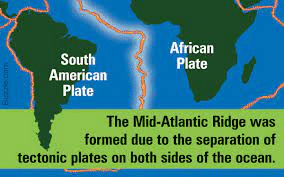
Mid-Atlantic Ridge
Seamounts
- These are isolated mountains rising from the ocean floor that do not reach the surface.
- They are often extinct volcanoes and can be found both near and away from tectonic plate boundaries.
- Example: The Emperor Seamounts in the Pacific Ocean.
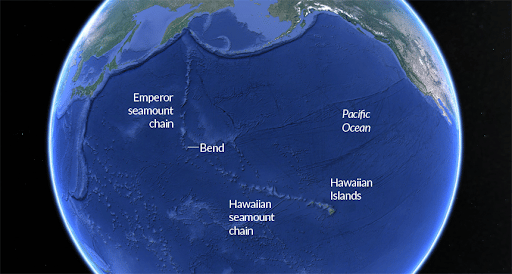
Emperor Seamount Chain
Guyots or Tablemounts
- These are flat-topped seamounts.
- They initially form as seamounts, but after reaching the ocean surface, they are eroded by wave action and later subside back below the sea level.
- Example: The Darwin Guyot in the Pacific Ocean.
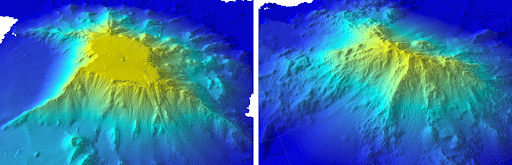
Guyots
Oceanic Plateaus
- These are large, flat, elevated regions on the ocea n floor, usually formed by extensive volcanic activity.
- An example is the Ontong Java Plateau.
Formation of Oceanic Mountains
- Tectonic Activity: Many oceanic mountains, especially mid-ocean ridges, are formed due to tectonic activities. As tectonic plates move apart at divergent boundaries, magma rises to form new oceanic crust.
- Hotspot Volcanism: Some seamounts and oceanic plateaus are formed away from plate boundaries due to plumes of hot material rising from deep within the mantle, known as hotspots. The Hawaiian-Emperor seamount chain is an example of a hotspot trail.
- Subsidence and Erosion: Guyots are initially formed as seamounts. Once they breach the ocean surface, they undergo erosion by wave action, which flattens their tops. Later, they subside below the sea level due to the cooling and sinking of the oceanic crust.
Underwater Mountain Features
- Mountain ranges that are mostly or fully underwater, specifically beneath the surface of an ocean, are known as undersea mountain ranges.
- Most oceanic mountains are of volcanic origin. They form due to volcanic activity either at tectonic plate boundaries (like mid-ocean ridges) or away from them (like hotspots).
- Oceanic mountains can vary significantly in size and height. Some seamounts rise just a few hundred meters above the seafloor, while mid-ocean ridges and oceanic plateaus can span vast areas.
- Some seamounts and ridges rise close to the ocean's surface, while others remain deep below.
- These structures often serve as hotspots for marine biodiversity. The varied topography and nutrient upwelling around oceanic mountains provide habitats for a wide array of marine species.
- Coral reefs can sometimes be found on submerged mountain structures, offering habitats for numerous marine species.
- The presence of large underwater structures can deflect and redirect ocean currents. This can result in upwelling, where deeper, nutrient-rich waters rise to the surface, fostering productive ecosystems.
- Oceanic mountains, especially seamounts, are known to harbor significant mineral resources. Polymetallic nodules, crusts rich in cobalt, and massive sulfide deposits can be found around these features.
- The flanks and summits of oceanic mountains can accumulate sediments over time, offering insights into the history of the surrounding ocean and global climate.
- In regions of active volcanism, such as mid-ocean ridges, hydrothermal vents can form. These vents spew superheated, mineral-rich water, supporting unique communities of organisms adapted to extreme conditions.
Significance of Oceanic Mountains
- Underwater mountains help in the rise of ocean water from the depths.
- Deep waters can be trapped by the oceanic mountains, preventing them from traveling to flatter, calmer sections of the ocean.
- Oceanic mountains help in transporting nutrients from the seafloor's depths to the sunlit surface, providing nutrient-rich sustenance for sea life.
- Oceanic mountains often serve as biodiversity hotspots. The structures provide habitats for a variety of marine species and can influence ocean currents and nutrient upwelling, creating productive ecosystems.
- Studying oceanic mountains offers insights into the Earth's geological processes, including plate tectonics, volcanism, and the history of the ocean basins.
- Some oceanic mountains, especially seamounts, are rich in minerals and metals. They are considered potential sites for deep-sea mining.
Conclusion
Oceanic mountains are significant underwater geological structures that play crucial roles in shaping the Earth's geology, influencing marine ecosystems, and offering potential resources for exploration.
FAQs
Question: What are oceanic mountains?
Answer: Oceanic mountains are underwater mountain structures formed on the ocean floor, primarily due to volcanic activity and tectonic processes.
Question: How do oceanic mountains differ from continental mountains?
Answer: Oceanic mountains are formed underwater and primarily result from volcanic activity, whereas continental mountains are formed on land due to tectonic plate collisions.
Question: What is the significance of oceanic mountains?
Answer: Oceanic mountains are vital for understanding plate tectonics, supporting marine biodiversity, and offering potential mineral resources.
Question: What is a mid-ocean ridge?
Answer: A mid-ocean ridge is a continuous underwater mountain range formed at divergent tectonic plate boundaries where new oceanic crust is created.
Question: What is the role of seamounts in marine ecosystems?
Answer: Seamounts provide habitats for a wide variety of marine species, contributing to marine biodiversity and supporting unique ecosystems.
MCQs
- Which type of mountain range is formed at divergent plate boundaries?
A) Fold mountains
B) Fault-block mountains
C) Mid-ocean ridges
D) Volcanic arcs
Answer: (C) See the Explanation
Mid-ocean ridges form at divergent tectonic plate boundaries where magma rises to create new oceanic crust.
- What is a seamount?
A) A submerged flat plain
B) An underwater volcanic mountain that does not reach the surface
C) A mountain formed due to glacial activity
D) A mountain on a continental shelf
Answer: (B) See the Explanation
Seamounts are isolated volcanic mountains under the ocean that do not emerge above sea level.
- Which of the following is an example of an oceanic mountain?
A) Himalayas
B) Mauna Kea
C) Andes
D) Rockies
Answer: (B) See the Explanation
Mauna Kea is a dormant volcano in Hawaii, considered one of the tallest mountains when measured from its base on the ocean floor.
- What are guyots?
A) Mountains with sharp peaks
B) Flat-topped seamounts
C) Fold mountains found on land
D) Submerged continental slopes
Answer: (B) See the Explanation
Guyots are seamounts with flat tops, which were once above sea level but have since eroded and submerged.
- Which is the largest mid-ocean ridge?
A) Himalayas
B) Andes
C) Mid-Atlantic Ridge
D) Rocky Mountains
Answer: (C) See the Explanation
The Mid-Atlantic Ridge is the largest mid-ocean ridge and a key feature of seafloor spreading in the Atlantic Ocean.
GS Mains Questions and Model Answers
Q1: Discuss the formation and importance of oceanic mountains in understanding Earth's geological processes.
Answer: Oceanic mountains, including mid-ocean ridges, seamounts, and guyots, form due to volcanic activity and tectonic movements. These underwater structures provide critical insights into seafloor spreading, plate tectonics, and the creation of new oceanic crust. They are essential for studying Earth's internal processes and dynamics. Furthermore, they support marine biodiversity, harboring unique ecosystems, and offer potential resources like polymetallic nodules, contributing to both ecological and economic development.
Q2: Explain the ecological and economic significance of seamounts.
Answer: Seamounts serve as biodiversity hotspots, offering habitats for diverse marine species and supporting complex ecosystems. They play a crucial role in the food chain by attracting various organisms. Economically, seamounts are rich in mineral resources such as cobalt, nickel, and rare earth elements found in polymetallic nodules. Understanding and conserving seamount ecosystems is vital for sustainable resource utilization and biodiversity protection.
Q3: Evaluate the challenges and opportunities associated with exploring oceanic mountains for mineral resources.
Answer: Oceanic mountains harbor valuable mineral resources like polymetallic nodules and hydrothermal deposits, presenting opportunities for resource extraction. However, exploration poses challenges, including technological limitations, environmental concerns, and the high cost of deep-sea mining. The ecological impact of disrupting marine ecosystems must be addressed through sustainable practices and international regulations to balance economic benefits with environmental conservation.
Previous Year Questions on Oceanic Mountains
UPSC CSE Prelims 2022
Q1: What are mid-ocean ridges, and how do they contribute to plate tectonics?
Answer: Mid-ocean ridges are continuous underwater mountain chains formed at divergent tectonic plate boundaries. They play a significant role in plate tectonics by facilitating seafloor spreading, where magma rises to create new oceanic crust. This process drives the movement of tectonic plates, reshaping Earth's surface over geological time.
UPSC CSE Mains 2021
Q2: Analyze the role of oceanic mountains in global climate regulation and marine biodiversity conservation.
Answer: Oceanic mountains influence global climate regulation by impacting ocean currents and carbon cycling. They support unique marine ecosystems that are crucial for maintaining biodiversity. These structures act as biological hotspots, promoting the growth of coral reefs and providing habitats for various marine species. Protecting these ecosystems is essential for biodiversity conservation and mitigating climate change effects.
Download the PREPP App and attempt FREE IAS Exam Mock Tests and get complete study material!
UPSC IAS : CSAT - Mini Live Test

Live Test : UPSC CSE Prelims CSAT (Paper-II) (Oct 20 - 23)
Full Test - 04: UPSC CSE Prelims CSAT (Paper-II)
Full Test - 03: UPSC CSE Prelims CSAT (Paper-II)
UPSC CSE Prelims 2026 GS Paper 1 Question Paper (24-May-2026)
UPSC CSE Prelims 2026 CSAT Paper 2 Question Paper (24-May-2026)

17 February 2025 | The Hindu Must Read Articles | Current Affairs

16 February 2026 | The Hindu Must Read Articles | Current Affairs

13 February 2026 | The Hindu Must Read Articles | Current Affairs









Comments