Fold Mountains - Physical Geography - Geography Notes
Fold mountains are formed when two or more tectonic plates collide with one another. This is the reason why fold mountains are frequently found around the borders of continents and are formed by sedimentary rocks. The Himalayas (India), the Andes (South America), and the Alps (Europe) are examples of fold mountain ranges. The topic “Fold Mountains” is an important part of the UPSC/IAS Exam Geography syllabus which is discussed in this article in detail.
|
Table of Contents |
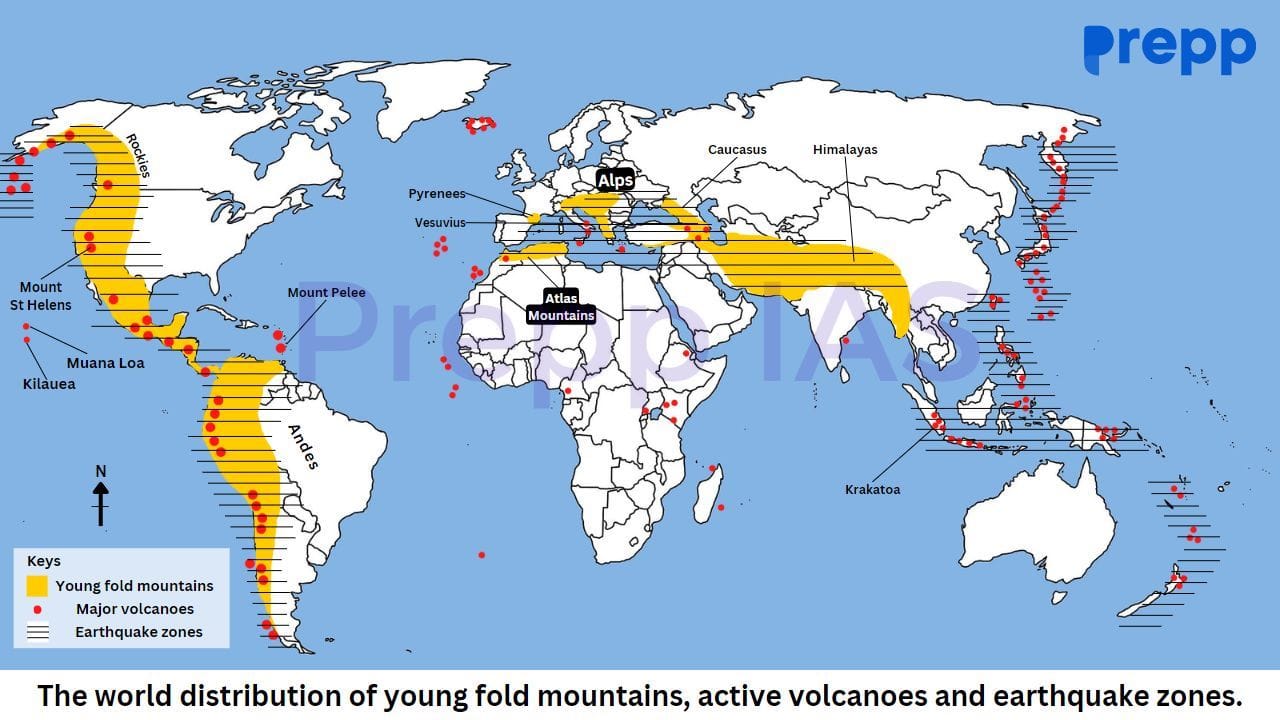
Distribution of fold mountains around the globe
What exactly are Fold Mountains?
- Fold mountains are formed by compressive forces generated by endogenic processes from within the earth folding crustal rocks.
- Fold mountains are often located along the edges of continents in either a north-south or east-west direction, according to their distributional pattern around the world.
- Due to compression, rocks, and debris are warped and folded into rocky outcrops, hills, mountains, and entire mountain ranges.
- When plates and the continents that ride on them collide, the accumulated layers of rock crumple and fold like a pushed-across tablecloth.

Formation of Fold Mountains according to the Theory of Plate Tectonics
- According to Plate Tectonics, mountains are formed by colliding lithospheric plates along convergent boundaries.
- The resulting sediments are compressed, accumulated, and uplifted as the plates collide.
- The denser oceanic crust is subducted under the lighter continental crust at the Oceanic-Continental (O-C) convergent plate boundary.
- The sediments are squeezed and folded as a result of the subduction's lateral compressive force.
- The amount of sedimentation is greatest near the Continental-Continental (C-C) convergent plate boundary, resulting in the development of the world's highest mountains.
- The largest compressive stresses are connected with C-C convergence; therefore, the fold mountains here form complicated folds and reverse faults.


Location of Fold Mountains
- Fold Mountains are not randomly spread across the Earth's surface.
- Young fold mountains are found mostly on the edges of continents.
- They are mostly found in the north and west of continents, such as the Atlas in Africa, the Rockies in North America, and the Andes in South America.
- The Himalayas were formerly positioned near the continent's edges if we consider the former Tethys Sea.
- Some of the major plate borders are marked by them.
- Within the current continents, there are old-fold mountains. They are representations of old plate borders and orogenic motions.
Characteristics of Fold Mountains
- Due to the existence of active plate borders, the region is prone to earthquakes in general.
- Fold mountains are part of the earth's youngest mountain group. They are one of the world's newest mountains.
- Generally found in an arc form with a concave slope on one side and a convex slope on the other.
- The presence of fossils implies that these folded mountains' sedimentary rocks developed after silts and sediments accumulated and consolidated in a marine environment.
- Fold mountains are long but narrow.
- Fold mountains are mainly found at oceanic continental edges (C-O Convergence).
- Granite intrusions (produced when magma crystallizes and solidifies underground to form intrusions) on a huge scale define fold mountains.
- Volcanic activity is frequently associated with high heat flux (the Himalayas are an exception).
- These mountains are both the most numerous and the most significant.
- They also have abundant mineral resources such as tin, copper, gold, and other metals.
Classification of Fold Mountains
Fold Mountains are classified on various bases as follows:
On the Basis of the Period of Origin
Fold mountains can be categorized into three categories based on their age of origin - very old fold mountains, old fold mountains, and Alpine fold mountains.
Very Old Fold Mountains
- They date back over 500 million years.
- They have a rounded appearance (due to denudation).
- They are situated at a low altitude.
- Laurentian mountains and Algoma mountains in Canada are examples of this category.
Old Fold Mountains
- Before the Tertiary period, Old Fold Mountains existed (the tertiary period started 66 million years ago).
- This category includes fold mountain systems from the Caledonian and Hercynian mountain-building periods.
- North America's Appalachians and Russia's Ural Mountains are examples of this category.
- From India Aravali and Vindyachal are examples of this category.
- Because of their moderately rounded characteristics and medium elevation, they are also known as thickening relict fold mountains.
- Erosion action has worn off the top layers.
Aravali Mountains
- India's Aravalli Range is one of the country's oldest fold mountain systems.
- The range grew during the Aravalli-Delhi orogeny, a Post Precambrian occurrence.
Alpine or Young Fold Mountains
- Because they formed in the Tertiary period (66 million years ago to the present), Alpine fold mountains dating to the Tertiary period can be classified as new fold mountains.
- The Rockies in North America, the Andes in South America, the Alps in Europe, and the Himalayas in India are examples of this category.
- These fold mountains have rugged terrain, and lofty mountains and peaks are conical.
On the Basis of the Nature of Folds
Folded mountains are divided into 2 broad categories on the basis of the nature of folds.
Simply Folded Mountains with Open Folds
- Such mountains have well-developed anticlines and synclines, with folds grouped in a wave pattern.
- The folds in these mountains are open and simple.
Complex Folded Mountains
- Fold mountains have a complicated structure made up of tightly squeezed folds such as 'nappe'.
- The creation of recumbent folds produced by high compressive forces results in complex folded mountains.

*To know about types of folding, click this link Types of Folding
Significance of Fold Mountains
- Climate, vegetation, lifeforms, and human activities in the area are all influenced by the fold mountains.
- The Himalayan fold mountains, likewise, influence the climate of the Indian subcontinent.
- Fold Mountains protect people from the harsh winters of Siberia by blocking the chilly winds.
- The orographic rainfall caused by the south-eastern monsoonal winds is also due to the presence of fold mountains.
- These regions are home to some of the world's most popular tourist destinations.
- During the summer, they provide a vacation destination and offer adventure sports opportunities.
- Their high slope and glacier-melting water present enormous promise for hydroelectric power, a greener energy source than coal-based thermal power.
- Aside from forest products like lumber and fuelwood, agriculture (restricted to sun-facing slopes) and mining minerals are two of the mountains' significant economic benefits.
Disadvantages
- Fold mountains, on the other hand, are vulnerable to both natural and man-made calamities.
- Earthquakes affect almost all of them, and many are also vulnerable to volcanic eruptions.
- These mountains' soft soil makes them vulnerable to landslides in the case of severe rains or earthquakes.
- As evidenced by the Nepal earthquake of 2015 and the Uttarakhand mountain Tsunami of 2013, human activities have further destabilized the area's natural balance and exacerbated the region's vulnerability
Conclusion
Fold mountains are formed primarily by the impacts of folding on strata within the Earth's crust's top layers. The phrase was applied to most mountain belts, including the Himalayas before plate tectonic theory or the underlying architecture of thrust belts were well recognized. Orogenic motions are the forces responsible for the creation of fold mountains. Plate tectonics is the primary cause of the creation of fold mountains.
FAQs
Question: What are fold mountains and how are they formed?
Answer: Fold mountains are formed when the earth’s crust is compressed and folded due to the collision of tectonic plates at convergent plate boundaries.
Question: What is the difference between young and old fold mountains?
Answer: Young fold mountains like the Himalayas are still rising due to tectonic activity, while old fold mountains like the Aravalli Range have undergone erosion and are less elevated.
Question: Why are fold mountains important for water resources?
Answer: Fold mountains are home to glaciers and rivers, providing vital water resources for irrigation, drinking, and hydroelectric power.
Question: What role do fold mountains play in the climate system?
Answer: Fold mountains like the Himalayas influence regional climate by acting as a barrier that affects wind patterns, monsoons, and precipitation.
Question: Which mountain ranges are examples of fold mountains?
Answer: Examples of fold mountains include the Himalayas in Asia, the Alps in Europe, the Andes in South America, and the Rockies in North America.
MCQs
1. Which of the following is an example of a young fold mountain?
A. Himalayas
B. Aravallis
C. Appalachians
D. Western Ghats
Answer: (A) See the Explanation
The Himalayas are an example of young fold mountains, still rising due to the ongoing tectonic activity between the Indian and Eurasian plates.
2. What causes the formation of fold mountains?
A. Erosion
B. Volcanic activity
C. Collision of tectonic plates
D. Subsidence
Answer: (C) See the Explanation
Fold mountains are formed due to the collision of tectonic plates at convergent plate boundaries, causing the earth's crust to fold and uplift.
3. Which of the following fold mountains are located in South America?
A. Alps
B. Rockies
C. Andes
D. Carpathians
Answer: (C) See the Explanation
The Andes are located in South America and are among the longest and tallest fold mountain ranges in the world.
4. Which old fold mountain range is located in India?
A. Himalayas
B. Western Ghats
C. Aravallis
D. Satpuras
Answer: (C) See the Explanation
The Aravalli Range is an example of old fold mountains in India, which have been eroded over time and are much lower in elevation compared to young fold mountains.
5. What is the primary reason for the rugged terrain of fold mountains?
A. Volcanic activity
B. Glaciation
C. Tectonic plate movement
D. River erosion
Answer: (C) See the Explanation
The rugged terrain of fold mountains is primarily due to the tectonic plate movement, which creates folds, ridges, and steep valleys.
GS Mains Questions and Model Answers
Q1: Discuss the role of fold mountains in influencing global and regional climate patterns.
Answer: Fold mountains like the Himalayas play a crucial role in influencing both global and regional climate patterns. The Himalayas act as a barrier to the cold winds from Central Asia, keeping the Indian subcontinent warmer during the winter months. Additionally, they block the moist monsoon winds, forcing them to rise and release precipitation, which is essential for the Indian monsoon. Similarly, the Andes in South America affect the climate by influencing the movement of air masses, contributing to the formation of deserts like the Atacama on the western side of the range.
Q2: Analyze the significance of fold mountains in providing natural resources and their role in economic development.
Answer: Fold mountains are rich in natural resources such as minerals, forests, and water resources. The Himalayas, for example, are a source of freshwater rivers that sustain agriculture and provide drinking water for millions of people. They are also important for hydroelectric power generation due to the fast-flowing rivers and steep gradients. Moreover, fold mountains are rich in mineral deposits like iron, coal, and gold, which contribute to industrial development. The tourism sector also benefits from the natural beauty and adventure activities in fold mountain regions, further contributing to the local and national economy.
Q3: Evaluate the environmental challenges faced by fold mountain ecosystems and suggest measures to address these challenges.
Answer: Fold mountain ecosystems face several environmental challenges, including deforestation, soil erosion, glacial retreat, and biodiversity loss. Human activities such as logging, mining, and construction in mountain areas exacerbate these issues. Soil erosion due to deforestation can lead to landslides, threatening lives and infrastructure. The retreat of glaciers in mountain ranges like the Himalayas due to climate change poses a serious threat to water security in the region. To address these challenges, sustainable practices like afforestation, soil conservation, and regulated mining should be implemented. Additionally, policies aimed at mitigating climate change can help reduce the impact on these fragile ecosystems.
Previous Year Questions from Fold Mountains - Physical Geography
1. UPSC CSE Prelims 2020
Question: Which of the following is an example of fold mountains?
A. Vindhya Range
B. Aravalli Range
C. Himalayas
D. Western Ghats
Answer: C
Explanation: The Himalayas are fold mountains, formed by the collision of the Indian and Eurasian tectonic plates.
2. UPSC CSE Mains 2019 (GS Paper 1)
Question: Explain the process of formation of fold mountains and their significance in the global climatic system.
Explanation: Fold mountains are formed by the collision of tectonic plates at convergent boundaries, which results in the folding and uplifting of the earth’s crust. They play a crucial role in the global climatic system by influencing wind patterns, precipitation, and temperature. For example, the Himalayas block cold winds from Central Asia, protecting the Indian subcontinent from extreme cold. Additionally, fold mountains contribute to water cycles by acting as sources of major rivers, which sustain life and ecosystems downstream.
Download the PREPP App and attempt FREE IAS Exam Mock Tests and get complete study material!

Live Test : UPSC CSE Prelims CSAT (Paper-II) (Oct 20 - 23)
Full Test - 04: UPSC CSE Prelims CSAT (Paper-II)
Full Test - 03: UPSC CSE Prelims CSAT (Paper-II)
UPSC CSE Prelims 2026 GS Paper 1 Question Paper (24-May-2026)
UPSC CSE Prelims 2026 CSAT Paper 2 Question Paper (24-May-2026)

17 February 2025 | The Hindu Must Read Articles | Current Affairs

16 February 2026 | The Hindu Must Read Articles | Current Affairs

13 February 2026 | The Hindu Must Read Articles | Current Affairs









Comments