Citizen’s Charter – Ethics Notes
Citizen’s Charter is a response to the desire to solve the challenges that citizens face on a daily basis when engaging with organizations that provide public services. It is also one of the prerequisites for Good Governance. The term 'Citizen' in the Citizen's Charter refers to the clients or customers whose interests and values are addressed by the Citizen's Charter, and thus includes not only citizens, but also all stakeholders, i.e., citizens, customers, clients, users, beneficiaries, other Ministries/ Departments/ Organizations, State Governments, UT Administrations, and so on. In this article we will discuss Citizen’s Charter which will be helpful for UPSC exam Ethics, Integrity & Aptitude (GSIV) preparation.
Table of Contents
- Citizen’s Charter – Background
- What is a Citizen’s Charter?
- Principles of Citizen’s Charter
- Citizen’s Charter – Salient Features
- Framework of Citizen’s Charter
- Components of Citizen’s Charter
- Significance of Citizen’s Charter
- Challenges Faced in Implementing Citizen’s Charter
- Citizen’s Charter in India
- Evaluation of Citizen’s Charter
- Key Recommendations for Citizen’s Charter
- Conclusion
- FAQs
Citizen’s Charter – Background
- The Citizens' Charter concept enshrines trust between the service provider and its consumers.
- The concept was first articulated and implemented in the United Kingdom in 1991 as a national Programme by the Conservative Government of John Major with a simple goal: to continuously improve the quality of public services for the people of the country so that these services respond to the needs and wishes of the users.
- The Program was relaunched in 1998 by Tony Blair's Labour government, which renamed it Services First.
- An 'Action Plan for Effective and Responsive Government' at the Centre and State levels was adopted at a Conference of Chief Ministers of various States and Union Territories held on May 24, 1997 in New Delhi, presided over by the Prime Minister of India.
- One of the important decisions made at that Conference was that the Central and State Governments would develop Citizens' Charters, beginning with sectors having a high public interface (e.g., railways, telecommunications, postal services, and public distribution systems).
- These Charters were supposed to incorporate reasonable service standards and time restrictions for the public, pathways for grievance resolution, and a framework for independent scrutiny with the participation of citizen and consumer groups.
| Other Relevant Links | |
|---|---|
| Emotional Intelligence | Political Neutrality |
| Corporate Governance | International Morality |
| Utilization of Public Funds | Attitude |
| Kindness, Forgiveness, Self-Control And Good Temper, Fortitude, Cowardice, Empathy, Atruism, Truthfulness-Ethical Qualities | Code of Ethics And Code of Conduct |
| Ethical Ideas in Indian Philosophical Tradition | Code of Ethics for Civil Servants |
| Right to Information Act | Corruption |
What is a Citizen’s Charter?
- A citizen's charter is a document that states a government agency's commitment to residents regarding the services it provides.
- It gives citizens the ability to press for the committed service standards.
- The charter's major goal is to bridge the gap between residents and administration by streamlining citizens' demands and concerns for efficient execution.
- Citizen Charter is a document created by an organization that contains information on the many services hosted by the organization, as well as the cost and time required to deliver such services.
- In other words, it is a collection of obligations made by an organization regarding the service standards that it provides.
- A Citizen Charter is a document that demonstrates a systematic attempt to focus on the Organization's commitment to its Citizens in terms of Service Quality, Information, Choice and Consultation, Non-discrimination and Accessibility, Grievance Redress, Courtesy, and Value for Money.
- This also includes the Organization's expectations from the Citizen in terms of fulfilling the Organization's promise.
- A citizen-centered approach stresses residents as customers by ensuring that public services are responsive to the citizens they serve.
- It includes the organization's Vision and Mission Statements, as well as the overall plan for achieving these goals and achievements.
- A Citizen's Charter is not legally binding and hence cannot be litigated.
Principles of Citizen’s Charter
The basic objective of the Citizens Charter is to empower the citizen in relation to public service delivery. Six principles of the Citizens Charter movement as originally framed, were:
- Quality: Improving the quality of services;
- Choice: Wherever possible;
- Standards: Specify what to expect and how to act if standards are not met;
- Value: For the taxpayers money;
- Accountability: Individuals and Organisations; and
- Transparency: Rules/ Procedures/ Schemes/Grievances.
These were later elaborated by the Labour Government as following nine principles of Service Delivery (1998):
- Set standards of service;
- Be open and provide full information;
- Consult and involve;
- Encourage access and the promotion of choice;
- Treat all fairly;
- Put things right when they go wrong;
- Use resources effectively;
- Innovate and improve;
- Work with other providers.
Citizen’s Charter – Salient Features
Standards
- The Charter should provide explicit service delivery criteria so that users understand what they can properly expect from service providers.
- These standards must be timely, pertinent, accurate, measurable, and explicit.
- Organizations must avoid the inclination to create targets and standards based on their own convenience rather than the requirements of citizens.
Information and Openness
- The availability of relevant and succinct information to users at the correct time and location is a crucial quality of good service.
- The Charters should include complete and accurate information on the services supplied, the levels and quality of service to be expected, the accessible routes for grievance redressal, and so on.
- Handbooks, guides, posters, and websites are some of the avenues via which citizens can receive information.
Choice and Consultation
- Wherever possible, the Charter should give people a choice of services.
- Regular and thorough interaction with service users is required to establish service standards and ensure the quality-of-service delivery.
Courtesy and Helpfulness
- The Charter can help to instil in public officials a culture of courteous and helpful service.
- Furthermore, minor initiatives like as 'name badges', 'May I assist you' counters, and so on can go a long way toward increasing client confidence.
Grievance Redressal and Complaints Handling
- There is a clear correlation between providing exceptional service and managing complaints effectively.
- For starters, the reasons for complaints can be addressed by facilitating and responding to them.
- Second, by identifying 'trends' in complaints, the service provider is able to tackle systematic and reoccurring issues.
Framework of Citizen’s Charter
- A citizen's charter is a document that contains pledges made by a government entity to people/client groups regarding the services/schemes that are or will be delivered to them.
- The goal of the Charter exercise is to develop bridges between citizens and administration while also streamlining administration to better meet the demands of citizens.
- If properly developed and executed, this activity can energize and enable organizations to tailor their strategy, policy, and performance to the wants and concerns of citizens/ stakeholders/ users/ clients.
- For this transformative process to be realized, effective realization strategies must be developed at numerous levels, and authorization of these methods must be attempted at every level of the political and administrative system.
- These strategies must include three components.
- One, clarity at all levels about the Charter's aims as a tool for policy rationalization and administrative tweaking to accomplish policy goals desired by citizens.
- Two, developing and delivering Charters as live instruments of citizen-administration interface, as well as establishing citizens in the public sphere.
- Three, evolving systems for charter monitoring, evaluation, and review. Establishing a method for recognizing effectiveness in Charter implementation can aid the process.
Components of Citizen’s Charter
1) Vision Statement: The ultimate direction in which the organization wishes to move is implied by vision. Clarity of vision allows the organization to plan and prepare for specified goals.
2) Mission Statement: The 'mission' statement outlines the exact goals that will propel the company toward its vision.
3) Identification of Services: The Charter should clearly describe the services that the organization will deliver in order to achieve its mission and vision. This should include a list of all the services that will be made available through its various agencies.
4) Identification of Levels: Because organizations operate at numerous levels, the delegation of responsibilities and authority defines their commitment to certain client groups/users/stakeholders. The levels at which particular services would be delivered should be clearly identified in the Charter.
5) Identification of Client Groups/Stakeholders/Users: Organizations would need to have a clear awareness of their client groups/ stakeholders/ users in order to have a greater contact with them in terms of policy and administration. This will also allow the organization to better meet the needs of these groups.
6) Specification of Time-Frames for Each Service: The Charter should include a clear commitment about the timeframe for delivering specified services. This would free the organization from unwarranted expectations while also allowing it to project its capacity to commit to service delivery and work toward it in its own organizational goals.
7) Specification of Time-Frames for Each Level: It is critical to establish service delivery timeframes at each level at which specialized services are supplied. Adherence to these must also be ensured.
Significance of Citizen’s Charter
- Improved Service Delivery: Citizen Charter has resulted in improved service delivery, reduced bureaucracy, and increased citizen satisfaction.
- For example, the Ministry of Railways introduced the Passenger's Charter, which specifies train passengers' rights and responsibilities.
- It includes promises like supplying clean coaches, leaving on time, and promptly resolving grievances.
- The entire passenger experience has improved as a result of this endeavour.
- Increased Accountability: Accountability has increased as a result of the Citizen Charter, which establishes performance criteria, service commitments, and timetables for service delivery, holding government officials accountable for their activities.
- Better Grievance Redressal: It has improved service quality and grievance redressal processes for citizens who have been wronged.
- For example, the Citizen's Charter of the Hyderabad Metropolitan Water Supply and Sewerage Board includes a provision for payment of compensation as a mark of commitment to its customers in the event of service failure.
- Trust and Public Confidence: When government entities openly commit to and demonstrate adherence to service standards, citizens gain confidence.
- Continuous Improvement: Government agencies can discover gaps, fix inadequacies, and make necessary improvements by evaluating performance against service standards and soliciting feedback from citizens.
- Incorporating Citizen Feedback in Policymaking: The Citizen Charter assists in incorporating feedback from service users in order to improve service delivery quality.
- Reduced Corrupt Practices: The Citizens Charter aims to decrease corruption by increasing openness and limiting discretionary authority.
Challenges Faced in Implementing Citizen’s Charter
- The prevalent assumption among organizations that developed Citizens' Charters was that the exercise was necessary because there was a directive from on high. The consultation procedure was either limited or non-existent. As a result, it became one of the organization's everyday activities with little focus.
- For any Charter to succeed, the personnel responsible for its execution must get sufficient training and orientation, as Charter promises cannot be expected to be delivered by a workforce that is unaware of the Charter's spirit and content. However, in many cases, the relevant personnel were not appropriately taught or sensitized.
- Transfers and reshuffles of relevant officers at critical stages of the formulation/implementation of a Citizens' Charter in an organization have occasionally seriously weakened the strategic procedures that have been put in place and delayed the initiative's success.
- Client education initiatives concerning the Charter were not carried out in a systematic manner.
- In several circumstances, the standards/time norms of services described in the Citizens' Charter were either too lenient or too strict, creating unreasonable expectations among Charter clients.
- The Citizens' Charter concept was not adequately grasped. Previously generated information booklets, PR materials, and pamphlets by the organizations were misidentified as Citizens' Charters.
Citizen’s Charter in India
- Significant progress has been made in the sphere of economic development in India over the years.
- This, combined with a significant increase in literacy (from 51.63% to 65.38% in the recent decade), has made Indian individuals more conscious of their rights.
- Citizens have become more articulate, and they expect the administration to anticipate their needs as well as respond to them.
- The job of organizing, creating, and implementing Citizens' Charters was initiated by the Government of India's Department of Administrative Reforms and Public Grievances (DARPG).
- Guidelines for developing the Charters, as well as a list of do's and don'ts, were distributed to various government departments/organizations in order for them to produce focused and successful charters.
- The following aspects are expected to be included in the Charters:
- Vision and Mission Statement
- Details of business transacted by the organisation
- Details of clients
- Details of services provided to each client group
- Details of grievance redress mechanism and how to access it
- Expectations from the clients
Evaluation of Citizen’s Charter
- DARPG hired a professional agency in 2002-03 to create a standardised mechanism for internal and external evaluation of Citizens' Charters in a more effective, quantitative, and objective manner.
- This agency also assessed the execution of charters in 5 Central Government Organizations and 15 Departments/Organizations in the states of Andhra Pradesh, Maharashtra, and Uttar Pradesh.
- This Agency was also tasked with recommending means for expanding awareness, both within the organization and among users, as well as possible techniques for orienting management and staff in the process of developing and deploying Charters.
- According to the Agency's evaluation report, the following were the significant findings:
- In the majority of situations, Charters were not developed through a consultation process.
- Service providers are often unfamiliar with the philosophy, goals, and principal characteristics of the Charter.
- Adequate publicity to the Charters was not provided in any of the Departments assessed. Most Departments' Charters are still in the early or intermediate stages of implementation.
- No funds have been particularly designated for raising awareness of the Citizens' Charter or orienting personnel on the various components of the Charter.
Key Recommendations for Citizen’s Charter
Recommendations by Indian Institute of Public Administration (IIPA)
- The need for citizens and staff to be consulted at every stage of the Charter's formulation.
- Staff orientation about the Charter's salient features and goals/objectives; the department's vision and mission statement; and skills such as team building, problem solving, grievance handling, and communication skills.
- The need for the creation of a database on consumer grievances and redress.
- The need for wider publicity of the Charter through print media, post.
- Designation of specific budgets for staff knowledge and orientation.
- Replication of best practices in this field.
Recommendations by Second ARC Report
- Internal reorganization should come before the creation of the Charter: Simply declaring the Charter will have no effect on how the Organization operates. It is critical to establish favourable conditions for employees through engagement and training.
- One Size Doesn’t Fit All: The creation of Citizens' Charters should be a decentralized process, with the main office offering broad guidelines.
- Process of Wide Consultation: The charter must be developed not only by senior specialists, but also through contact with the cutting-edge employees who will ultimately implement it, as well as with the user.
- Citizens' Charters must establish firm commitments in quantitative terms.
- Redressal Mechanism: Citizens' Charter should explicitly state the relief that the organization is obligated to provide if it fails to meet the promised standards of service.
- Citizens' Charters to be reviewed periodically: Since the Citizens' Charter is a living document, it should be reviewed at least every six months.
- Participation of Civil Society in the Process: Encourage cooperation among government agencies, civil society organizations, and individuals in developing, implementing, and monitoring Citizen's Charters.
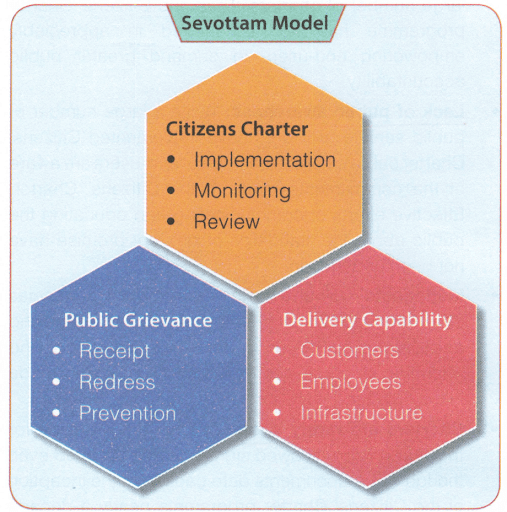
Sevottam Model
First Pillar – Citizen’s Charter
Second Pillar – Grievance Redressal Mechanism
Third Pillar – Drive for Excellence
|
Conclusion
The implementation of the Citizens' Charter is an ongoing process since it must reflect the enormous and ongoing changes occurring in the realm of public services. The Indian government is constantly striving to serve its residents in an effective and efficient manner, not only meeting but exceeding their expectations. Citizens' Charter is a significant step in this approach.
| Other Relevant Links | |
|---|---|
| Challenges To Ethics and Moral Accountability | Gandhian Ethics |
| Aspects of Morals | Definition of Ethics |
| Post Aristotelian Philosophers | Ethical Ideas in Indian Philosophical Tradition |
| Lessons From The Lives Of Great Indian Leaders, Reformers And Administration | Moral Thinkers of the Twentieth Century |
FAQs
Question: What is a Citizens' Charter?
Answer: A Citizens' Charter is a written document that outlines the standards of service, rights, and responsibilities of citizens in their dealings with government bodies or public sector organizations.
Question: Why was the Citizens' Charter initiative introduced?
Answer: The initiative was introduced to improve transparency, accountability, and the quality of public services by setting clear expectations and guidelines for the government and its citizens.
Question: What are the main components of a Citizens' Charter?
Answer: A Citizens' Charter typically includes service standards, grievance redressal mechanisms, and performance commitments regarding services offered by public institutions.
Question: How does the Citizens' Charter benefit citizens?
Answer: The Citizens' Charter ensures transparency in service delivery, provides a framework for addressing grievances, and helps citizens access services more efficiently by holding government bodies accountable.
Question: Which countries have adopted the Citizens' Charter?
Answer: The Citizens' Charter concept was first introduced in the United Kingdom in 1991 and has since been adopted by several countries including India, Canada, Australia, and others.
MCQs
1. What is the primary goal of a Citizens' Charter?
A) To provide economic subsidies to citizens
B) To set standards for government services and enhance transparency
C) To reduce government expenditure
D) To ensure the availability of resources to citizens
Answer: (B) See the Explanation
Explanation: The primary goal of a Citizens' Charter is to set clear standards for government services, ensuring transparency and accountability in the delivery of public services.
2. In which year was the Citizens' Charter concept introduced in India?
A) 1980
B) 1991
C) 1997
D) 2000
Answer: (B) See the Explanation
Explanation: The concept of the Citizens' Charter was introduced in India in 1997 to enhance the quality of services and address grievances in government institutions.
3. What is the main benefit of a Citizens' Charter for the government?
A) To create new laws
B) To ensure the efficient use of public funds
C) To improve service delivery and accountability
D) To increase public sector employment
Answer: (C) See the Explanation
Explanation: A Citizens' Charter helps improve service delivery by setting clear service standards and enhances accountability by providing a mechanism to address grievances.
4. Who is responsible for implementing the Citizens' Charter?
A) Citizens themselves
B) Government bodies or public sector organizations
C) Non-governmental organizations
D) The judiciary
Answer: (B) See the Explanation
Explanation: The implementation of a Citizens' Charter is the responsibility of government bodies or public sector organizations that offer services to citizens.
5. How are grievances addressed under a Citizens' Charter?
A) By raising taxes
B) Through a dedicated grievance redressal mechanism
C) By ignoring them
D) By suspending the services
Answer: (B) See the Explanation
Explanation: A Citizens' Charter includes a grievance redressal mechanism, through which citizens can lodge complaints, and their concerns are addressed in a timely manner.
GS Mains Questions and Model Answers
Q1: Critically examine the role of Citizens' Charters in improving public service delivery in India.
Answer: Citizens' Charters play a significant role in improving public service delivery by setting clear expectations for government services. They promote transparency, accountability, and responsiveness by providing citizens with well-defined service standards and grievance redressal mechanisms. In India, Citizens' Charters have helped enhance the quality of services in various sectors, including healthcare, education, and public administration. However, challenges such as poor implementation, lack of awareness, and limited monitoring have hindered their full potential. Strengthening the enforcement of these charters and increasing public awareness is crucial for maximizing their impact on public service delivery.
Q2: How do Citizens' Charters contribute to strengthening good governance in India?
Answer: Citizens' Charters contribute to strengthening good governance by ensuring that government bodies adhere to defined service standards and are accountable for their actions. By providing a formal mechanism for citizens to register complaints and receive timely responses, these charters promote transparency and foster trust between the government and the public. Furthermore, they empower citizens to demand better services, thereby encouraging government agencies to perform efficiently and effectively. This accountability framework is essential for building a robust system of governance based on citizen participation and responsiveness.
Q3: Discuss the challenges faced in the implementation of Citizens' Charters in India and suggest ways to overcome them.
Answer: The implementation of Citizens' Charters in India faces several challenges, including a lack of awareness among citizens, inadequate staff training, and inconsistent enforcement of service standards. Many government agencies lack the capacity or resources to fulfill the commitments made in the charters, and the grievance redressal mechanisms often remain ineffective. To overcome these challenges, it is essential to improve public awareness about the charters, ensure the proper training of officials, and establish clear monitoring and evaluation systems. Additionally, there should be greater political will to enforce accountability and empower citizens to take action when service standards are not met.
Previous Year Questions on Citizens' Charter
1. UPSC CSE Mains 2020 (GS Paper 2):
Question: "Explain the concept of Citizens' Charter in the Indian context and its role in ensuring transparency and accountability in public services."
Answer: The Citizens' Charter is a document introduced to improve the delivery of public services by setting service standards and outlining the rights and responsibilities of citizens. In India, it plays a crucial role in ensuring transparency and accountability by allowing citizens to hold government organizations accountable for their actions. The charter includes performance commitments, grievance redressal mechanisms, and transparency measures, helping improve the quality of services in sectors like healthcare, education, and public administration.
2. UPSC CSE Mains 2019 (GS Paper 2):
Question: "Discuss the significance of Citizens' Charters in enhancing public sector service delivery and their impact on citizen-state relations."
Answer: Citizens' Charters have significantly enhanced public sector service delivery by setting clear expectations for both citizens and government agencies. They help improve transparency, reduce corruption, and increase accountability in the public sector. These charters also foster a better relationship between citizens and the state, as they empower citizens with the right to demand services and redress grievances. However, the effective implementation and monitoring of these charters are crucial to ensuring that they truly benefit the public and strengthen governance.
Download the PREPP App and attempt FREE IAS Exam Mock Tests and get complete study material!

Full Test - 04: UPSC CSE Prelims CSAT (Paper-II)
Full Test - 03: UPSC CSE Prelims CSAT (Paper-II)
UPSC CSE Prelims 2026 GS Paper 1 Question Paper (24-May-2026)
UPSC CSE Prelims 2026 CSAT Paper 2 Question Paper (24-May-2026)

17 February 2025 | The Hindu Must Read Articles | Current Affairs

16 February 2026 | The Hindu Must Read Articles | Current Affairs

13 February 2026 | The Hindu Must Read Articles | Current Affairs









Comments