Centre To Look Into ‘Havana Syndrome’: What It Means And The Term’s History
Relevance: GS 2 - Issues relating to the development and management of Social Sector/Services relating to Health.
(Source: Indian Express, 08/08/23)
Click here for Daily Current Affairs
Why in the news?
- Recently, a petitioner sought a writ of mandamus for an inquiry into Havana Syndrome and the prevention of high-frequency microwave transmission in India.
- The Karnataka High Court disposed off the petition after the centre assured the Court that it will address the issue of 'Havana Syndrome' in India.
Table of Contents

What is Havana Syndrome?
- Havana Syndrome refers to a set of mental health symptoms that are said to be experienced by United States intelligence and embassy officials in various countries.
- The Havana Syndrome typically involves symptoms such as hearing certain sounds without any outside noise, nausea, vertigo and headaches, memory loss and balance issues.
- The word ‘syndrome’ simply means a set of symptoms. It does not mean a unique medical condition, but rather a set of symptoms that are usually experienced together whose origins may be difficult to confirm.
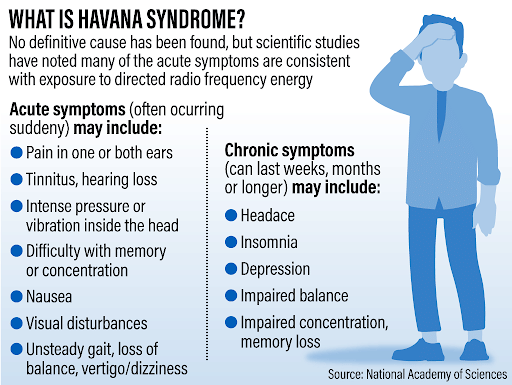
Origin of Havana Syndrome
- The term "Havana Syndrome" originates from incidents in Cuba in 2016, where some of the US embassy staff experienced brain pressure, headaches, disorientation, and insomnia.
- Following the initial Cuban incident, American intelligence and foreign affairs officials stationed in different countries have reported experiencing symptoms associated with the Havana Syndrome.
Similar cases have since been reported worldwide
- Uzbekistan (2017): A USAID employee reported an incident at the US Embassy in Tashkent.
- China (2018): US diplomats in Guangzhou consulate experienced similar symptoms.
- United States (2019-2020): Incidents occurred in Washington DC and near the White House.
- Global Spread: Over 130 cases reported in countries including Russia, Poland, Georgia, Taiwan, Colombia, Kyrgyzstan, Uzbekistan, and Austria.
- 2021: In 2021, US Vice-President Kamala Harris visit to Hanoi, Vietnam was delayed due to a similar incident reported by a US official in Vietnam.
Case in India
- The first reported case of Havana Syndrome occurred in 2021. A US intelligence officer traveling to New Delhi with CIA director William Burns experienced symptoms associated with the syndrome.
- As of July 2023, the 2021 incident stands as India's sole reported case of the syndrome.
- Indian officials expressed skepticism about possessing such a weapon and questioned the motive of targeting the US, considering their strong ties.
What are the causes of Havana Syndrome?
- Initially, it was thought to be a "sonic attack" during the Cuban incidents. However, further studies suggested that high-powered microwaves damage the nervous system, causing brain pressure and auditory sensations.
- It was said to have built pressure inside the brain that generated the feeling of a sound being heard.
- Greater exposure to high-powered microwaves is said not only to interfere with the body’s sense of balance but also to impact memory and cause permanent brain damage.
- Low levels of microwaves are also emitted from mobile phones but they are not targeted.
- Microwaves are a type of electromagnetic radiation, as are radio waves, ultraviolet radiation, X-rays and gamma-rays. Microwaves have a range of applications, including communications, radar and cooking.
- There were suspicions that high-powered microwaves were transmitted using a device known as a "microwave weapon."
- Weaponizing Microwaves as a counter-intelligence tool has been explored by both Russia and the US since the Cold War.
- Earlier reports suggest that US embassy officials in Moscow during the 1970s faced mental health problems linked to suspected microwave use.
Present status on origin of disease
- Lack of evidence on causes: Despite years of research, experiments, and medical assessments, the US has not found conclusive proof of the existence of the "microwave weapon."
- The mechanics and targeting of this supposed weapon remain unclear.
- Some US medical experts dismiss the theory, attributing the syndrome to psychological factors and heightened fear.
- Some experts have highlighted the absence of similar reports from officials of other countries, except for the Canadian embassy in Havana
(*Click this link to read prelims specific weekly current affairs articles)
FAQs
Question: What is meant by Syndrome?
Answer:
The word ‘syndrome’ simply means a set of symptoms. It does not mean a unique medical condition, but rather a set of symptoms that are usually experienced together whose origins may be difficult to confirm.
Question: What is Havana Syndrome?
Answer:
Havana Syndrome refers to a set of mental health symptoms that are said to be experienced by United States intelligence and embassy officials in various countries.
The Havana Syndrome typically involves symptoms such as hearing certain sounds without any outside noise, nausea, vertigo and headaches, memory loss and balance issues.
Question: What are microwaves?
Answer:
Microwaves are a type of electromagnetic radiation, as are radio waves, ultraviolet radiation, X-rays and gamma-rays. Microwaves have a range of applications, including communications, radar and cooking.
MCQ
A question similar to the one given below can be asked on the application of microwaves
Question: “3D printing” has applications in which of the following? (UPSC-2018)
(1) Preparation of confectionery items
(2) Manufacture of bionic ears
(3) Automotive industry
(4) Reconstructive surgeries
(5) Data processing technologies
Select the correct answer using the code given below :
(a) 1, 3 and 4 only
(b) 2, 3 and 5 only
(c) 1 and 4 only
(d) 1, 2, 3, 4 and 5
Answer: (d) See the Explanation
- 3D printing or additive manufacturing is the construction of a three-dimensional object from a CAD model or a digital 3D model.It can be done in a variety of processes in which material is deposited, joined or solidified under computer control,with material being added together (such as plastics, liquids or powder grains being fused), typically layer by layer.
- 3D printing offers a wide range of applications, including the creation of artificial limbs, stents, dental crowns, automobile parts, consumer goods, etc.
- Therefore, option (d) is the correct answer.
Download the PREPP App and attempt FREE IAS Exam Mock Tests and get complete study material!

Full Test - 04: UPSC CSE Prelims CSAT (Paper-II)
Full Test - 03: UPSC CSE Prelims CSAT (Paper-II)
UPSC CSE Prelims 2026 GS Paper 1 Question Paper (24-May-2026)
UPSC CSE Prelims 2026 CSAT Paper 2 Question Paper (24-May-2026)

17 February 2025 | The Hindu Must Read Articles | Current Affairs

16 February 2026 | The Hindu Must Read Articles | Current Affairs

13 February 2026 | The Hindu Must Read Articles | Current Affairs









Comments