The Hardening Trade Stance
Relevance: GS2 - Government policies and interventions; GS3 - Indian Economy; Changes in industrial policy and their effects on industrial growth; Growth and Development
(Source: Indian Express, 08/08/2023)
Click here for Daily Current Affairs
Why in the news?
- The recent decision by the Government to impose restrictions on the import of items like personal computers, laptops, and requiring a special license for their import, signifies a departure from the long-standing policy followed by previous governments since the time of the Rajaraman Committee.
- This article sheds light on India's changing trade policy landscape.
Table of Contents
About Rajaraman Committee
- The 1981 Rajaraman Committee, led by Prof. V Rajaraman proposed concessions for importing computers against software exports.
- This shift aimed to encourage computer imports against software exports, challenging the state-owned Electronics Corporation's monopoly.
- This policy shift led to the computerization of various sectors, including railways and finance, catalyzing India's IT revolution.
Background of Trade Barriers
- For over two decades, successive Indian governments had pursued a consistent policy of lowering import duties.
- This approach led to a substantial reduction in peak customs duty rates for non-agricultural products:
- from 150% in 1991-92 to 40% in 1997-98, followed by further reductions to 20% in 2004-05, and ultimately to 10% in 2007-08.
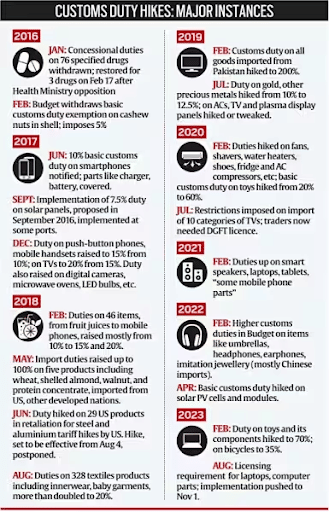
- In 2016, India began adopting a series of tariff hikes. This departure from the established trajectory marked a departure from the country's long-standing commitment to reducing trade barriers.
- India's customs duties policies experienced a shift from mid-2017 onward, with tariff adjustments aimed at benefiting domestic manufacturing and addressing trade imbalances.
Challenges to India's Trade Policy Approach
- Bilateral Trade Deals: India's pursuit of bilateral Free Trade Agreements (FTAs) shows a renewed interest in expanding trade relations with specific countries. Bilateral FTAs can provide benefits in terms of targeted trade openings but might not lead to comprehensive integration into broader regional trading blocs.
- Avoidance of Mega-Regional Trading Arrangements: India's decision to stay out of significant regional trading arrangements like the Regional Comprehensive Economic Partnership (RCEP) raises questions about its approach. RCEP is a major pact among Asian economies, and India's absence might limit its access to a vast market and potential economic gains.
Examples of Opposition to the Trade Stance
- Import Duty Hike on Toys: In February 2020, the Indian toy industry united under the All India Toys Federation to vehemently oppose the increase in import duties on toys as proposed in that year's budget.
- Concessional Customs Duties on Essential Drugs: The withdrawal of reduced customs duties on 76 drugs in January 2016 was partially reversed due to negative effects on drug prices and availability. The Ministry of Health reinstated customs duty concessions on three drugs (Octreotide, Somatropin, and Anti-Haemophilic factor VIII & IX) on February 17, 2016.
- Solar Panel Duty Hike Opposition: Both the New and Renewable Energy Ministry and solar project developers objected to the duty increase on solar panels starting from September 2017.
- Basic customs duty on cashew nuts: The removal of customs duty exemption on cashew nuts in shell during Budget 2016-17 led to appeals from trade and industry in different states like Andhra Pradesh, Karnataka, Kerala, Tamil Nadu and the Cashew Export Council. They requested a repeal of the 5% duty on cashew nuts in shell.
Why did the Government impose a Ban on Import of Laptops and Similar Electronic Goods recently?
- Boost domestic manufacturing: The recently imposed restrictions aim to boost domestic manufacturing of IT hardware through the production-linked incentive (PLI) scheme while also curbing the influx of these products from countries like China and Korea.
- Ensure security: It was stated that the main reason for these restrictions is to ensure the security of citizens. Certain hardware might pose security risks and could compromise sensitive and personal data. Therefore, these measures have been taken to address these potential security-related issues.
- The move is in line with the government's initiatives to boost manufacturing in India ‘Make In India’ programme. The curbs on import will give a boost to local manufacturers of electronic products such as laptops, computers, etc.
Conclusion
- The importance of finding a balanced approach between protectionism and trade liberalization for sustainable economic growth should be emphasized.
- The sudden shift in trade policy, including the use of licensing as a trade tool, has disrupted the consistent approach followed by previous governments.
- There is a need for thoughtful policy decisions that consider the potential impact on industries, consumers, and international trade commitments.
(*Click this link to read prelims specific weekly current affairs articles)
FAQs
Question: What is Tariff?
Answer:
A tariff is a tax imposed by the government of a country or by a supranational union on imports or exports of goods.
Question: What is Licensing?
Answer:
Licensing acts as a control mechanism. It allows the government to manage and regulate the flow of these imported products, ensuring that they meet certain criteria or conditions before being allowed into the country.
Question: What is a Production Linked Incentive (PLI) scheme?
Answer:
It is a set of initiatives launched by the Government of India to boost domestic manufacturing and exports in various sectors. The schemes aim to provide financial incentives to eligible manufacturers based on their incremental production and sales over a base year.
UPSC Mains Practice Question:
|
MCQ
Question: A “closed economy” is an economy in which (UPSC 2011)
(a) the money supply is fully controlled
(b) deficit financing takes place
(c) only exports take place
(d) neither exports or imports take place
Answer: (d) See the Explanation
A closed economy typically refers to a country that does not trade or engage in other financial exchanges with any other country. That means no imports come into the country and no exports leave it.
Therefore, option (d) is the correct answer.
Download the PREPP App and attempt FREE IAS Exam Mock Tests and get complete study material!

Full Test - 04: UPSC CSE Prelims CSAT (Paper-II)
Full Test - 03: UPSC CSE Prelims CSAT (Paper-II)
UPSC CSE Prelims 2026 GS Paper 1 Question Paper (24-May-2026)
UPSC CSE Prelims 2026 CSAT Paper 2 Question Paper (24-May-2026)

17 February 2025 | The Hindu Must Read Articles | Current Affairs

16 February 2026 | The Hindu Must Read Articles | Current Affairs

13 February 2026 | The Hindu Must Read Articles | Current Affairs









Comments