Chhattisgarh Cabinet Paves Way For 32% Tribal Quota In Education
Relevance: GS2 - Government policies and interventions for development in various sectors; Welfare schemes for vulnerable sections of the population by the Centre and States and the performance of these schemes
(Source: The Hindu, Indian Express, 08/08/2023)
Why in the news?
- Recently, the Chhattisgarh cabinet took a decision to implement 58% reservation for the scheduled tribes, scheduled caste and other backward classes in the admission process for educational institutions of the state.
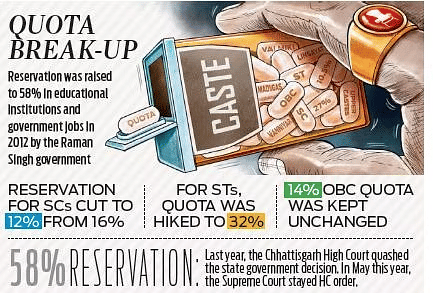
- The reservation for the SCs was reduced from 16% to 12% while increasing the same for STs to 32% and the quota for OBCs was kept at 14%.
Table of Contents
Background of Reservation Policy in Chhattisgarh
- In September, 2022, the Chhattisgarh High Court ruled that the State Government's decision to reserve 58% of the seats in recruitment and admission exams for members of the Scheduled Castes, Scheduled Tribes, and Other Backward Classes is "unconstitutional" since it goes over the 50% cap.
- In May, 2023, the Supreme Court granted interim relief to the State government, allowing them to maintain the pre-existing reservation system for appointment/selection procedures and educational institution admissions.
- The decision to amend the reservation policy was taken in 2012.
- The reservation for Scheduled Tribes was increased from 20% to 32% while the quota for scheduled castes were lowered from 16% to 12% and other backward classes had a 14% quota.
Scheduled Tribes in India
- The Constitution of India in Article 366 (25) prescribes that Scheduled Tribes means such tribes or tribal communities as are deemed under Article 342 of the Constitution to be Scheduled Tribes.
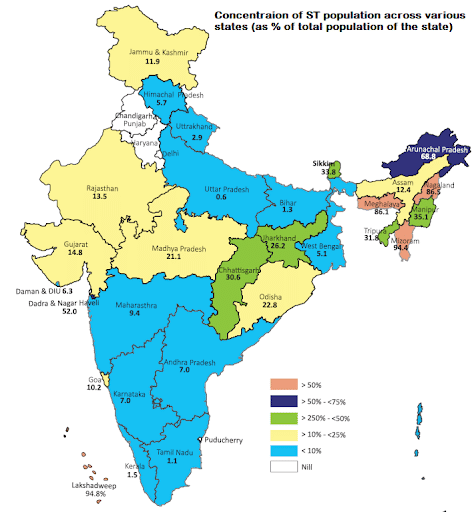
- The tribal population of the country, as per 2011 census, is 10.43 crore, constituting 8.6% of the total population.
How does the Indian Constitution deal with Reservation?
- Article 15(4): It was added by the Constitution (1st Amendment) Act, 1951. It provides for special provision for the advancement of backward classes.
- Article 15 (5) was introduced by the 93rd Amendment Act, 2005. It confers the power on the state to provide by law reserving seats in favour of backward classes of citizens in educational institutions including private educational institutions whether aided or unaided by the state by excluding minority educational institutions.
- Article 16(3): It is an exception to clause 2 of Article 16 which forbids discrimination on the ground of residence. It provides for reservation of Posts in Public Employment on the Basis of Residence.
- Article 16(4): It provides for reservation for Backward Classes in Public Employment. It empowers the state to make special provision for the reservation in appointments of posts in favour of any backward class of citizens which in the opinion of the State are not adequately represented in the services under the State.
- Fundamental Right: The Constitution of India provides for the right to equality. A fundamental right, it provides for equality irrespective of religion, race, gender, caste or place of birth. It also includes the right of equal opportunity in employment as well as the abolition of titles and untouchability.
- Preamble: The preamble states, “Equality of status and of opportunity”. Reservation hence seemed to be a justified recourse. It elevated those sections of society that had for generations been neglected. It provided a chance for equal opportunities or status in society and culture.
Government Initiatives for Tribal Development
- Eklavya Model School
- Van Bandhu Kalyan Yojana
- Rajiv Gandhi National Fellowship Scheme (RGNF)
- Vocational Training Center in Tribal Areas
- Swarnajayanti Gram Swarozgar Yojana
- MGNREGA
FAQs
Question: What is the reservation?
Answer:
Reservation is the process of assisting persons who have been subjected to historical injustice in areas such as education, scholarship, and employment. It is a type of affirmative action based on quotas.
Question: Who is the Chief Minister of Chhattisgarh?
Answer:
Bhupesh Baghel is an Indian politician serving as the 3rd and current Chief Minister of Chhattisgarh since 2018.
Question: Who are Scheduled Tribes in India?
Answer:
The Scheduled Tribes are tribes or tribal communities, or parts of or groups within these tribes and tribal communities, that have been proclaimed as such by the President by a public announcement, according to Article 342 of the Constitution.
Question: What is Eklavya Model Residential School (EMRS)?
Answer:
Eklavya Model Residential School (EMRS) is an welfare scheme of the Ministry of Tribals,Government of India aims to establish model residential schools for tribals (Scheduled Tribes) across India.
UPSC Mains Practice Question:
|
MCQ
Question: If a Particular area is brought under the Fifth Schedule of the Constitution of India, which one of the following statements best reflects the consequence of it? (UPSC 2022)
(a) This would prevent the transfer of land of tribal people to non-tribal people.
(b) This would create a local self-governing body in that area.
(c) This would convert that area into a Union Territory.
(D) The state having such areas would be declared as a Special Category State.
Answer: (a) See the Explanation
The Fifth Schedule of the Constitution deals with the administration and control of Scheduled Areas and Scheduled Tribes residing in any state other than Assam, Meghalaya, Tripura, and Mizoram. After consulting with the tribes advisory council, the governor may issue regulations for the peace and good governance of a designated area. Such regulations may prohibit or limit the transfer of land by tribal members to non-tribal members or among scheduled tribe members, as well as regulate the allotment of land to scheduled tribe members.
Therefore, option (a) is the correct answer.
Download the PREPP App and attempt FREE IAS Exam Mock Tests and get complete study material!

Full Test - 04: UPSC CSE Prelims CSAT (Paper-II)
Full Test - 03: UPSC CSE Prelims CSAT (Paper-II)
UPSC CSE Prelims 2026 GS Paper 1 Question Paper (24-May-2026)
UPSC CSE Prelims 2026 CSAT Paper 2 Question Paper (24-May-2026)

17 February 2025 | The Hindu Must Read Articles | Current Affairs

16 February 2026 | The Hindu Must Read Articles | Current Affairs

13 February 2026 | The Hindu Must Read Articles | Current Affairs









Comments