A ‘Distraction’ Balloon In The Winds Of Federalism
Relevance: GS2 - Indian Constitution, issues and challenges pertaining to the federal structure, Salient features of the Representation of People’s Act, Government policies and interventions for development in various sectors and issues arising out of their design and implementation
(Source: The Hindu, 09/05/2023)
Click here for Daily Current Affairs
Why in the news?
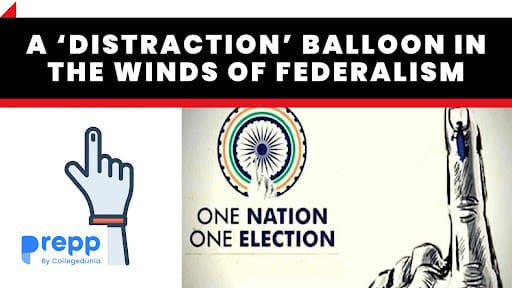
This article discusses the proposed One Nation, One Election scheme and the opportunities and challenges presented by it.
Table of Contents
| White-Collar Hiring Falls 6% In August On Cautious Sentiment In It, Auto Sectors: Report | Emerging Countries Need Women-Led Climate Action |
| UPSC current Affairs | UPSC Study Notes |
Why is the One Nation, One Election scheme considered necessary?
- According to the American political commentator, Sidney Blumenthal, India is in a permanent campaign, meaning that an election has been conducted at either the state or national level every year for the last 36 years.
- This results in a substantial burden on the finances and resources of the government and other political parties.
- Elections held constantly in some part of the country with a ‘model code of conduct’ distracts from governance and leads to policy paralysis.
Why is this a flawed argument?
Selective Impact
- The argument that India is in a 'permanent campaign' due to frequent elections is not accurate.
- In case elections are held in one state, for eg: West Bengal, the regional parties which contest elections in other states, such as Tamil Nadu, are not affected.
- National Parties' Pressure: Only national parties that involve their national-level officials for all local-level elections can be considered to be in a permanent campaign.
- The imposition of the Model Code of Conduct in the state will not halt developmental projects in other states.
- Therefore it can not be claimed that the whole of India is in ‘election mode’ rather some parts of the country are.
Diverse Political Landscape:
- Varied State Politics: India is a politically diverse nation with each state having its own unique political cultures and parties.
- It is therefore not right to alter the election framework of the country that encourages the growth of regional parties, solely for the convenience of national parties.
- Federalism Undermined: The idea of simultaneous elections infringes on the rights of the states such as its power to dissolve governments and recommend early elections adversely impacts Indian federalism.
Misleading arguments
Historical Perspective
- The simultaneous elections that were held in India between 1951-52 and 1967 were not the result of any planned design but a coincidence.
- India's diverse polity and plurality encouraged the emergence of new regional parties.
- Consequently, the political requirements of the states made it necessary to organize varied election schedules.
- A forced resynchronization of elections across the country would be regressive and adversely impact the country’s democratic functioning.
- The notification to constitute a panel for studying 'One Nation One Election' is seen as a distraction from other pressing issues.
Cost-Saving Myth
- Deceptive savings: It is misleading to claim that the One Nation One Election scheme is comparatively cost-effective.
- According to estimates prepared by the Union government, the Election Commission, and the Niti Aayog, conducting all State and parliamentary elections in a five-year cycle costs around ₹10 per voter per year while synchronized elections would cost around ₹5 per voter per year according to the Niti Aayog.
- In the short term, synchronized elections would require more equipment such as EVMs, VVPATs, and control units, thereby increasing costs.
- Economic Impact: Election spending by parties and candidates stimulates the economy and increases tax revenues, countering claims of wasteful spending.
- Political parties and candidates spend a lot more money on elections than the government.
Incompatibility with Parliamentary System
- The ‘One Nation One Election' is suitable in a presidential system where a legislative majority is not necessary to ensure the survival of the executive.
- However, India's parliamentary democracy relies on legislative majorities, which makes the implementation of synchronized elections challenging.
Unitarism in the form of efficiency
- The proposal reflects an ideological divide between the idea of a uniform nation and polity versus that of a diverse union of states and polities.
What are the Pros and Cons of simultaneous election?
| Pros | Cons |
|---|---|
Reducing expenses
Effective governance
Better decision-making
More efficient conduct of elections
Impact on the social fabric
|
Synchronizing elections
Need for constitutional amendments
Accountability of governments
Anti-federal
Anti-democratic
Logistical Challenges |
Way forward
- The government must set up panels of legal and constitutional experts to assess which articles of the Constitution must be amended and to study the potential impacts of such amendments.
- An independent and transparent assessment of the costs and savings associated with One Nation One Election must be conducted and the findings published in the public domain so that citizens can be made aware of the financial implications associated with the programme.
- A clear policy must be developed to handle midterm collapses of government at the center or the states and ensure stable transitions.
- One method could be to adopt a hybrid approach where simultaneous elections are implemented in some states while retaining the present method in others.
- Another method would be to implement pilot projects to study its effectiveness before expanding it to a national scale.
- The states must be engaged in the process to ensure that their views are also heard and their concerns about centralization are addressed.
- The framework to implement the idea of simultaneous elections should uphold the principle of federalism, and the rights of the electorate, promote effective governance, and ensure accountability.
(*Click this link to read prelims specific weekly current affairs articles)
FAQs
Question: What is the Model Code of Conduct?
Answer:
The Model Code of Conduct is a set of guidelines established by the Election Commission before elections, to ensure free and fair elections. It prescribes guidelines for the ruling party to ensure that a level playing field is maintained and that its official position is not misused for electoral gains. It is not legally enforceable.
Question: What is a parliamentary democracy?
Answer:
A parliamentary democracy is a system of government in which citizens elect representatives to a legislature i.e. parliament to make the necessary laws and decisions for the country.
UPSC Mains Practice Question:
|
MCQs
Question: The main advantage of the parliamentary form of government is that (UPSC CSE 2017)
(a) The executive and legislature work independently.
(b) It provides continuity of policy and is more efficient.
(c) The executive remains responsible to the legislature.
(d) The head of the government cannot be changed without an election.
Answer: (c) See the Explanation
- Articles 74 and 75 (Union) and Articles 163 and 164 (States) of the Constitution deal with the Parliamentary form of government in India.
- In a Parliamentary system, the executive is responsible to the legislature. Hence statement 3 is correct.
- The features of the Presidential system are the independent functioning of the executive and the legislature work and continuity of policy.
Therefore, option (c) is the correct answer.
Question: Consider the following statements:
- The Election Commission of India is a five-member body.
- Union Ministry of Home Affairs decides the election schedule for the conduct of both general elections and bye-elections.
- The Election Commission resolves the disputes relating to splits/mergers of recognized political parties.
Which of the statements given above is/are correct?
(a) 1 and 2 only
(b) 2 only
(c) 2 and 3 only
(d) 3 only
Answer: (d) See the Explanation
- The Election Commission consists of three members including a Chief Election Commissioner and two Election Commissioners. Hence statement 1 is incorrect.
- The election schedule for the conduct of both general elections and bye-elections is determined by the Election Commission. Hence statement 2 is incorrect.
- The Election Commission is responsible for resolving disputes related to the splits or mergers of political parties. Hence statement 3 is correct.
Therefore, option (d) is the correct answer.
Download the PREPP App and attempt FREE IAS Exam Mock Tests and get complete study material!

Full Test - 04: UPSC CSE Prelims CSAT (Paper-II)
Full Test - 03: UPSC CSE Prelims CSAT (Paper-II)
UPSC CSE Prelims 2026 GS Paper 1 Question Paper (24-May-2026)
UPSC CSE Prelims 2026 CSAT Paper 2 Question Paper (24-May-2026)

17 February 2025 | The Hindu Must Read Articles | Current Affairs

16 February 2026 | The Hindu Must Read Articles | Current Affairs

13 February 2026 | The Hindu Must Read Articles | Current Affairs









Comments