Emerging Countries Need Women-Led Climate Action
Relevance: GS3 - Conservation, environmental pollution and degradation, environmental impact assessment, Disaster and disaster management GS1 - Role of women and women’s organization, population and associated issues, their problems and remedies
(Source: The Hindu, 09/05/2023)
Click here for Daily Current Affairs
Why in the news?
- Recently, a study published by McAllister study has highlighted how there could be 1.2 billion climate refugees by 2050.
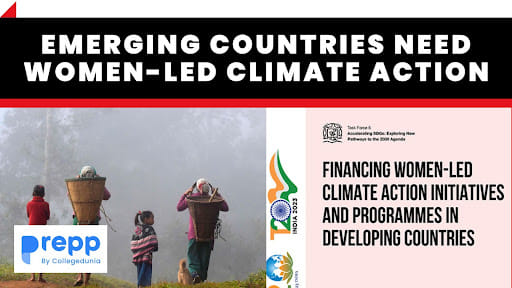
- This article discusses the role played by women in climate action and the need to invest in education and training.
Table of Contents
| A ‘Distraction’ Balloon In The Winds Of Federalism | White-Collar Hiring Falls 6% In August On Cautious Sentiment In It, Auto Sectors: Report |
| UPSC current Affairs | UPSC Study Notes |
Gendered Impact of Climate Change
Productivity loss and vulnerability
- According to a study by the International Labour Organization, by 2030, 2.2% of total working hours globally will be lost to high temperatures.
- This will amount to a loss of productivity equal to 80 million full-time jobs.
- According to the Organisation for Economic Cooperation and Development, gender equality and environmental goals are mutually reinforcing and contribute towards creating a virtuous circle that will help achieve the SDGs.
Vulnerability of women
- A 2009 study by the United Nations highlighted that women are more vulnerable and disproportionately affected by climate change compared to men.
- The vulnerability of women to climate change is determined by factors such as location, and socioeconomic status.
Felt more in low-income countries
Dependence on natural resources
- Women in developing and low-income countries, particularly rural areas, are more vulnerable due to their reliance on natural resources and labor-intensive livelihoods.
- Women are also prone to severe risks to their health, safety, and quality of life and are more likely to live in poverty than men, making them more susceptible to the effects of climate change.
Unpaid domestic work
- Women from low-income households are more susceptible to the adverse effects of climate change as they are increasingly responsible for unpaid domestic work such as securing nutritious food, clean water, and efficient cooking fuel.
- They are often forced to travel long distances to collect these basic necessities, however, the climate crisis has increased the time and effort required in such activities and increases the health and safety risks.
Low-income countries
- Women in low-income countries such as South Asia and sub-Saharan Africa engage in climate-vulnerable occupations such as farming and other labor-intensive work.
- According to the ILO, over 60% of working women in these regions are employed in agriculture and are underpaid and overworked.
- Women are the backbone of the food production systems in these countries but own only 10% of the land used for farming.
Gender-specific issues
Displacement and vulnerability
- According to a study by the UN, 80% of those people displaced by climate-related disasters are women and children, who are the worst affected during and after climate-related disasters.
- This leads to an increase in their vulnerability as a result of prejudice and exploitation.
- Eg: In the aftermath of the earthquake in Nepal in 2015, the United Nations Population Fund (UNFPA) found that women were more exposed to trafficking and exploitation.
Post-disaster challenges
- The gender-specific issues faced by women include:
- Separation from social networks,
- Increased gender-based violence
- Decreased access to employment, education, and essential health services including sexual and reproductive health care and psychosocial support.
Impact on Agricultural Workforce
- Women form a major portion of the agricultural workforce in emerging countries.
- Agricultural productivity is negatively influenced by climate change which results in heat stress and lowered crop productivity.
- Women and laborers employed in agriculture lack access to quality inputs, education, and technical knowledge and are increasingly vulnerable due to changing precipitation patterns and extreme weather events.
- According to various studies, an increase in flooding events has exacerbated water scarcity and subsequently violence and exploitation of women.
Invest in women’s education, training
Exacerbation of Poverty
- Climate change is linked to women's inequality as it exacerbates poverty and socioeconomic inequalities.
- According to estimates, 130 million people could be pushed into poverty due to climate change risks, natural disasters, and food inflation by 2050.
- This is likely to worsen the inequality experienced by women.
Empowerment and Climate Action
- Investing in Women: In order to build resilience to climate change, investments must be made in areas such as women's education, training, and access to resources.
- Increase women’s and girls access to education
- Encourage them to practice sustainable farming, water resource management, and energy conservation.
- Support groups and invest in training women in eco-friendly farming and educate and train people to adapt to climate change.
- Eg: The Self-Employed Women’s Association (SEWA) teaches women farmers how to respond to shifting climate patterns to support themselves better financially.
- Participation in Decision-Making: It is necessary to enhance the role played by women in climate policy decision-making as they are more vulnerable to climate change.
- This can be achieved by ensuring gender parity in decision-making bodies that are responsible for developing and implementing effective climate change mitigation and adaptation strategies.
- E.g.: The Gender and Climate Change Development Programme in South Asia aims to increase women’s influence in policymaking by enhancing their voice.
Conclusion
- There is an urgent need for gender-responsive approaches to addressing the impact of climate change on women, especially those in low-income countries.
- This is highlighted by the intersection of gender equality, climate change, and sustainable development.
- It is therefore necessary to empower women through education, training, and active participation in climate policy decision-making to achieve sustainable development goals and build resilience to climate change.
(*Click this link to read prelims specific weekly current affairs articles)
FAQs
Question: What is climate change?
Answer:
Climate change refers to long-term shifts in temperatures and weather patterns which may be due to natural causes such as solar cycle variations, anthropogenic causes such as pollution, etc. It makes predicting weather more difficult, thereby making agriculture more complicated.
Question: What is the UNFPA?
Answer:
The UNFPA or UN Population Fund is a subsidiary of the UN General Assembly that operates as a sexual and reproductive health organization that was established in 1967. Its mandate is determined by UNESCO. It works directly to achieve SDG3 (health), SDG4 (education), and SDG5 (gender equality).
Question: What is gender equality?
Answer:
Gender equality or sexual equality is the state in which there is equal ease of access to resources and opportunities, and equal value for different behaviors, aspirations, and needs regardless of gender.
UPSC Mains Practice Question:
|
MCQs
Question: In the context of India’s preparation for Climate-smart Agriculture, consider the following statements:
- The ‘Climate-Smart Village’ approach in India is part of a project led by the Climate Change, Agriculture and Food Security (CCAFS), an international research programme.
- The project of CCAFS is carried out under the Consultative Group on International Agricultural Research (CGIAR) headquartered in France.
- The International Crops Research Institute for the Semi-Arid Tropics (ICRISAT) in India is one of the CGIAR’s research centers.
Which of the statements given above are correct? (UPSC CSE 2021)
(a) 1 and 2 Only
(b) 2 and 3 Only
(c) 1 and 3 Only
(d) 1, 2 and 3
Answer: (d) See the Explanation
- India’s Climate-Smart Village project is a program by the CGIAR Research Program on Climate Change, Agriculture, and Food Security (CCAFS) which was started in 2012 for African and South Asian countries. Hence statement 1 is correct.
- The CCFAS is carried out under the CGIAR, a global partnership that unites international organizations engaged in research about food security, which is headquartered in Montpellier, France. Hence statement 2 is correct.
- The International Crops Research Institute for the Semi-Arid Tropics (ICRISAT) is a CGIAR Research Center that is a non-profit, non-political public international research organization. Hence statement 3 is correct.
Therefore, option (d) is the correct answer.
Question: Which one of the following statements best describes the term ‘Social Cost of Carbon? (UPSC CSE 2020)
(a) Long-term damage done by a tonne of CO2 emissions in a given year.
(b) Requirement of fossil fuels for a country to provide goods and services to its citizens, based on the burning of those fuels.
(c) Efforts put in by a climate refugee to adapt to live in a new place.
(d) Contribution of an individual person to the carbon footprint on the planet Earth.
Answer: (a) See the Explanation
- The social cost of carbon is a monetary value estimate that refers to the economic damage that results from the addition of one additional tonne of greenhouse gases into the atmosphere.
- It refers to ecological damage in economic terms to help policymakers understand the impact of decisions that increase or decrease emissions.
Therefore, option (a) is the correct answer.
Download the PREPP App and attempt FREE IAS Exam Mock Tests and get complete study material!

Full Test - 04: UPSC CSE Prelims CSAT (Paper-II)
Full Test - 03: UPSC CSE Prelims CSAT (Paper-II)
UPSC CSE Prelims 2026 GS Paper 1 Question Paper (24-May-2026)
UPSC CSE Prelims 2026 CSAT Paper 2 Question Paper (24-May-2026)

17 February 2025 | The Hindu Must Read Articles | Current Affairs

16 February 2026 | The Hindu Must Read Articles | Current Affairs

13 February 2026 | The Hindu Must Read Articles | Current Affairs









Comments