
Which option is WRONG?
Secondary data is original
Understanding Data Types: Primary vs. Secondary Data
The question asks us to identify the incorrect statement regarding data types, specifically focusing on secondary data. To do this, we first need to understand the fundamental difference between primary data and secondary data in research and statistics.
What is Primary Data?
Primary data is data that is collected by the researcher for the very first time. It is original data gathered specifically for the current research problem or objective. Examples include data collected through surveys, interviews, experiments, or direct observations conducted by the researcher.
What is Secondary Data?
Secondary data, on the other hand, refers to data that has already been collected by someone else for a purpose other than the current research. This data is not original for the current study. It exists in various forms, such as published reports, government statistics, company records, academic papers, or online databases.
Analyzing the Statements about Secondary Data
Let's examine each option provided in the question:
-
Option 1: Secondary data requires less time and money than primary data
This statement is generally correct. Since secondary data has already been collected and compiled, accessing it typically takes less time and involves lower costs compared to collecting original primary data, which requires planning, data collection instruments, fieldwork, etc.
-
Option 2: Secondary data is less reliable and less suitable than primary data
This statement can be correct in many cases. Secondary data was collected for a different purpose, which might not perfectly align with the needs of the current research. The methods used for its collection might not be known, controlled, or suitable, potentially affecting its reliability and suitability for the specific research question.
-
Option 3: Secondary data refer to those data that have already been collected by some other person.
This statement is the standard definition of secondary data. It accurately describes secondary data as data previously collected by someone else.
-
Option 4: Secondary data is original
This statement is incorrect. By definition, secondary data is *not* original data for the current research. Original data collected for the first time for a specific research purpose is called primary data. Secondary data is data that already exists, having been collected previously by someone else.
Identifying the Wrong Statement
Based on the analysis of each option and the definitions of primary and secondary data, the statement that is WRONG is that secondary data is original. Secondary data is by definition not original; it is data that has been collected previously.
| Feature | Primary Data | Secondary Data |
|---|---|---|
| Originality | Original (collected for the first time) | Not Original (collected by someone else previously) |
| Collection Effort | High (surveys, interviews, experiments) | Low (accessing existing sources) |
| Cost and Time | More time and money | Less time and money |
| Suitability for Current Study | Generally highly suitable (collected for this purpose) | Suitability varies (collected for a different purpose) |
| Reliability | Higher control over quality | Reliability needs careful evaluation |
Conclusion
The incorrect statement among the options is that secondary data is original. Secondary data is characterized by having been collected previously by someone else, making it non-original for the current research.
Revision Table: Primary vs. Secondary Data Key Differences
| Aspect | Primary Data | Secondary Data |
|---|---|---|
| Definition | Collected for the first time for the specific research problem. | Already collected and available from other sources. |
| Source | First-hand sources (surveys, interviews, experiments). | Second-hand sources (publications, databases, reports). |
| Cost & Time | High | Low |
| Control over Collection | High | None |
| Relevance & Accuracy | High (tailored to need) | Varies (may not fit perfectly, accuracy depends on original source) |
Additional Information: Sources of Secondary Data
Secondary data can be obtained from numerous sources. These sources are typically categorized as internal or external.
- Internal Sources: Data available within the organization itself, such as sales records, customer databases, financial statements, employee records, etc.
- External Sources: Data obtained from outside the organization, including:
- Government publications (census data, economic reports)
- Non-government publications (trade associations, research organizations)
- Published books and periodicals
- Company websites and annual reports
- Databases (commercial databases, online repositories)
- Academic journals and research papers
While using secondary data saves time and cost, researchers must carefully evaluate its relevance, accuracy, reliability, and suitability before incorporating it into their study.
Similar Questions
Following histogram shows certain frequency distribution against class intervals.
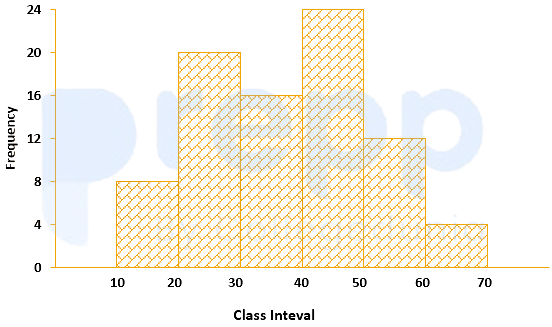
The approximated mean of this distribution is:
The annual vehicles production (in lacs) in india is given in the pie chart.
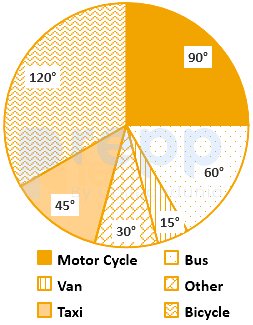
If the annual production of motor cycle is 1.80 lacs, the annual production of Bicycle is
For determination of mode and median graphically, one considers:
The curve obtained by joining the points, whose x-coordinates are the upper limits of the class interval and y-coordinates are corresponding cumulative frequencies is called:
The variation among the observations of each specific class is known as:
For making frequency distribution, the number of classes used depends upon:
When the collected data is grouped with reference to time, we have
Mutual and unique variances among multiple factors can be embodied in a diagram that comprises overlapping circles. The diagram is known as:
Which of the following is a method of collection of primary data?
The grouped data for the observation are
Class: 1-3 3-5 5-7 Frequency: 2 1 2 The population skewness
Important Questions from Classification of Data
The class marks in a frequency table are given to be 5, 10, 15, 20, 25, 30, 35, 40, 45, 50. The class limits of the first five classes are
In a test in Mathematics, 20% of the students obtained “first class”. If the data are represented by a Pie-Chart, what is the central angle corresponding to “first class”?
The following table gives the monthly expenditure of two families:
Expenditure (in Rs.)
Items
Family A
Family B
Food
3,500
2,700
Clothing
500
800
Rent
1,500
1,000
Education
2,000
1,800
Miscellaneous
2,500
1,800
In constructing a pie diagram to the above data, the radii of the circles are to be chosen by which one of the following ratios?
In an examination, 40% of candidates got second class. When the data are represented by a pie chart, what is the angle corresponding to second class?
Following histogram shows certain frequency distribution against class intervals.
The approximated mean of this distribution is:



