
ABCD is an isoceles trapezium such that AD||BC, AB = 5 cm, AD = 8 cm and BC = 14 cm. What is the area (in cm 2) of trapezium?
44
In isosceles trapezium ABCD with AD∥BC, drop perpendiculars from A and D to BC at E and F. Then EF=AD=8 and BE=CF.
Step 1 — Find BE:
\[BE=\frac{BC-AD}{2}=\frac{14-8}{2}=3\text{ cm}\]
Step 2 — Height by Pythagoras in ▵ABE:
\[h=\sqrt{AB^2-BE^2}=\sqrt{25-9}=4\text{ cm}\]
Step 3 — Area:
\[\text{Area}=\tfrac{1}{2}(AD+BC)\times h=\tfrac{1}{2}(8+14)(4)=44\text{ cm}^2\]
Therefore the area is 44 cm².
Similar Questions
A cyclic quadrilateral ABCD is such that AB = BC, AD = DC and AC, BD intersect at O and BD is angle bisector of ∠B. If ∠CAD = 46°, then the measure of ∠AOB is equal to:

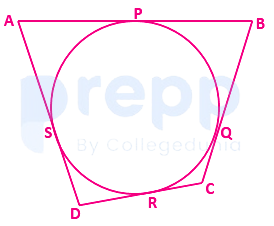
A circle is inscribed in a quadrilateral ABCD, touching sides AB, BC CD and DA at P, Q, R and S, respectively. If AS = 6 cm, BC = 12 cm, and CR = 5 cm, then the length of AB (in cm) is:
ABCD is a cyclic quadrilateral. AB and DC meet at F, when produced. AD and BC meet at E, when produced. If ∠BAD = 68° and ∠AEB = 27°, then what is the measure of ∠BFC?
ABCD is a cyclic quadrilateral in which sides AD and BC are produced to meet at P, and sides DC and AB meet at Q when produced. If ∠A = 60° and ∠ABC = 72°, then ∠DPC –∠BQC = ?
In a trapezium ABCD, DC ∥ AB, AB = 12 cm and DC = 7.2cm. What is the length of the line segment joining the mid-points of its diagonals?
In the given figure, a circle touches quadrilateral ABCD. If AB = 2x + 3, BC = 3x – 1, CD = x + 6 and DA = x + 4, then what is the value of x?
PQRS is a cyclic quadrilateral and PQ is the diameter of the circle. If ∠RPQ = 38°, then what is the value (in degrees) of ∠PSR?
PQRS is a parallelogram and its area is 300 cm 2. Side PQ is extended to X such that PQ = QX. If XS intersects QR at Y, then what is the area (in cm 2) of triangle SYR?
ABCD is a cyclic quadrilateral whose diagonals intersect at P. If AB = BC, ∠DBC = 70° and ∠BAC = 30°, then the measure of ∠PCD is:
ABDC is a parallelogram in which diagonals AD and BC intersect at O. AE and DF are perpendicular on BC at E and F, respectively. Which of the following is not true?
Important Questions from Quadrilaterals
The ratio between the length and breadth of a rectangular park is 3 : 2. If a man cycling along the boundary at the speed of 12 km per hour completes one round in 8 minutes, then the area of the park in square meter will be
The side of a rhombus is 26 cm. The length of one of its diagonals is 20 cm. The sum of the lengths of the diagonals of this rhombus is equal to the perimeter of a rectangle. If the difference between the length and breadth of the rectangle is 6 cm, then what is the area of the rectangle?
PQRS is a cyclic quadrilateral. If ∠P is 4 times ∠R, and ∠S is 3 times ∠Q, then the average of ∠Q and ∠R is:
ABCD is a trapezium in which AB || DC and DC is perpendicular to BC. If ∠DAB = 110°, then ∠ABC - ∠ADC =_____.
If the quadrilateral has an inscribed circle, then the sum of a pair of opposite sides equals:



