
In the given figure, a circle touches quadrilateral ABCD. If AB = 2x + 3, BC = 3x – 1, CD = x + 6 and DA = x + 4, then what is the value of x?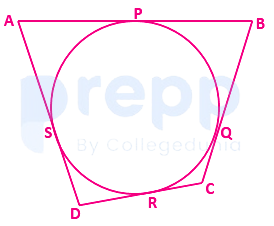
6
A quadrilateral whose all four sides touch a circle, is known as cyclic quadrilateral
Also, when two tangents are drawn from an external point to a circle, the lengths of the tangents is equal
Hence, in the given figure,
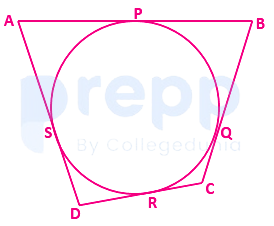
⇒ AP = AS
⇒ BP = BQ
⇒ CR = CQ
⇒ DR = DS
Adding all four equations, we get,
⇒ AP + BP + CR + DR = AS + DS + BQ + CQ
⇒ AB + CD = AD + BC
Substituting values,
⇒ 2x + 3 + x + 6 = 3x – 1 + x + 4
⇒ 3x + 9 = 4x + 3
⇒ 4x – 3x = 9 – 3
⇒ x = 6Similar Questions
ABCD is an isoceles trapezium such that AD||BC, AB = 5 cm, AD = 8 cm and BC = 14 cm. What is the area (in cm 2) of trapezium?
PQRS is a cyclic quadrilateral and PQ is the diameter of the circle. If ∠RPQ = 38°, then what is the value (in degrees) of ∠PSR?
PQRS is a parallelogram and its area is 300 cm 2. Side PQ is extended to X such that PQ = QX. If XS intersects QR at Y, then what is the area (in cm 2) of triangle SYR?
ABCD is a cyclic quadrilateral whose diagonals intersect at P. If AB = BC, ∠DBC = 70° and ∠BAC = 30°, then the measure of ∠PCD is:
ABDC is a parallelogram in which diagonals AD and BC intersect at O. AE and DF are perpendicular on BC at E and F, respectively. Which of the following is not true?
The sides BA and DE of a regular pentagon are produced to meet at F. What is a measure of ∠EFA?
ABCD is a cyclic quadrilateral. Diagonals BD and AC intersect each other at E. If ∠BEC = 128° and ∠ECD = 25°, then what is the measure of ∠BAC?
In E is a point inside the quadrilateral ABCD where DE and CE is the angle bisector of ∠D and ∠C respectively. If ∠B is 82° and ∠DEC is 80°, then find the ∠A.
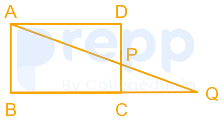
In the given figure, ABCD is a rectangle and P is a point on DC such that BC = 24 cm, DP = 10 cm, and CD = 15 cm. If AP produced intersects BC produced at Q, then find the length of AQ.
ABCD is a rhombus with ∠ABC = 52°. The measure of ∠ACD is:
Important Questions from Quadrilaterals
ABCD is a quadrilateral such that $\angle A = 47^\circ$, $\angle B = 66^\circ$, $\angle C = 133^\circ$ and $\angle D = 114^\circ$. What type of a quadrilateral is ABCD?
- What is the main purpose of cell division in multicellular organisms?
- Which of the following organelles is the first to divide during binary fission in Amoeba?
- The sum of all internal angles of a quadrilateral is:
- If ABCD is a cyclic quadrilateral and ABC is an equilateral triangle find the angle of CDA.



