In the given figure, ABCD is a rectangle and P is a point on DC such that BC = 24 cm, DP = 10 cm, and CD = 15 cm. If AP produced intersects BC produced at Q, then find the length of AQ.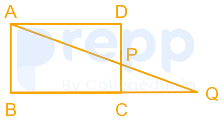
39 cm
Given :
A rectangle ABCD in which BC = 24, DP = 10 cm and CD = 15 cm
CP = 15 - 10 = 5
Concept used :
The similarity of a triangle
If values of corresponding angles between two triangles are the same then triangles are said to be similar
If two triangles are similar then the ratio of their corresponding sides are the same
Calculations :
In ∆ADP and ∆QCP
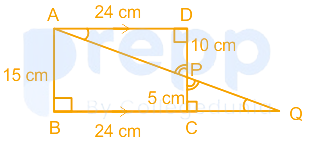
∠ADP = ∠QCP (both are 90°)
∠APD = ∠QPC (vertically opposite angles)
As AD||BQ, then
∠PAD = ∠PQC (alternate angles)
So, ∆ADP and ∆QCP are similar triangles
Now,
AD/QC = DP/CP = AP/QP
In ∆APD
AD 2+ DP 2= PA 2
24 2+ 10 2 = PA 2 (AD = BC opposite side of a rectangle)
PA = 26
⇒ 24/QC = 10/5 = 26/QP
⇒ QP = 13
Now,
AQ = AP + PQ = 26 + 13
⇒ 39
∴ AQ will be 39 cm
Similar Questions
ABCD is an isoceles trapezium such that AD||BC, AB = 5 cm, AD = 8 cm and BC = 14 cm. What is the area (in cm 2) of trapezium?
In a trapezium ABCD, DC ∥ AB, AB = 12 cm and DC = 7.2cm. What is the length of the line segment joining the mid-points of its diagonals?
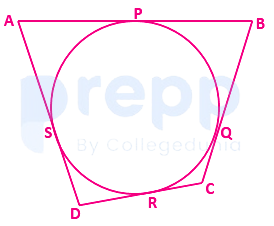
In the given figure, a circle touches quadrilateral ABCD. If AB = 2x + 3, BC = 3x – 1, CD = x + 6 and DA = x + 4, then what is the value of x?
PQRS is a cyclic quadrilateral and PQ is the diameter of the circle. If ∠RPQ = 38°, then what is the value (in degrees) of ∠PSR?
PQRS is a parallelogram and its area is 300 cm 2. Side PQ is extended to X such that PQ = QX. If XS intersects QR at Y, then what is the area (in cm 2) of triangle SYR?
ABCD is a cyclic quadrilateral whose diagonals intersect at P. If AB = BC, ∠DBC = 70° and ∠BAC = 30°, then the measure of ∠PCD is:
ABDC is a parallelogram in which diagonals AD and BC intersect at O. AE and DF are perpendicular on BC at E and F, respectively. Which of the following is not true?
The sides BA and DE of a regular pentagon are produced to meet at F. What is a measure of ∠EFA?
ABCD is a cyclic quadrilateral. Diagonals BD and AC intersect each other at E. If ∠BEC = 128° and ∠ECD = 25°, then what is the measure of ∠BAC?
In E is a point inside the quadrilateral ABCD where DE and CE is the angle bisector of ∠D and ∠C respectively. If ∠B is 82° and ∠DEC is 80°, then find the ∠A.
Important Questions from Quadrilaterals
ABCD is a quadrilateral such that $\angle A = 47^\circ$, $\angle B = 66^\circ$, $\angle C = 133^\circ$ and $\angle D = 114^\circ$. What type of a quadrilateral is ABCD?
- What is the main purpose of cell division in multicellular organisms?
- Which of the following organelles is the first to divide during binary fission in Amoeba?
- The sum of all internal angles of a quadrilateral is:
- If ABCD is a cyclic quadrilateral and ABC is an equilateral triangle find the angle of CDA.