The sides BA and DE of a regular pentagon are produced to meet at F. What is a measure of ∠EFA?
36°
Understanding the Problem: Regular Pentagon and Extended Sides
The question asks for the measure of the angle formed when two sides of a regular pentagon, specifically sides BA and DE, are extended until they meet at a point F. We need to find the measure of angle $\angle$EFA.
Let's visualize a regular pentagon ABCDE. Side BA is extended past A to meet side DE extended past E at point F. This forms a triangle, $\triangle$AFE.
Properties of a Regular Pentagon
A regular pentagon has 5 equal sides and 5 equal interior angles. We need to know the measure of the interior and exterior angles of a regular pentagon.
- The sum of the interior angles of a polygon with $n$ sides is given by the formula $(n-2) \times 180^\circ$. For a regular pentagon, $n=5$.
- Sum of interior angles = $(5-2) \times 180^\circ = 3 \times 180^\circ = 540^\circ$.
- Each interior angle of a regular pentagon = $\frac{540^\circ}{5} = 108^\circ$.
- The sum of the exterior angles of any convex polygon is $360^\circ$.
- Each exterior angle of a regular pentagon = $\frac{360^\circ}{5} = 72^\circ$.
Calculating Angles in $\triangle$AFE
The triangle formed is $\triangle$AFE. We need to find the measures of the angles within this triangle at vertices A and E to calculate the angle at vertex F ($\angle$EFA).
- Angle at vertex A ($\angle$FAE): The side BA is produced (extended) to meet at F. This means F lies on the line extending BA past A. The line segment FA is part of the extended line of BA. The angle $\angle$FAE is formed by the extended side BA (segment AF) and the side AE of the pentagon. This angle is the exterior angle of the pentagon at vertex A, formed by extending side BA. The interior angle at A is $\angle$BAE = $108^\circ$. The exterior angle at A, formed by extending BA, is adjacent to the interior angle on a straight line (the extended line of BA). Thus, $\angle$FAE is equal to the exterior angle of the regular pentagon at A.
So, $\angle$FAE = Exterior angle of regular pentagon = $72^\circ$.
- Angle at vertex E ($\angle$FEA): Similarly, the side DE is produced (extended) to meet at F. This means F lies on the line extending DE past E. The line segment FE is part of the extended line of DE. The angle $\angle$FEA is formed by the extended side DE (segment FE) and the side AE of the pentagon. This angle is the exterior angle of the pentagon at vertex E, formed by extending side DE. The interior angle at E is $\angle$AED = $108^\circ$. The exterior angle at E, formed by extending DE, is adjacent to the interior angle on a straight line (the extended line of DE). Thus, $\angle$FEA is equal to the exterior angle of the regular pentagon at E.
So, $\angle$FEA = Exterior angle of regular pentagon = $72^\circ$.
Now we have two angles in $\triangle$AFE: $\angle$FAE = $72^\circ$ and $\angle$FEA = $72^\circ$. The sum of the angles in any triangle is $180^\circ$.
In $\triangle$AFE:
$\angle$EFA + $\angle$FAE + $\angle$FEA = $180^\circ$
$\angle$EFA + $72^\circ$ + $72^\circ$ = $180^\circ$
$\angle$EFA + $144^\circ$ = $180^\circ$
$\angle$EFA = $180^\circ - 144^\circ$
$\angle$EFA = $36^\circ$
Final Answer for the Angle
The measure of $\angle$EFA is $36^\circ$. This is the angle formed where the extended sides BA and DE of the regular pentagon meet.
Revision Table: Key Geometry Concepts
| Concept | Description | Formula/Value (for regular n-gon) |
|---|---|---|
| Interior Angle Sum | Sum of all interior angles in a polygon. | $(n-2) \times 180^\circ$ |
| Each Interior Angle | Measure of one interior angle in a regular polygon. | $\frac{(n-2) \times 180^\circ}{n}$ (For pentagon, $108^\circ$) |
| Each Exterior Angle | Angle formed by a side and the extension of an adjacent side in a regular polygon. | $\frac{360^\circ}{n}$ (For pentagon, $72^\circ$) |
| Angles on a Straight Line | Adjacent angles that form a straight line sum to $180^\circ$. | Sum = $180^\circ$ |
| Sum of Angles in a Triangle | The sum of the three interior angles of any triangle. | Sum = $180^\circ$ |
Additional Information: Related Polygon Geometry
Understanding the properties of regular polygons is fundamental in geometry. Here are a few more points:
- All exterior angles of any convex polygon, one at each vertex, always sum up to $360^\circ$.
- The number of sides of a regular polygon can be found if you know the measure of an interior or exterior angle. If the exterior angle is $\theta_{ext}$, $n = \frac{360^\circ}{\theta_{ext}}$. If the interior angle is $\theta_{int}$, first find the exterior angle $\theta_{ext} = 180^\circ - \theta_{int}$, then use the formula for $n$.
- Isosceles Triangles: Since $\angle$FAE = $\angle$FEA = $72^\circ$, $\triangle$AFE is an isosceles triangle with AF = FE.
- The intersection point F lies outside the pentagon, as expected when extending non-adjacent sides.
Similar Questions
ABCD is an isoceles trapezium such that AD||BC, AB = 5 cm, AD = 8 cm and BC = 14 cm. What is the area (in cm 2) of trapezium?
In a trapezium ABCD, DC ∥ AB, AB = 12 cm and DC = 7.2cm. What is the length of the line segment joining the mid-points of its diagonals?
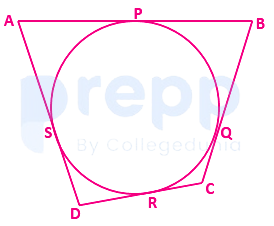
In the given figure, a circle touches quadrilateral ABCD. If AB = 2x + 3, BC = 3x – 1, CD = x + 6 and DA = x + 4, then what is the value of x?
PQRS is a cyclic quadrilateral and PQ is the diameter of the circle. If ∠RPQ = 38°, then what is the value (in degrees) of ∠PSR?
PQRS is a parallelogram and its area is 300 cm 2. Side PQ is extended to X such that PQ = QX. If XS intersects QR at Y, then what is the area (in cm 2) of triangle SYR?
ABCD is a cyclic quadrilateral whose diagonals intersect at P. If AB = BC, ∠DBC = 70° and ∠BAC = 30°, then the measure of ∠PCD is:
ABDC is a parallelogram in which diagonals AD and BC intersect at O. AE and DF are perpendicular on BC at E and F, respectively. Which of the following is not true?
ABCD is a cyclic quadrilateral. Diagonals BD and AC intersect each other at E. If ∠BEC = 128° and ∠ECD = 25°, then what is the measure of ∠BAC?
In E is a point inside the quadrilateral ABCD where DE and CE is the angle bisector of ∠D and ∠C respectively. If ∠B is 82° and ∠DEC is 80°, then find the ∠A.
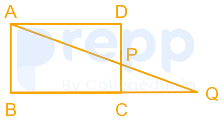
In the given figure, ABCD is a rectangle and P is a point on DC such that BC = 24 cm, DP = 10 cm, and CD = 15 cm. If AP produced intersects BC produced at Q, then find the length of AQ.
Important Questions from Quadrilaterals
ABCD is a quadrilateral such that $\angle A = 47^\circ$, $\angle B = 66^\circ$, $\angle C = 133^\circ$ and $\angle D = 114^\circ$. What type of a quadrilateral is ABCD?
- What is the main purpose of cell division in multicellular organisms?
- Which of the following organelles is the first to divide during binary fission in Amoeba?
- The sum of all internal angles of a quadrilateral is:
- If ABCD is a cyclic quadrilateral and ABC is an equilateral triangle find the angle of CDA.