ABCD is a cyclic quadrilateral. Diagonals BD and AC intersect each other at E. If ∠BEC = 128° and ∠ECD = 25°, then what is the measure of ∠BAC?
103°
Understanding the Cyclic Quadrilateral Problem
The question describes a cyclic quadrilateral ABCD. In a cyclic quadrilateral, all four vertices lie on the circumference of a circle. The diagonals BD and AC intersect at point E. We are given the measures of two angles: the angle formed by the intersecting diagonals, $\angle \text{BEC}$, and an angle involving a diagonal and a side, $\angle \text{ECD}$. Our goal is to find the measure of $\angle \text{BAC}$.
To solve this problem, we need to utilize the properties of angles in a circle and triangles, specifically those related to cyclic quadrilaterals and intersecting lines.
Analyzing Given Angles
We are provided with the following information:
- ABCD is a cyclic quadrilateral.
- Diagonals AC and BD intersect at E.
- $\angle \text{BEC} = 128^\circ$
- $\angle \text{ECD} = 25^\circ$
We need to find $\angle \text{BAC}$.
Applying Geometric Properties
Let's use the given angles and geometric properties to find the unknown angle $\angle \text{BAC}$.
Step 1: Find Angle CED using Linear Pair Property
Angles $\angle \text{BEC}$ and $\angle \text{CED}$ form a linear pair on the straight line BD. The sum of angles in a linear pair is $180^\circ$.
So, $\angle \text{BEC} + \angle \text{CED} = 180^\circ$.
Substituting the given value of $\angle \text{BEC}$:
$$128^\circ + \angle \text{CED} = 180^\circ$$
$$ \angle \text{CED} = 180^\circ - 128^\circ = 52^\circ $$
Step 2: Find Angle EDC in Triangle DEC
Now consider the triangle $\triangle \text{DEC}$. We know two angles in this triangle: $\angle \text{ECD} = 25^\circ$ (given) and $\angle \text{CED} = 52^\circ$ (calculated in Step 1).
The sum of angles in any triangle is $180^\circ$. Therefore, in $\triangle \text{DEC}$:
$$ \angle \text{EDC} + \angle \text{ECD} + \angle \text{CED} = 180^\circ $$
Substitute the known values:
$$ \angle \text{EDC} + 25^\circ + 52^\circ = 180^\circ $$
$$ \angle \text{EDC} + 77^\circ = 180^\circ $$
$$ \angle \text{EDC} = 180^\circ - 77^\circ = 103^\circ $$
Step 3: Relate Angle EDC to Angle BAC using Cyclic Quadrilateral Property
ABCD is a cyclic quadrilateral. Angles subtended by the same arc at the circumference of a circle are equal.
The angle $\angle \text{EDC}$ is part of the angle $\angle \text{BDC}$. Both $\angle \text{BDC}$ (or $\angle \text{EDC}$) and $\angle \text{BAC}$ are subtended by the same arc BC at the circumference of the circle.
Therefore, $\angle \text{BAC} = \angle \text{BDC}$.
Since $\angle \text{BDC}$ is the same as $\angle \text{EDC}$ (as E lies on BD), we have:
$$ \angle \text{BAC} = \angle \text{EDC} $$
From Step 2, we found $\angle \text{EDC} = 103^\circ$.
Thus, $\angle \text{BAC} = 103^\circ$.
Summary of Steps and Results
| Step | Action | Calculation | Result |
|---|---|---|---|
| 1 | Find $\angle \text{CED}$ using linear pair with $\angle \text{BEC}$. | $180^\circ - 128^\circ$ | $\angle \text{CED} = 52^\circ$ |
| 2 | Find $\angle \text{EDC}$ in $\triangle \text{DEC}$ using sum of angles. | $180^\circ - (\angle \text{ECD} + \angle \text{CED}) = 180^\circ - (25^\circ + 52^\circ)$ | $\angle \text{EDC} = 103^\circ$ |
| 3 | Relate $\angle \text{EDC}$ ($\angle \text{BDC}$) to $\angle \text{BAC}$ using property of angles subtended by same arc BC. | $\angle \text{BAC} = \angle \text{BDC} = \angle \text{EDC}$ | $\angle \text{BAC} = 103^\circ$ |
Final Answer
Based on the calculations, the measure of $\angle \text{BAC}$ is $103^\circ$.
Revision Table: Key Concepts Revisited
| Concept | Description | Application in this Problem |
|---|---|---|
| Cyclic Quadrilateral | A quadrilateral whose vertices all lie on a single circle. | Used to apply properties of angles in a circle. |
| Linear Pair | Two adjacent angles that form a straight line ($180^\circ$). | Used to find $\angle \text{CED}$ from $\angle \text{BEC}$. |
| Sum of Angles in a Triangle | The three interior angles of any triangle sum to $180^\circ$. | Used to find $\angle \text{EDC}$ in $\triangle \text{DEC}$. |
| Angles Subtended by Same Arc | Angles subtended by the same arc at the circumference are equal. | Used to equate $\angle \text{BAC}$ and $\angle \text{BDC}$ (or $\angle \text{EDC}$). |
Additional Information: Properties of Cyclic Quadrilaterals
Beyond the property used in this problem, cyclic quadrilaterals have several other important characteristics:
- Opposite angles are supplementary (sum to $180^\circ$). For example, $\angle \text{A} + \angle \text{C} = 180^\circ$ and $\angle \text{B} + \angle \text{D} = 180^\circ$.
- The exterior angle is equal to the interior opposite angle.
- Ptolemy's Theorem: For a cyclic quadrilateral ABCD, the sum of the products of the lengths of opposite sides is equal to the product of the lengths of the diagonals (AC $\cdot$ BD = AB $\cdot$ CD + BC $\cdot$ AD).
- If a trapezoid is cyclic, it must be an isosceles trapezoid (non-parallel sides are equal).
Understanding these properties is crucial for solving geometry problems involving cyclic quadrilaterals.
Similar Questions
ABCD is an isoceles trapezium such that AD||BC, AB = 5 cm, AD = 8 cm and BC = 14 cm. What is the area (in cm 2) of trapezium?
In a trapezium ABCD, DC ∥ AB, AB = 12 cm and DC = 7.2cm. What is the length of the line segment joining the mid-points of its diagonals?
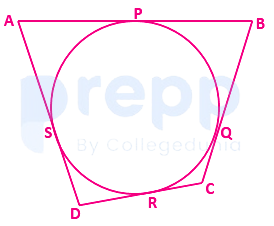
In the given figure, a circle touches quadrilateral ABCD. If AB = 2x + 3, BC = 3x – 1, CD = x + 6 and DA = x + 4, then what is the value of x?
PQRS is a cyclic quadrilateral and PQ is the diameter of the circle. If ∠RPQ = 38°, then what is the value (in degrees) of ∠PSR?
PQRS is a parallelogram and its area is 300 cm 2. Side PQ is extended to X such that PQ = QX. If XS intersects QR at Y, then what is the area (in cm 2) of triangle SYR?
ABCD is a cyclic quadrilateral whose diagonals intersect at P. If AB = BC, ∠DBC = 70° and ∠BAC = 30°, then the measure of ∠PCD is:
ABDC is a parallelogram in which diagonals AD and BC intersect at O. AE and DF are perpendicular on BC at E and F, respectively. Which of the following is not true?
The sides BA and DE of a regular pentagon are produced to meet at F. What is a measure of ∠EFA?
In E is a point inside the quadrilateral ABCD where DE and CE is the angle bisector of ∠D and ∠C respectively. If ∠B is 82° and ∠DEC is 80°, then find the ∠A.
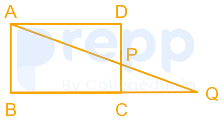
In the given figure, ABCD is a rectangle and P is a point on DC such that BC = 24 cm, DP = 10 cm, and CD = 15 cm. If AP produced intersects BC produced at Q, then find the length of AQ.
Important Questions from Quadrilaterals
ABCD is a quadrilateral such that $\angle A = 47^\circ$, $\angle B = 66^\circ$, $\angle C = 133^\circ$ and $\angle D = 114^\circ$. What type of a quadrilateral is ABCD?
- What is the main purpose of cell division in multicellular organisms?
- Which of the following organelles is the first to divide during binary fission in Amoeba?
- The sum of all internal angles of a quadrilateral is:
- If ABCD is a cyclic quadrilateral and ABC is an equilateral triangle find the angle of CDA.