
ABCD is a rhombus with ∠ABC = 52°. The measure of ∠ACD is:
64°
Understanding the Properties of a Rhombus
A rhombus is a special type of quadrilateral where all four sides are equal in length. It has several important properties that are useful for solving problems involving its angles and sides. Key properties relevant to this problem include:
- All sides are equal (AB = BC = CD = DA).
- Opposite angles are equal (\(\angle ABC = \angle ADC\) and \(\angle BAD = \angle BCD\)).
- Adjacent angles are supplementary (add up to 180°). For example, \(\angle ABC + \angle BCD = 180^\circ\)).
- The diagonals of a rhombus bisect the angles at the vertices.
- The diagonals intersect at right angles.
Analyzing the Given Information
We are given that ABCD is a rhombus and \(\angle ABC = 52^\circ\). We need to find the measure of \(\angle ACD\).
Calculating Adjacent Angle \(\angle BCD\)
In a rhombus, adjacent angles are supplementary. This means the sum of consecutive angles is 180°. Therefore, we can find \(\angle BCD\) using \(\angle ABC\):
\(\angle ABC + \angle BCD = 180^\circ\)
Substitute the given value for \(\angle ABC\):
\(52^\circ + \angle BCD = 180^\circ\)
Now, solve for \(\angle BCD\):
\(\angle BCD = 180^\circ - 52^\circ\)
\(\angle BCD = 128^\circ\)
Finding \(\angle ACD\) using Diagonal Properties
One of the crucial properties of a rhombus is that its diagonals bisect the vertex angles. The diagonal AC bisects the angle \(\angle BCD\). This means that \(\angle ACD\) is exactly half of \(\angle BCD\), and \(\angle BCA\) is also half of \(\angle BCD\), with \(\angle ACD = \angle BCA\).
Using this property, we can calculate \(\angle ACD\):
\(\angle ACD = \frac{1}{2} \angle BCD\)
Substitute the calculated value for \(\angle BCD\):
\(\angle ACD = \frac{1}{2} \times 128^\circ\)
\(\angle ACD = 64^\circ\)
Alternatively, consider triangle ABC. Since ABCD is a rhombus, AB = BC (all sides are equal). Therefore, triangle ABC is an isosceles triangle with AB = BC. In an isosceles triangle, the angles opposite the equal sides are also equal, so \(\angle BCA = \angle BAC\).
The sum of angles in triangle ABC is 180°:
\(\angle BAC + \angle BCA + \angle ABC = 180^\circ\)
Since \(\angle BAC = \angle BCA\), we can write:
\(2 \angle BCA + \angle ABC = 180^\circ\)
Substitute the given value \(\angle ABC = 52^\circ\):
\(2 \angle BCA + 52^\circ = 180^\circ\)
\(2 \angle BCA = 180^\circ - 52^\circ\)
\(2 \angle BCA = 128^\circ\)
\(\angle BCA = \frac{128^\circ}{2}\)
\(\angle BCA = 64^\circ\)
As mentioned earlier, the diagonal AC bisects \(\angle BCD\), so \(\angle ACD = \angle BCA\).
Therefore, \(\angle ACD = 64^\circ\).
Conclusion
The measure of \(\angle ACD\) is 64°.
| Given | Calculated | Property Used |
|---|---|---|
| \(\angle ABC = 52^\circ\) | \(\angle BCD = 128^\circ\) | Adjacent angles are supplementary |
| \(\angle BCD = 128^\circ\) | \(\angle ACD = 64^\circ\) | Diagonal bisects the angle |
Revision Table: Rhombus Properties
| Property | Description |
|---|---|
| Sides | All four sides are equal in length. |
| Opposite Angles | Opposite angles are equal. |
| Adjacent Angles | Adjacent angles are supplementary (sum to 180°). |
| Diagonals (Bisect Angles) | Diagonals bisect the vertex angles. |
| Diagonals (Intersection) | Diagonals intersect at right angles. |
| Diagonals (Bisect each other) | Diagonals bisect each other. |
Additional Information on Rhombus Angles
Understanding the relationship between angles in a rhombus is key to solving many geometry problems. Since a rhombus is also a parallelogram, it inherits all parallelogram properties, such as opposite sides being parallel and opposite angles being equal. However, the equal sides and the angle-bisecting diagonals are specific characteristics of a rhombus that distinguish it from a general parallelogram.
Consider the angles around the intersection of the diagonals. Since the diagonals intersect at right angles, all four angles formed at the intersection are 90°. This property is often useful when dealing with triangles formed by the diagonals and sides of the rhombus.
For instance, if the diagonals intersect at point O, then triangles ABO, BCO, CDO, and DAO are all right-angled triangles. Furthermore, since the diagonals bisect each other and the angles, these four right-angled triangles are congruent.
Knowing just one angle of a rhombus allows you to determine all other interior angles. If one angle is \(\theta\), the adjacent angle is \(180^\circ - \theta\), and the opposite angles are also \(\theta\) and \(180^\circ - \theta\) respectively.
Similar Questions
ABCD is an isoceles trapezium such that AD||BC, AB = 5 cm, AD = 8 cm and BC = 14 cm. What is the area (in cm 2) of trapezium?
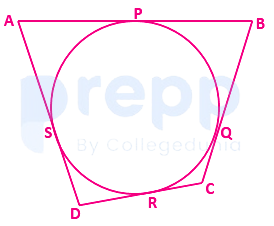
In the given figure, a circle touches quadrilateral ABCD. If AB = 2x + 3, BC = 3x – 1, CD = x + 6 and DA = x + 4, then what is the value of x?
PQRS is a cyclic quadrilateral and PQ is the diameter of the circle. If ∠RPQ = 38°, then what is the value (in degrees) of ∠PSR?
PQRS is a parallelogram and its area is 300 cm 2. Side PQ is extended to X such that PQ = QX. If XS intersects QR at Y, then what is the area (in cm 2) of triangle SYR?
ABCD is a cyclic quadrilateral whose diagonals intersect at P. If AB = BC, ∠DBC = 70° and ∠BAC = 30°, then the measure of ∠PCD is:
ABDC is a parallelogram in which diagonals AD and BC intersect at O. AE and DF are perpendicular on BC at E and F, respectively. Which of the following is not true?
The sides BA and DE of a regular pentagon are produced to meet at F. What is a measure of ∠EFA?
ABCD is a cyclic quadrilateral. Diagonals BD and AC intersect each other at E. If ∠BEC = 128° and ∠ECD = 25°, then what is the measure of ∠BAC?
In E is a point inside the quadrilateral ABCD where DE and CE is the angle bisector of ∠D and ∠C respectively. If ∠B is 82° and ∠DEC is 80°, then find the ∠A.
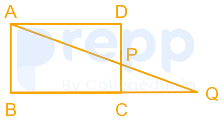
In the given figure, ABCD is a rectangle and P is a point on DC such that BC = 24 cm, DP = 10 cm, and CD = 15 cm. If AP produced intersects BC produced at Q, then find the length of AQ.
Important Questions from Quadrilaterals
ABCD is a quadrilateral such that $\angle A = 47^\circ$, $\angle B = 66^\circ$, $\angle C = 133^\circ$ and $\angle D = 114^\circ$. What type of a quadrilateral is ABCD?
- What is the main purpose of cell division in multicellular organisms?
- Which of the following organelles is the first to divide during binary fission in Amoeba?
- The sum of all internal angles of a quadrilateral is:
- If ABCD is a cyclic quadrilateral and ABC is an equilateral triangle find the angle of CDA.



