
Which one is not basis of classification of data?
Geological classification
Understanding Data Classification
Data classification is a way of arranging or organizing data into different groups or classes based on their characteristics. This helps in summarizing data, making comparisons, and analyzing information more easily. Data can be classified based on various factors, depending on the nature of the data and the purpose of the study.
Common Bases for Data Classification
Let's look at the common ways data is classified in statistics and data analysis:
- Geographical Classification: This method classifies data based on location or geographical areas. Examples include classifying sales data by states, districts, cities, or countries. Data from different regions can be compared to understand spatial patterns.
- Qualitative Classification: This method classifies data based on attributes or qualities that cannot be measured numerically. Examples include classifying people based on gender (male/female), religion (Hindu, Muslim, Christian, etc.), nationality, or color. These attributes are descriptive.
- Temporal Classification: This method classifies data based on time. Data is arranged according to the time period in which it was collected. Examples include classifying monthly sales figures, annual production data, or daily temperature readings. This helps in studying trends over time.
Identifying What is Not a Basis of Data Classification
We are asked to find the option that is NOT a basis for data classification among the given choices. We have discussed Geographical, Qualitative, and Temporal classifications, which are standard methods used in statistics and data analysis.
The remaining option is Geological classification.
- Geological Classification: Geology is the study of Earth, its rocks, structures, and processes. Geological classification deals with classifying rocks, minerals, geological periods, or landforms based on their formation, age, composition, etc. While geology involves classifying data, "Geological classification" is not a standard basis for classifying general statistical or economic data about populations, businesses, or social phenomena in the same way Geographical, Qualitative, or Temporal methods are. It is specific to the field of geology itself, not a general method of classifying diverse datasets in statistics or data analysis.
Therefore, Geological classification is not a common or general basis for classifying data in the context typically referred to in statistics and data handling exercises compared to the other options.
Conclusion on Data Classification Bases
Based on the analysis, Geographical classification, Qualitative classification, and Temporal classification are recognized bases for classifying various types of data in statistical studies. Geological classification is a specific method within the field of geology and is not a general basis for classifying broader datasets.
| Classification Basis | Description | Commonly Used in Data Analysis? |
|---|---|---|
| Geographical | Based on location/area | Yes |
| Qualitative | Based on attributes/qualities | Yes |
| Temporal | Based on time period | Yes |
| Geological | Based on geological features/time | No (Specific to geology) |
Revision Table: Key Data Classification Types
| Type | Criterion | Example |
|---|---|---|
| Temporal | Time | Monthly sales, annual production |
| Geographical | Place | Population by state, sales by region |
| Qualitative | Attribute | Gender, Religion, Nationality |
| Quantitative | Measurement | Height, Weight, Income (Not an option here, but a key type) |
Additional Information on Data Classification
Besides the types mentioned, data can also be classified quantitatively, where data is grouped based on measurable characteristics like height, weight, marks, income, etc. The data is divided into classes based on numerical values.
The choice of classification method depends entirely on the nature of the data being analyzed and the objectives of the statistical investigation. Effective data classification makes complex datasets understandable and facilitates further statistical analysis and interpretation.
Similar Questions
Following histogram shows certain frequency distribution against class intervals.
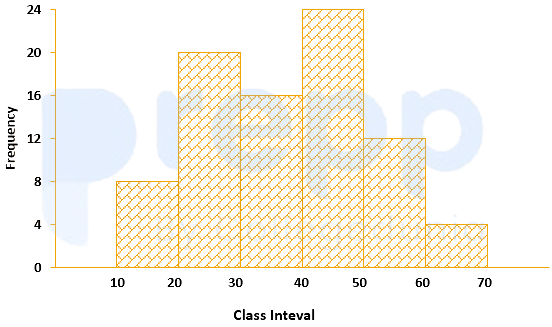
The approximated mean of this distribution is:
The annual vehicles production (in lacs) in india is given in the pie chart.
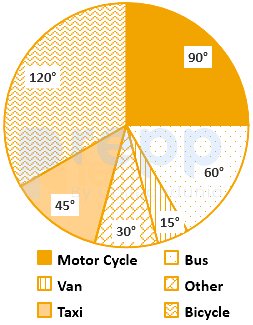
If the annual production of motor cycle is 1.80 lacs, the annual production of Bicycle is
For determination of mode and median graphically, one considers:
The curve obtained by joining the points, whose x-coordinates are the upper limits of the class interval and y-coordinates are corresponding cumulative frequencies is called:
The variation among the observations of each specific class is known as:
For making frequency distribution, the number of classes used depends upon:
When the collected data is grouped with reference to time, we have
Mutual and unique variances among multiple factors can be embodied in a diagram that comprises overlapping circles. The diagram is known as:
Which of the following is a method of collection of primary data?
The grouped data for the observation are
Class: 1-3 3-5 5-7 Frequency: 2 1 2 The population skewness
Important Questions from Classification of Data
The class marks in a frequency table are given to be 5, 10, 15, 20, 25, 30, 35, 40, 45, 50. The class limits of the first five classes are
In a test in Mathematics, 20% of the students obtained “first class”. If the data are represented by a Pie-Chart, what is the central angle corresponding to “first class”?
The following table gives the monthly expenditure of two families:
Expenditure (in Rs.)
Items
Family A
Family B
Food
3,500
2,700
Clothing
500
800
Rent
1,500
1,000
Education
2,000
1,800
Miscellaneous
2,500
1,800
In constructing a pie diagram to the above data, the radii of the circles are to be chosen by which one of the following ratios?
In an examination, 40% of candidates got second class. When the data are represented by a pie chart, what is the angle corresponding to second class?
Following histogram shows certain frequency distribution against class intervals.
The approximated mean of this distribution is:



