
Which of the following statements are correct in case of Light Emitting Diodes ? (a) Homojunctions LEDs are often surface emitters. (b) Heterojunctions LEDs are Edge emitters. (c) Heterojunction LEDs are often surface emitters. (d) LEDs provide monochromatic & coherent radiations. Options :
(a) & (b) are correct.
To determine which statements about Light Emitting Diodes (LEDs) are correct, let's analyze each statement in relation to known characteristics of LED technology:
- Statement (a): Homojunctions LEDs are often surface emitters.
This statement is correct. Homojunction LEDs typically emit light from the surface of the device, making them surface emitters. The light is emitted due to the recombination of electrons and holes in the semiconductor material, primarily at the surface.
- Statement (b): Heterojunctions LEDs are Edge emitters.
This statement is correct. Heterojunction LEDs are designed to emit light from the edge, referred to as edge emitters. The structure of heterojunctions, often involving layers with different bandgaps, facilitates this type of emission.
- Statement (c): Heterojunction LEDs are often surface emitters.
This statement is incorrect as Heterojunction LEDs, as mentioned previously, are typically edge emitters.
- Statement (d): LEDs provide monochromatic & coherent radiations.
While LEDs do provide monochromatic (single color) radiation due to their narrow emission spectrum, they do not provide coherent light. Coherent light requires the light waves to be in phase, a characteristic of LASERs, not LEDs.
Based on this analysis, the correct answer is:
- (a) & (b) are correct.
Similar Questions
Match the following :
List – I List – II a. LASER i. Emits monochromatic light of low intensity b. Solar cell ii. Consumes electrical power due to tHe incident light c. Photo diode iii. Delivers power to load d. LED iv. Emits monochromatic light of high intensity Codes :
Which one of the following is not LED material ?
1. Ga As
2. Ga P
3. Si
4. SiO2
When atoms in Direct bandgap semiconductors move from higher energy state (E2) to lower energy state (E1) and emission of light takes place, the energy of emitted photon is given as
Match the following :
List – I List – II a. LED i. Heavily doped b. Avalanche Photodiode ii. Coherent radiation c. Tunnel diode iii. Spontaneous emission d. LASER iv. Current gain Codes :
Match List I with List II
LIST I LIST II A. LED I. Photo resistive effect B. LCD II. Photo conductive effect C. LDR III. dynamic scattering of light D. Photo Diode IV. electro - luminescence Choose the correct answer from the options given below:
Match the following lists :
List - I List - II a) 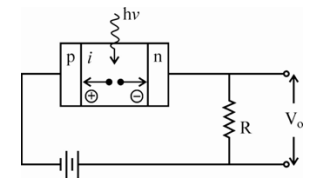
i) Solar cell b) 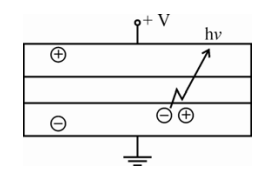
ii) Pn-photodiode c) 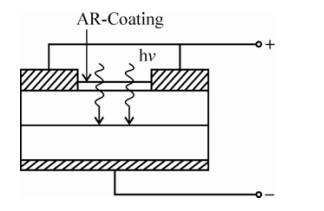
iii) Pin photodiode d) 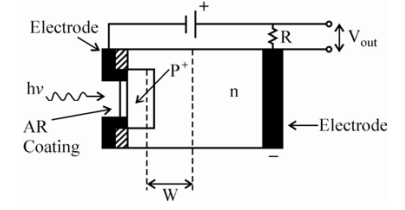
iv) Light emitting diode Choose the correct answer from the codes given below:
Arrange the below mentioned III-V materials to produce LEDs in order of their increasing emission wavelengths :
(a) In AS (b) Si C (c) Ga P (d) Ga AS
Codes :
The material LiNbO3 is used in the manufacturing of the following device :
Light emitting diodes fabricated from Ga, As emit radiations in the :
Important Questions from Optical Devices
An LCD requires a power of __________.
- The slope efficiency of a laser diode is 0.5 W/A, and the output optical power at a current of 100 mA is 30 mW. Assuming piece-wise linear characteristics of the laser diode, the threshold current of the laser is ________ mA.
- TV remote controls commonly use _____ to communicate with the TV.
- A DVD uses the _____ method to store and read data.
- The basic components of an optocoupler are _____.



